
Last updated: November 2026
You can learn a language on Duolingo without paying anything. The free version is not a demo — it is the full course. But free learning has limits, and most people hit them within a few weeks. This guide shows you exactly what is free, where the limits are, and how to get the most out of Duolingo without spending a dollar.
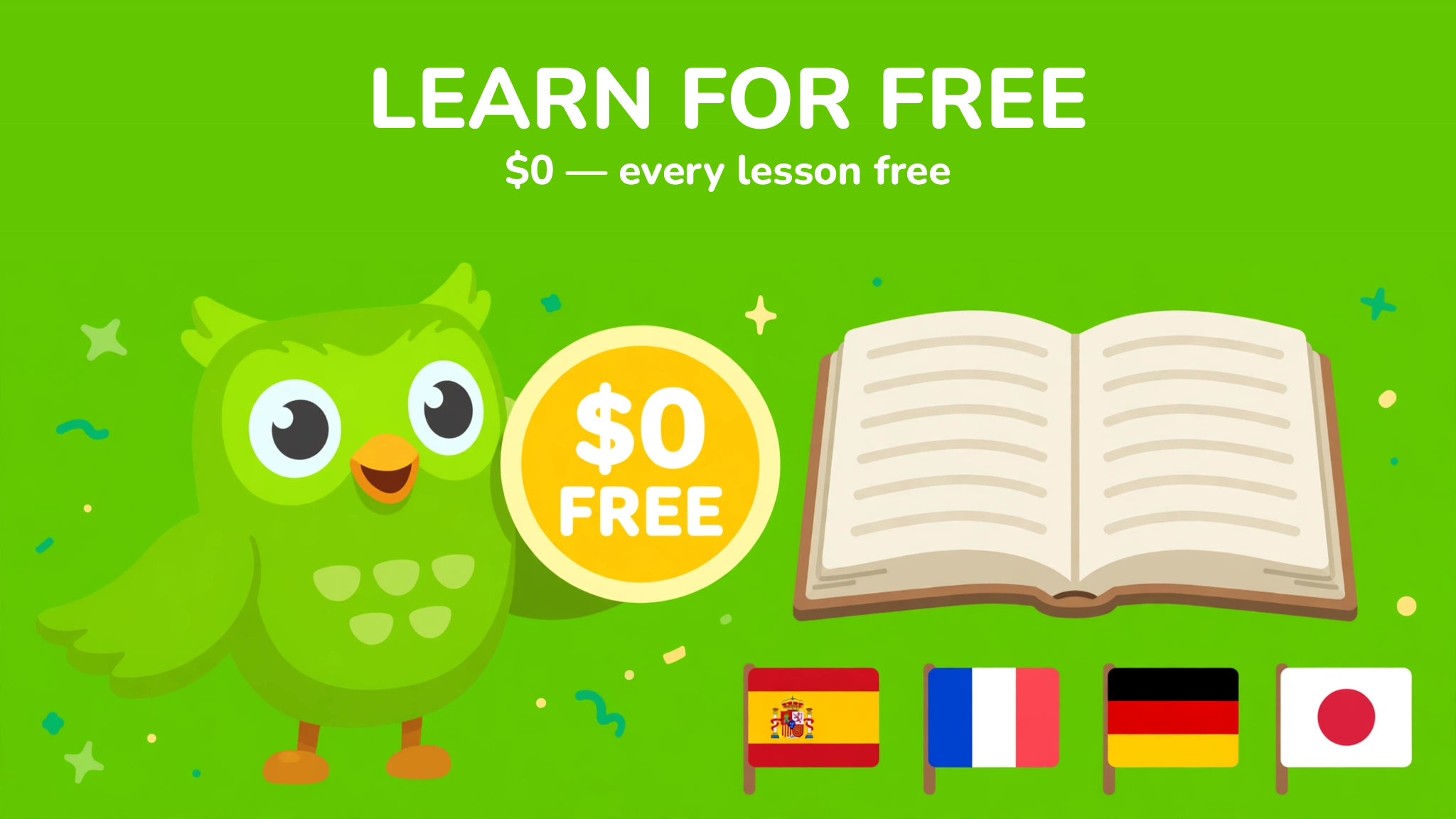
Yes, you can learn a language on Duolingo for free. Every lesson in every course costs $0. Paying only removes ads and the daily practice limit. It does not unlock extra lessons. About 9 in 10 Duolingo users learn on the free plan.
This is a practical guide, not a sales pitch. If you want the straight answer to “is Duolingo really free?”, read our companion article: Is Duolingo Really Free? Free vs Super in 2026. This guide is about how to actually learn for free — the features, the limits, the workarounds, and the point where paying starts to make sense.
Here is what we will cover:
- What is free on Duolingo
- The two limits: energy and ads
- How to learn free without hitting the limits
- Free gems, streaks, and practice tools
- Free extras: Stories, Math, and Music
- What free cannot do — and what to add for free
- When paying for Super is worth it
- FAQs
What Is Free on Duolingo?
The free version gives you the whole course. Duolingo’s own App Store listing says it in four words: “every course is free.” Free and paying users study the same lessons — Duolingo says all learners get the same lesson content.
As a free user, you get:
- Full language courses in 40+ languages — Spanish, French, German, Japanese, Korean, Italian, Chinese, and many more
- All lessons and levels — reading, writing, listening, and speaking practice
- Stories in select languages, for reading practice in context
- Leagues, streaks, XP, and weekly challenges — the game side of Duolingo costs nothing
- Explain My Answer, which tells you why your answer was wrong — free for all learners since 1 January 2026
- Practice Hub, for reviewing your mistakes — free for all learners since 18 February 2026
- Guidebooks and tips built into each unit
- Math and Music courses, free alongside the language courses
In Q2 2026, Duolingo had about 140.6 million monthly users and 12.7 million paying subscribers. That means about 9 in 10 people use Duolingo for free — you are in the majority.
The Two Limits: Energy and Ads
Free is real, but it is not limitless. Two things slow you down: energy and ads.
Energy: your daily limit
On the mobile app, most free accounts now use an energy bar of 25 points. Every exercise uses some energy — even a correct answer. When the bar is empty, you must stop and wait for it to refill, which takes about a day.
Energy replaced the old hearts system in 2025. Under hearts, you only lost a life when you made a mistake. Under energy, even a perfect lesson uses energy. That is why free learners now get roughly 2–3 lessons a day on mobile — about 15–20 minutes — before they hit the limit.
Ads
Free users see short ads between lessons. That is how Duolingo pays for the free plan. The ads never block a lesson in progress, and they last only a few seconds. Super removes them.
| Free-plan limit | What happens | Free workaround |
|---|---|---|
| Energy runs out (mobile) | You cannot start new lessons until it refills | Study on the web version — no energy limit |
| Low on energy | A few exercises left, then you stop | Watch one ad for +5 energy, or take the free +5 top-up |
| Ads between lessons | A short break between lessons | Nothing to do — but ads never block a lesson |
| Out of energy, want more now | Wait until tomorrow | Full recharge costs 600 gems, earned free from quests and chests |
| Hearts account (older system) | Mistakes cost hearts; 0 hearts stops you | Practise old lessons to earn hearts back, or watch an ad |
How to Learn Free Without Hitting the Limits
Most free learners never need to pay. They just need a routine that fits inside the free limits. Here is what works:
1. Use the web version for long sessions
This is the single best free trick. Open Duolingo in your desktop or mobile browser and there is no energy limit. Save the app for short sessions on the go, and do your long weekend study on the web.
2. Study a little every day, not a lot once a week
One or two lessons a day fits inside the energy bar easily. A short daily streak beats a long session once a week — for learning and for energy. Set a small daily goal (10 XP) and keep it.
3. Top up energy for free before you think about paying
- Answer in a row: a run of correct answers gives energy back
- Take the free +5: the energy screen offers a small free top-up
- Watch an ad: one short ad gives +5 energy
- Spend gems: a full recharge costs 600 gems, which you earn from quests and chests — no money needed
4. Review your mistakes — it costs nothing
Reviewing mistakes at the end of a lesson costs no energy, and the Practice Hub is now free for everyone. Use it. Re-doing what you got wrong is the fastest way to actually remember it.
5. Slow down and read twice
Correct answers in a row give energy back and help you learn faster. Rushing through lessons wastes energy and teaches you less.
Free Gems, Streaks, and Practice Tools
Gems are Duolingo’s free in-app currency. You earn them without paying:
- Complete daily goals — gems for finishing your daily XP target
- Win league competitions — top places in the weekly league pay gems
- Keep your streak going — streak milestones earn gems
- Finish quests and open chests — regular gem rewards
- Watch reward ads — a few gems for a short ad
Spend gems on energy refills (600 gems for a full recharge) or a Streak Freeze, which protects your streak if you miss a day. Do not spend gems on cosmetic items until your learning is covered.
Streaks are free motivation. Set an achievable daily goal, use a Streak Freeze when you travel, and join weekend challenges with friends. A streak you can keep is worth more than a big goal you quit after a week.
Free Extras: Stories, Math, and Music
Many free users never open these, but they cost nothing:
- Stories: short dialogues in your language, for reading in context. Available in select languages. They are the closest free Duolingo gets to real conversation.
- Math: a free course covering basic operations, mental maths, and problem-solving. Good for younger learners and for a break from language lessons.
- Music: free lessons in note reading, rhythm, and song recognition. A different kind of practice for the same app.
- Special and seasonal content: holiday themes, bonus challenges, and cultural notes appear in the free version too.
What Free Cannot Do — and What to Add for Free
Free Duolingo is a strong start, but it has real gaps. No app will make you fluent alone. Here is what is missing, and what to add without paying:
| The gap | Why it matters | Free fix |
|---|---|---|
| Little speaking practice | Speaking exercises are basic; real conversation needs real people | Language exchange apps and free conversation groups |
| Little culture | Duolingo teaches words, not how people really talk | Shows, YouTube, and podcasts in your language |
| Repetition | Exercises start to feel the same after a while | Books, music, and news in your language |
| Weak grammar explanations | Duolingo shows the rule; it rarely explains it deeply | Free grammar guides online and the in-unit Guidebooks |
Use Duolingo as your daily base, then add real language: watch shows, listen to podcasts, read simple books, and talk with native speakers when you can. That combination — free Duolingo plus free real input — beats paid Duolingo alone.
When Paying for Super Is Worth It
Most free learners never need to pay. Paying starts to make sense only when the free limits are the thing stopping you:
- You study on your phone for more than 20 minutes a day and keep hitting the energy wall
- Ads between lessons genuinely break your focus
- You travel a lot and need offline lessons
Super costs about $12.99–$13.99 a month or about $83.99–$119.99 a year in the US — and the Super Family plan is about $119.99–$143.99 a year for up to 6 people. Prices vary by account and country, so check your own checkout screen. For the full numbers, see Duolingo Plus Cost in 2026: Super Prices & Savings. Before you pay, try the free trial (usually 1 week on the web or 14 days in the app stores) and see if no ads and unlimited energy are actually worth it to you. Read our honest review first: Is Super Duolingo Worth It in 2026?
One thing paying will not do: it will not teach you more. The lessons are identical on the free and paid plans. If you are choosing between paying for Super and spending that money on a conversation tutor or a good textbook, the tutor or textbook usually wins.
Frequently Asked Questions
Is Duolingo really 100% free?
Yes. The app is free to download, and every lesson in every course is free. The paid plan, Super, only removes ads and limits. There is no lesson locked behind a payment.
How many lessons can I do for free each day?
On the mobile app, about 2–3 lessons a day before the 25-point energy bar runs out. On the web version, there is no limit — you can do as many lessons as you like.
Are there any hidden costs with the free version?
No. There are no hidden charges. The limits — ads and the daily energy cap — are shown to you in the app. You will never be charged unless you start a paid plan or a trial that turns into one.
What is the difference between hearts and energy?
Hearts were the old system: each mistake cost a heart. Energy is the newer system: each exercise uses energy, and correct answers give some back. Most mobile accounts now use energy. Some accounts still have hearts, and the web version has no limit at all.
Can I get Super for free?
The main way is the free trial — usually 1 week on the web or 14 days in the app stores. There is no permanent free version of Super, but some people get short stretches of free Super another way: a streak reward (3 days at the 7-day streak milestone), a referral reward, a gifted year, or a seat on someone else’s Family plan. See our guide: Why Do I Have Super Duolingo Without Paying?. Cancel at least 24 hours before the trial ends if you do not want to be charged.
Do I need Super to learn a language well?
No. Super makes learning smoother, but it does not teach you more. If you study daily on the free plan and add real listening and speaking practice, you can learn a lot without paying.
The Bottom Line
Duolingo’s free version is genuinely free and genuinely useful: full courses in 40+ languages, stories, streaks, leagues, and now even Explain My Answer and the Practice Hub at no cost. The price you pay is ads and a daily energy limit on mobile — and both have free workarounds, above all the web version with no energy limit.
Start free. Study a little every day. Add real listening and speaking from free sources. Pay only if the free plan starts to slow you down — and if you do pay, pay yearly, because it costs far less than paying month by month.




One Comment