
Last updated: November 2026
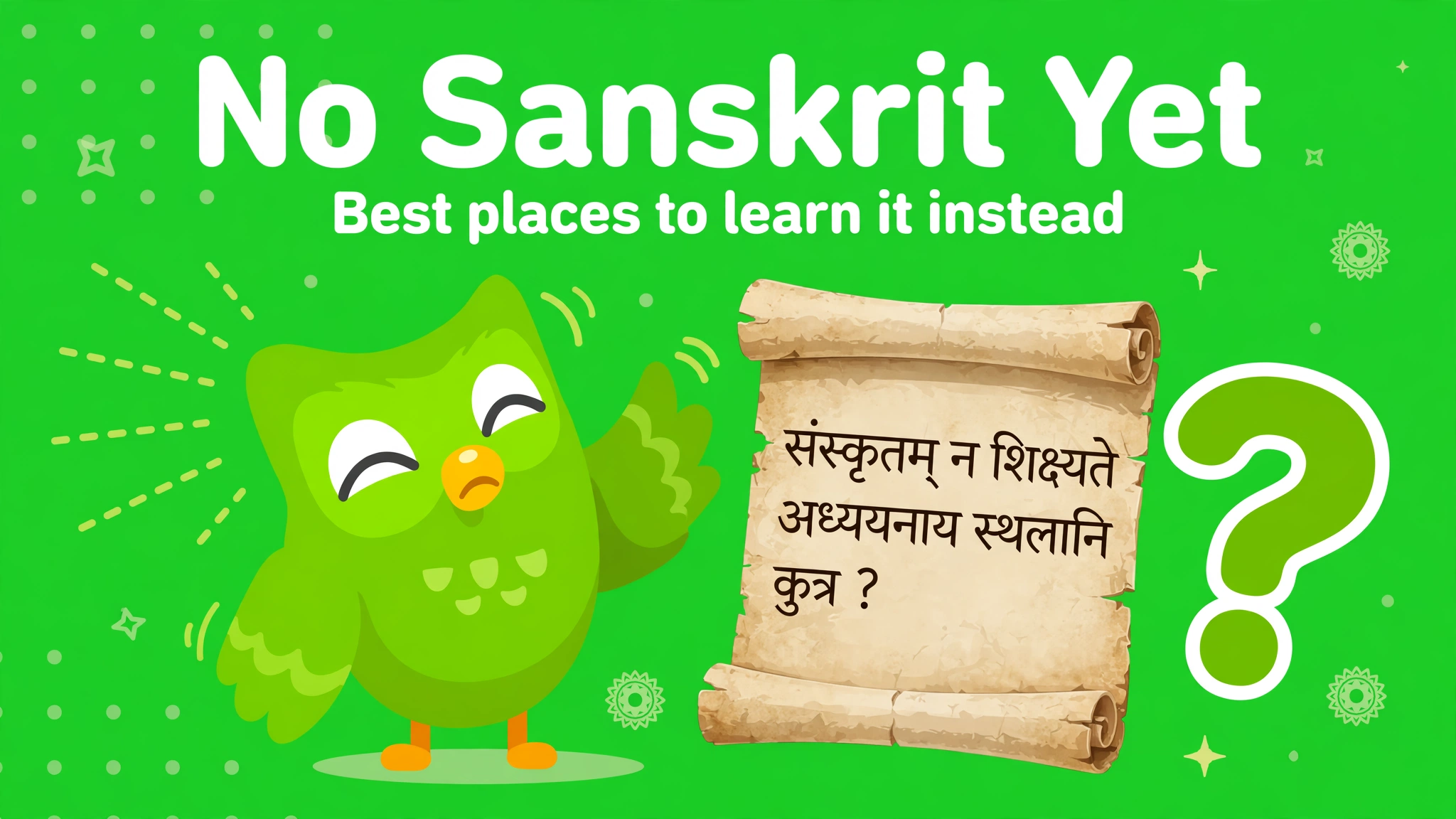
Short answer: no, Duolingo does not have Sanskrit. There is no Sanskrit course on Duolingo, in the app or on the website, and Duolingo has announced no Sanskrit course as of November 2026. If you want to learn Sanskrit, you will need to use another app, a tutor, or a textbook instead.
That is a shame, because Sanskrit is one of the most important languages in world history. It is the language of ancient Hindu, Buddhist, and Jain texts, and it is still used in religious ceremonies and yoga today. But Duolingo has never offered it, and there is no sign that is about to change. This article explains why, corrects some common myths about Sanskrit, and lists the best places to learn it instead.
Key Takeaways
- Duolingo does not offer a Sanskrit course, and none has been announced as of November 2026.
- Only 24,821 people listed Sanskrit as their mother tongue in the 2011 Census of India, about 0.002% of the population. Around 3.1 million people reported it as a first, second, or third language.
- Sanskrit is one of the oldest Indo-Aryan languages. It is not from the Indus Valley Civilization.
- The best alternatives in 2026 are Indilingo, Drops, Ling, Memrise, Liberation Philology Sanskrit, and tutors on iTalki and Preply.
Sanskrit at a Glance
| Fact | Detail |
|---|---|
| Language family | Indo-Aryan, one of the oldest languages in the family |
| Where it is used today | Hindu, Buddhist, and Jain religious texts and ceremonies, yoga, and classical Indian literature |
| Mother-tongue speakers | 24,821 people in the 2011 Census of India, about 0.002% of the population |
| People who report knowing it | About 3.1 million people listed Sanskrit as a first, second, or third language in the 2011 Census |
| Script | Usually written in Devanagari, the same script as Hindi |
| On Duolingo? | No. No course exists, and none has been announced as of November 2026 |
How Many People Speak Sanskrit?
Far fewer than most articles claim. A figure you will see repeated online says that 1% of Indians speak Sanskrit fluently, or about 14 million people. That is wrong.
The real numbers come from the 2011 Census of India. Only 24,821 people listed Sanskrit as their mother tongue, which is about 0.002% of India’s population. A wider count, people who listed Sanskrit as a first, second, or third language, comes to about 3.1 million. Sanskrit is a living language of religion, scholarship, and ceremony, but it is not a daily spoken language for millions of people.
This matters for Duolingo. The app builds courses for languages with large learner demand, and the small number of Sanskrit speakers is one reason it has never been a priority.
Where Does Sanskrit Come From?
Sanskrit is one of the oldest Indo-Aryan languages. It developed in ancient India and became the language of the Vedas, the Upanishads, the Bhagavad Gita, and a huge body of philosophy, poetry, grammar, and science.
One claim you may read is that Sanskrit comes from the Indus Valley Civilization. That is not correct. The Indus Valley Civilization used a script that has never been deciphered, and there is no evidence it was Sanskrit. Sanskrit belongs to the Indo-Aryan branch of the Indo-European family, and its earliest texts date from more than a thousand years after the Indus cities declined.
Sanskrit is often called “the language of the gods,” and its grammar, described by the ancient scholar Panini, is famously precise. That precision is one reason linguists still study it. But it also makes Sanskrit hard to teach in short, game-like lessons, which is the format Duolingo uses.
Why Duolingo Does Not Have Sanskrit
Duolingo has never given an official reason, but three factors explain the absence.
Low learner demand. Duolingo builds courses for languages millions of people want to learn. Sanskrit has a small learner base compared with Spanish, French, German, or Japanese, so it has never made the cut.
Hard to teach in the Duolingo format. Sanskrit has complex grammar, three genders, eight cases, and a sandhi system that changes word sounds when words join together. Teaching that well takes long explanations, and Duolingo’s short lessons are a poor fit.
Duolingo’s priorities lie elsewhere. Duolingo focuses on widely spoken languages and on its biggest courses. In 2026 it offers 42 languages and more than 250 courses, and it has been rebuilding its largest courses to teach through CEFR level B2. A niche classical language is not where its course-building effort goes.
One thing that will not bring Sanskrit to Duolingo is the old volunteer Incubator. Duolingo’s volunteer course incubator, where community members once built new courses, ended in 2019. New courses are now built by Duolingo’s own teams, so there is no community route to get Sanskrit added. As of November 2026, Duolingo has announced no Sanskrit course, and there is no public plan or timeline for one.
For the full list of languages Duolingo does teach, see our guide to all Duolingo languages.
Best Places to Learn Sanskrit Instead
Duolingo may not teach Sanskrit, but plenty of other tools do. Here are the best options confirmed in 2026, matched to how you like to learn.
| Option | Best for | What you get |
|---|---|---|
| Indilingo | Beginners who want a structured course | Sanskrit lessons built for learners, with guided practice |
| Drops | Vocabulary in five-minute sessions | Visual, picture-based word learning for Sanskrit vocabulary |
| Ling | Beginners who like games and quizzes | Sanskrit topics with games, quizzes, and spaced repetition |
| Memrise | Flashcards and everyday phrases | Community-made Sanskrit courses with flashcards and quizzes |
| Liberation Philology Sanskrit | Serious self-study, offline | Around 320 lessons covering Sanskrit grammar and vocabulary, with multiple-choice tests. Works offline |
| iTalki and Preply | One-on-one lessons with a tutor | Live video lessons with a Sanskrit tutor, tailored to your level and goals |
If you are a complete beginner, start with Indilingo or Ling for structure, and use Drops for daily vocabulary. If you want to go deep, Liberation Philology Sanskrit is the strongest self-study option, with real grammar teaching and offline lessons. If you want to speak, nothing beats a tutor on iTalki or Preply, where you get live feedback on pronunciation and sentence building.
Language exchange apps like HelloTalk and Tandem can also help once you know the basics, by connecting you with other Sanskrit learners for conversation practice. They do not teach grammar or vocabulary themselves, so use them alongside a course, not instead of one.
Frequently Asked Questions
Does Duolingo have Sanskrit?
No. Duolingo does not offer a Sanskrit course, and none has been announced as of November 2026.
Will Duolingo add Sanskrit in the future?
Duolingo has said nothing about adding Sanskrit. The volunteer Incubator that once let the community build new courses ended in 2019, so new courses now depend on Duolingo’s own teams and priorities. There is no public timeline.
How many people speak Sanskrit?
Only 24,821 people listed Sanskrit as their mother tongue in the 2011 Census of India, about 0.002% of the population. About 3.1 million people reported it as a first, second, or third language.
Is Sanskrit from the Indus Valley Civilization?
No. Sanskrit is one of the oldest Indo-Aryan languages. The Indus Valley script has never been deciphered, and there is no evidence it was Sanskrit.
What is the best app to learn Sanskrit?
It depends on your style. Indilingo and Ling are good for beginners, Drops is best for quick vocabulary, Liberation Philology Sanskrit is best for serious self-study with about 320 lessons, and iTalki or Preply are best if you want a live tutor.
Can I learn Sanskrit for free?
Yes, in part. Memrise has free community Sanskrit content, Liberation Philology Sanskrit has a free version, and Drops has a free daily limit. Tutors on iTalki and Preply are paid.
The Bottom Line
Duolingo does not have Sanskrit, and as of November 2026 there is no sign that will change. The language is too small in learner demand and too complex for Duolingo’s short-lesson format, and the old community Incubator that might once have built it closed in 2019. The good news is that Sanskrit is well served elsewhere: Indilingo, Ling, and Drops cover beginners, Liberation Philology Sanskrit covers serious self-study with around 320 lessons, and iTalki and Preply connect you with a live tutor. Pick the tool that fits how you learn, and start there.