
Last updated: November 2026
For years, Duolingo learners asked the company to ditch the heart system. Five hearts, one lost per mistake, and your lesson was over. It punished the exact people who needed the most practice: beginners who make the most mistakes.
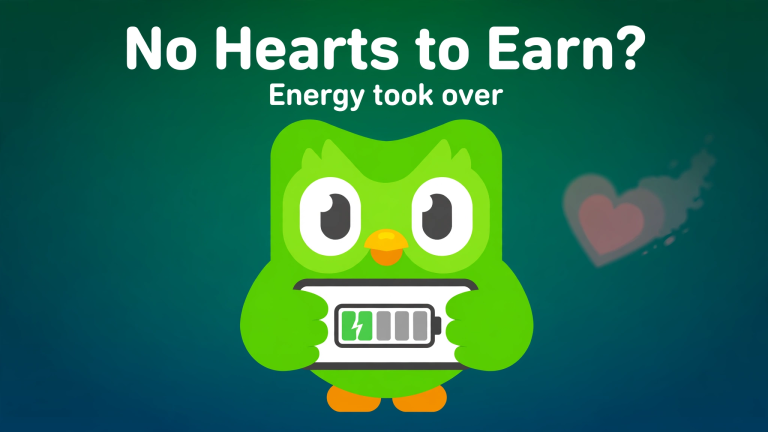
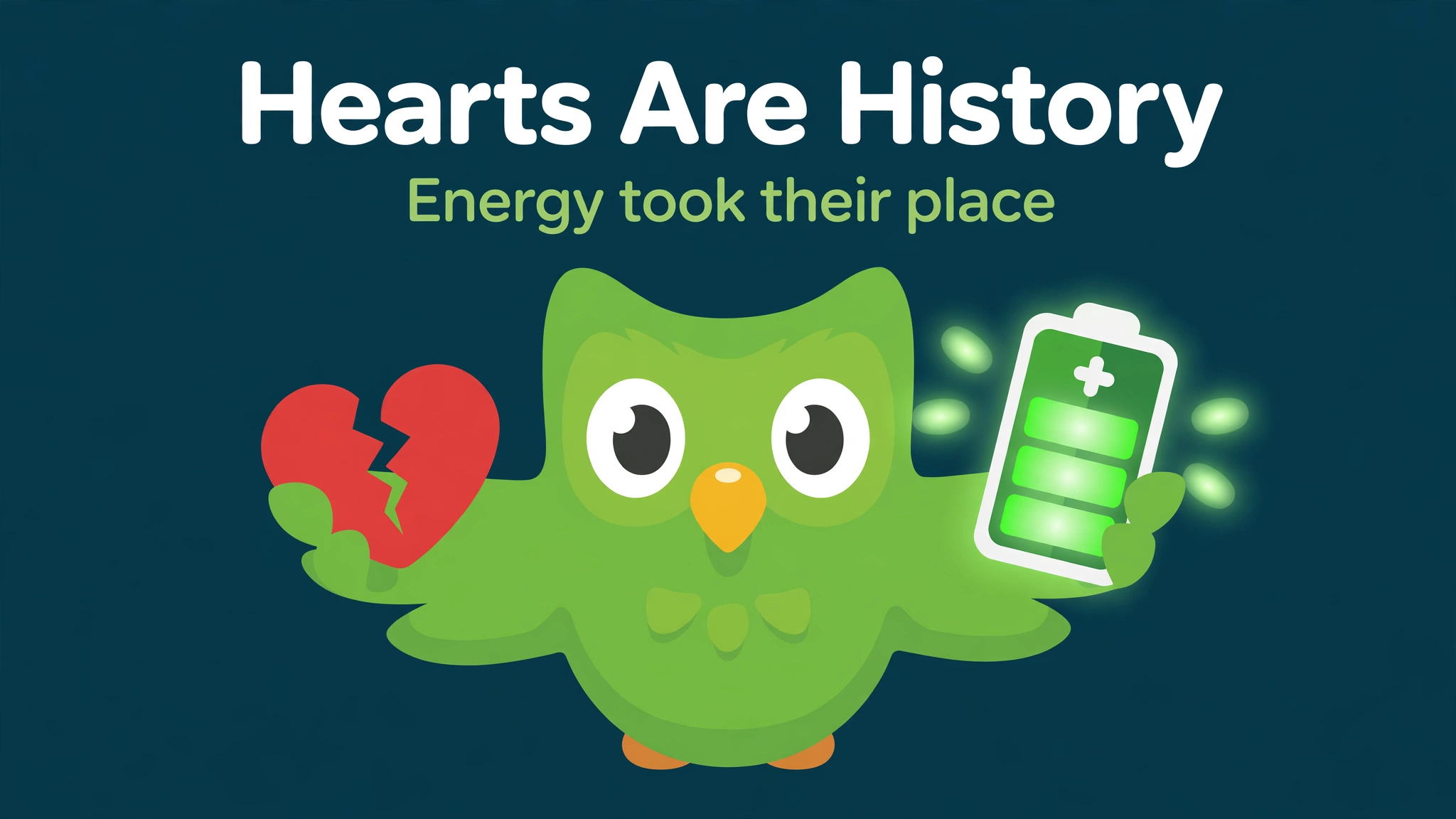
Here is the twist: Duolingo did ditch Hearts, mostly. In mid-2025, it replaced Hearts with Energy on most mobile accounts. But the replacement is not the fix learners asked for. Energy punishes every answer, not just mistakes, so free learners now get fewer lessons a day than they did under Hearts. This piece keeps its original call for change, because the call still stands. It is now aimed at Energy.
Our view: ditching Hearts was the right call. Replacing them with Energy was not the fix. A learning app should make mistakes cheap and practice easy. Energy does the opposite: it taxes every exercise, right or wrong, and stops free learners after about 2 to 3 lessons a day. Duolingo should finish the job and build a limit that rewards learning instead of rationing it.
What the Heart System Was
Under Hearts, you started with 5 hearts. Each mistake cost one heart. At zero hearts, your lesson ended until hearts refilled over time, you practiced old lessons to earn them back, or you paid gems for a refill. The default refill cost 350 gems, or 450 gems mid-lesson. Super subscribers got unlimited Hearts, so the limit only ever hit free learners.
The idea was simple: mistakes should have a cost, so learners slow down and pay attention. In practice, it worked backwards. Careful learners who rarely made mistakes could study for a long time. Beginners, who make mistakes on almost every new word, ran out of hearts in minutes. The system punished the people who needed the most help.
What Replaced Hearts: Energy
| Feature | Hearts (old) | Energy (current, mobile) |
|---|---|---|
| Full amount | 5 hearts | About 25 Energy |
| What costs you | Only mistakes | Every exercise, right or wrong |
| What earns it back | Practicing old lessons, watching ads | Runs of correct answers, ads, gems |
| Refill time | Refilled over hours | About a day for a full bar |
| Gem refill cost | 350 gems by default | 600 gems on iPhone, 350 gems on Android, user-editable |
| Web version | Hearts, with no real daily cap | Still Hearts on the web, no Energy limit |
| Super | Unlimited Hearts | Unlimited Energy |
Two things to know. First, the rollout is staggered, so some accounts still use Hearts. If your app still shows Hearts, you have the older system, and only mistakes cost you. Second, the web version never switched. Free learners on duolingo.com still use Hearts, with no Energy limit at all.
For the full numbers, see our Duolingo Energy system guide.
Why Hearts Deserved to Go
The case against Hearts was never just about annoyance. It was about how people learn.
Hearts made mistakes expensive. Learning a language means guessing, getting it wrong, and trying again. When every wrong answer costs a life, learners stop guessing. They play safe, repeat easy lessons, and avoid the hard words they most need to practice. Fear of losing hearts teaches caution, not language.
Hearts punished beginners most. A learner on day one makes mistakes constantly. Five hearts could vanish in a single lesson. Advanced learners, who rarely slip, barely noticed the system. A limit that only bites the weakest learners is a bad limit.
Hearts turned learning into anxiety. The red heart counter sat on screen the whole lesson, a visible countdown to failure. Many learners report rushing, second-guessing easy answers, or quitting a lesson early to save hearts. None of that helps memory.
Hearts pushed people toward paying, not toward learning. The fastest fix for zero hearts was always money: gems, or a Super subscription. That is a fair business model, but it is not a learning design. The limit existed to sell the removal of the limit.
Why Energy Is Not the Fix
Energy keeps every one of those problems and adds a new one: it charges you for being right.
Under Hearts, a careful learner could study for a long time, because only mistakes cost anything. Under Energy, every exercise costs one unit, right or wrong. A perfect lesson still drains the bar. Most free mobile users now get about 2 to 3 lessons a day, roughly 15 to 20 minutes, before the app stops them. Duolingo’s own shareholder letter frames Energy as a pacing system, and the numbers show it paces free learners hard.
That makes Energy a stricter limit than Hearts for the average learner, not a kinder one. It also makes the free plan feel broken in a new way: you can do everything right and still be told to come back tomorrow. At least Hearts gave you a reason. Energy just runs out.
The split between platforms makes it worse. The same free account gets unlimited practice on the web and a 25-point cap on the phone, for no reason the learner can see. Many learners only find out about the web workaround from other users, not from Duolingo.
The Good Signs Duolingo Is Moving the Right Way
To be fair, Duolingo has made two genuinely learner-friendly moves in 2026, and both point in the direction this piece has always argued for: reward review, do not punish errors.
- Explain My Answer is free for all since 1 January 2026. When you get an answer wrong, Duolingo now explains why, for every learner, not just paying ones. That turns a mistake into a lesson instead of a punishment.
- Practice Hub is free for all since 18 February 2026. Targeted review of your mistakes and weak words used to sit behind the paywall. Now every learner can practice what they got wrong, and reviewing mistakes at the end of a lesson costs no Energy.
These are the right instincts. If Duolingo can give every learner free mistake review, it can build a daily limit that works the same way: generous for real study, strict only for mindless grinding.
What a Better System Would Look Like
Duolingo does not need to remove all limits. Free apps need a business model, and Super is a fair one. But the limit should measure learning, not just screen time. Here is what that could look like:
- Charge Energy only for mistakes, or for repeating the same lesson. New material and first attempts should be cheap. That is the learning. Mindless replay is what a limit should slow down.
- Make review free, always. Practice Hub and mistake review already cost nothing. Keep it that way, and say so clearly in the app, so learners know review never eats their daily limit.
- Grow the daily allowance with streaks. A learner who shows up for 30 days straight has proved they will use extra practice well. Reward that with more Energy instead of the same 25 points as day one.
- Publish the numbers. Learners should not have to guess whether their bar holds 25 points, whether a refill costs 600 gems or 350, or whether their account is on Hearts or Energy. A limit you cannot see or understand feels arbitrary, and arbitrary limits feel unfair.
- Keep the web and the app honest with each other. One free plan should not mean unlimited practice on a laptop and 15 minutes on a phone. Pick one rule and apply it everywhere.
The Money Question
None of this changes the business reality. Super removes the limit entirely, along with ads, and adds offline lessons. It costs about $12.99 to $13.99 a month, or about $83.99 to $119.99 a year in the US, and Super Family is about $119.99 to $143.99 a year for up to 6 people. Duolingo publishes no price list, so check your own checkout screen before you pay.
Duolingo Max, the higher tier, is being phased out: Duolingo announced in November 2026 that it is ending Max, and its Video Call speaking feature is moving into Super. Do not buy Max from any site or seller.
Super is worth it for daily phone learners who keep hitting the Energy wall. But a free plan that stops a motivated beginner after 15 minutes is not a free plan doing its job. It is a demo with a timer. Duolingo became the biggest language app in the world, with about 140.6 million monthly users in Q2 2026, by being free and fun. The Energy system risks trading that goodwill for a few more subscriptions.
If you are deciding whether to pay, see our Duolingo free plan guide and our Is Duolingo really free guide.
Frequently Asked Questions
Is the Duolingo heart system gone?
Mostly. In mid-2025, Duolingo replaced Hearts with a 25-point Energy system on most mobile accounts. Some accounts still use Hearts, and the web version still uses Hearts with no Energy limit.
Is Energy better or worse than Hearts?
For most free learners, worse. Hearts only punished mistakes, so careful learners could study for a long time. Energy charges every exercise, right or wrong, so most free mobile users get about 2 to 3 lessons a day before they must stop.
How do I get unlimited Energy without paying?
There is no legitimate trick. The honest free workaround is the web version at duolingo.com, which has no Energy limit. On mobile, you can top up with the free top-up, watch an ad for about 5 Energy, or spend gems on a refill.
Does Super remove the Energy limit?
Yes. Super subscribers get unlimited Energy on mobile and unlimited Hearts on accounts that still use them. Super also removes ads and adds offline lessons.
Bottom line: Duolingo listened to the complaint about Hearts and answered it with Energy, a limit that is stricter, not kinder. The company deserves credit for making mistake review free for everyone in 2026. Now it should finish the job: build a daily limit that rewards real learning, publish the numbers, and stop charging learners for getting answers right.