
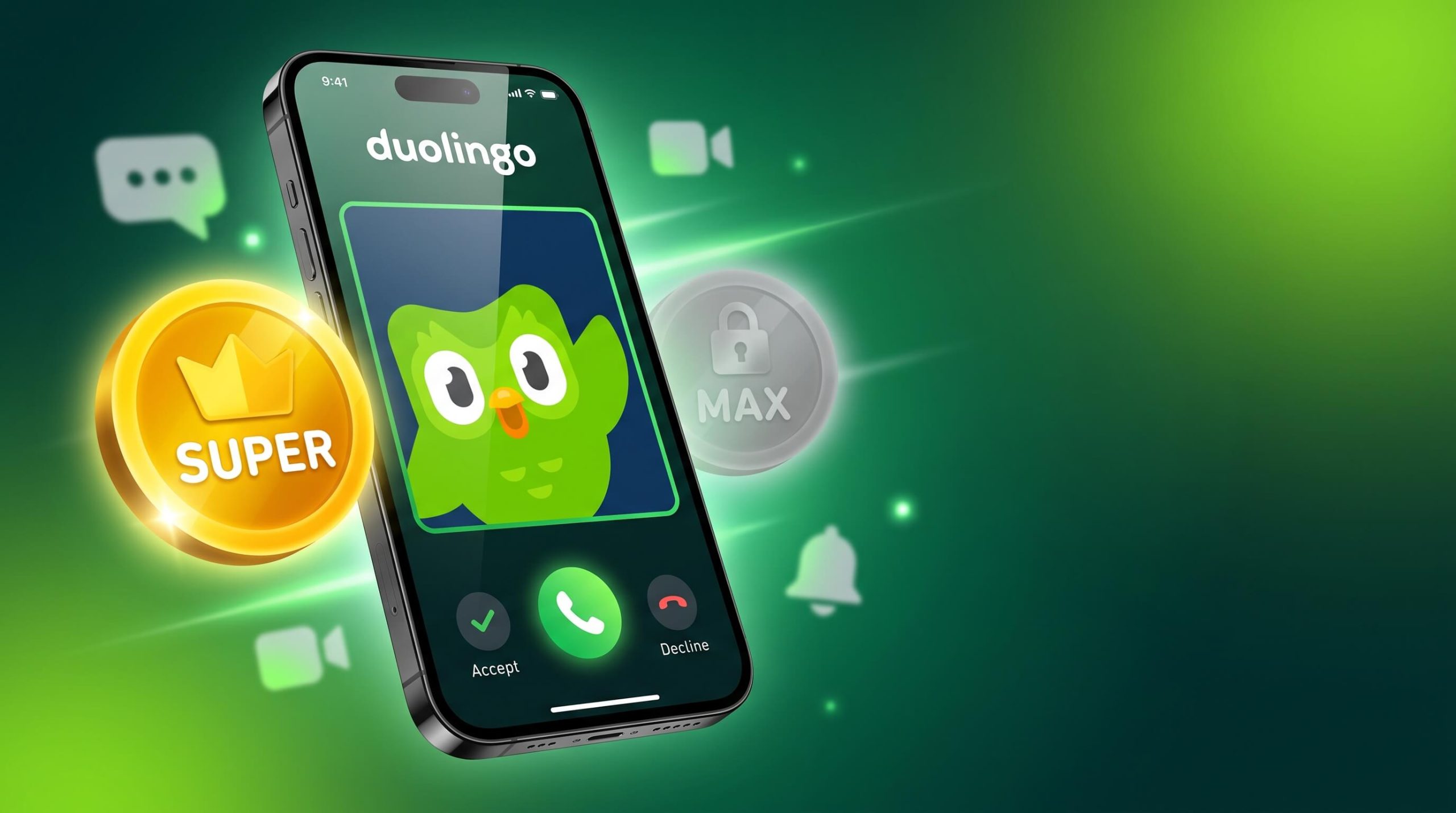
Duolingo’s most talked-about AI feature has, until now, belonged to one group only: people paying for Duolingo Max, the app’s priciest tier. That’s starting to change. Duolingo confirmed on its most recent earnings call, in May 2026, that Video Call — the feature that lets learners hold a live, spoken conversation with an AI character — is now actively being tested with Super Duolingo subscribers, the mid-tier plan roughly ten times more people already pay for.
This isn’t a rumor pulled from an app-store changelog or a leaked screenshot. It’s coming directly from Duolingo co-founder and CEO Luis von Ahn, who addressed it on back-to-back quarterly earnings calls. But it’s also not a finished, everyone-gets-it launch yet. Here’s exactly what’s confirmed, what’s still being tested, and what it likely means for your subscription.
What Is Video Call, and Why Has It Been Locked Behind Max?
Video Call launched as Duolingo Max’s flagship feature: a live, unscripted conversation with an AI character (most famously Lily, Duolingo’s deadpan, purple-haired mascot). Instead of tapping multiple-choice answers, you speak your responses out loud, the AI replies in real time, and it adjusts its pace and vocabulary to your level. Duolingo has described it as its most advanced conversation-practice feature, aimed at the gap between knowing vocabulary and being able to actually use it in a live exchange.
It launched on iOS for English, Spanish, and French learners, then expanded to German, Italian, Portuguese, Japanese, and Korean, with Android support following in January 2025. It has stayed a Duolingo Max exclusive since: Super subscribers can see the feature icon on their learning path but can’t activate it without upgrading.
The reason it launched behind Duolingo’s most expensive tier comes down to cost, not exclusivity for its own sake. Video Call runs on generative AI, and running a live AI conversation for every user is far more computationally expensive than a static, pre-written exercise. When Max launched, those AI inference costs were high enough that Duolingo restricted the feature to its priciest plan to keep it financially viable.
The Announcement: What Von Ahn Actually Said
The shift became public on Duolingo’s Q4 2025 earnings call (late February 2026). Asked directly about the Max-versus-Super roadmap, von Ahn explained the original logic and why it no longer holds:
“At the time, cost for AI inference was way higher than it is now. We decided to put our AI features… behind a much higher subscription tier, which is Duolingo Max. We said back then that as AI costs came down, we would experiment putting features in the different tiers… At this point, the cost of a Video Call has gone down very significantly… and we feel pretty comfortable being able to put it inside Super Duolingo.”
The scale argument is central to Duolingo’s reasoning: von Ahn noted there are roughly ten times as many Super subscribers as Max subscribers. Moving Video Call into Super would, in his words, give conversation practice to “about ten times as many learners” — a meaningful jump in how many people get access to what Duolingo considers a genuinely useful teaching tool, not just a retention perk.
Duolingo’s own Q4/FY2025 shareholder letter made the plan official in writing, stating the company would “move Video Call to be part of the Super Duolingo tier and experiment with changes to our top subscription tier, Duolingo Max.”
Notably, von Ahn was upfront that Duolingo doesn’t yet know how this will play out financially. On the same call, he laid out both possible outcomes candidly: it could increase revenue by pulling more people into Super or improving Super’s retention — or it could reduce Max bookings if fewer people see a reason to pay double for a feature they can now get cheaper. He also floated a middle-ground possibility if the numbers don’t work cleanly: metering. As he put it, Duolingo might cap Super users at something like one Video Call per day, while Max keeps unlimited access.
Where Things Stand as of Q1 2026: A Live Test, Not a Full Launch
By the Q1 2026 earnings call (May 4, 2026), the rollout had moved from stated intention to active experiment. Von Ahn confirmed:
“We’ve started doing that, so at the moment, we have a number of experiments giving Video Call to Super subscribers, particularly to new users. New Super subscribers are getting Video Call. We have not scaled this to all our existing user base… At the moment, there’s no change for Max. I don’t know what’s going to happen with Max.”
That’s the most current, verifiable status of the rollout: it is live for a subset of new Super subscribers as an A/B test — not for all existing Super subscribers, and not yet a general-availability feature.
Duolingo’s Q1 2026 shareholder letter framed this alongside a broader speaking-practice push, noting the company had “more than doubled the average number of words spoken per user in Video Call” over the prior year, and that it was “starting to expand access to Video Call to Super subscribers,” alongside newer speaking-focused additions like spoken-answer exercises, speaking-focused flashcards, and a scenario-based feature called Speaking Adventures.
On pricing, von Ahn was equally direct that Duolingo hasn’t landed on an answer yet: the company is running tests on “what the right price should be for Super with Video Call,” and results were still weeks to months out as of the May call. What we do know is that early signals suggest willingness to pay more: von Ahn said Duolingo has learned that “people are willing to pay more for Super with Video Call,” though he stopped short of giving a number.
What This Means for the Cost Side: Margin Pressure Duolingo Is Choosing to Accept
This rollout isn’t a cost-free gift to Super subscribers — Duolingo’s own financial guidance says as much. On the Q1 2026 call, CFO Gillian Munson guided gross margin down from a Q1 peak of 73.0% to roughly 69% by Q4 2026, a contraction the company has directly tied to “the rollout of expensive generative AI features to a broader user base.” In other words, Duolingo is knowingly trading some profitability now for what it hopes is stronger long-term subscriber growth and retention — a deliberate, disclosed strategic bet rather than a side effect.
That tradeoff is part of a larger pattern in Duolingo’s 2026 approach. The company also made a different Max-exclusive AI feature, Explain My Answer (which gives AI-generated explanations for wrong answers), free for every user — including free-tier learners — in January 2026. Von Ahn has since said that move alone hasn’t meaningfully accelerated daily active user growth the way the company hoped, which may be part of why the Video Call test is being run cautiously as an A/B experiment rather than an immediate blanket rollout.
How to Check If You Have It
Because this is a live, limited experiment rather than a universal switch, there’s no simple “update your app” fix if you don’t have it yet. Based on what Duolingo has confirmed, here’s what determines whether you’re likely to see it:
- New Super subscribers are the current test group. Von Ahn specifically said the experiments are targeting new sign-ups to Super, not the existing base.
- Existing long-time Super subscribers are less likely to have it yet, since Duolingo has explicitly said it hasn’t scaled the test to its full existing user base.
- Check your Practice Hub and learning path. Duolingo’s existing rollout pattern for other features (including the original Max launch) has been to surface a Video Call icon directly on path nodes and in the Practice Hub when a user has access.
- There’s no official self-serve toggle or opt-in confirmed. As of the most recent earnings call, Duolingo hasn’t described a way for users to manually request early access to the test.
If you’re a Super subscriber and don’t see it, that doesn’t mean anything has gone wrong — it likely just means your account hasn’t been included in the current test cohort.
It’s also worth understanding why Duolingo is testing this way at all, rather than flipping a single switch for everyone. Von Ahn has described the company’s general approach to product changes as “The Green Machine”: run small experiments, measure what actually happens, and expand only what works. Duolingo has applied that same philosophy to other major changes before — including its shift from the older Hearts system to the current Energy system, which rolled out unevenly across accounts rather than all at once, with some users still reporting the older system well into the transition period. A staggered, cohort-based rollout for Video Call fits that same operating pattern.
Video Call on Super vs. Max: What Might Differ
Duolingo hasn’t finalized how a Super version of Video Call will differ from the Max version, but von Ahn’s public comments point to two likely levers:
Usage limits: Rather than matching Max’s unlimited access, von Ahn floated metering as a real possibility — for example, one Video Call session per day on Super, with Max retaining unlimited calls. This isn’t confirmed as the final model, but it’s the specific example he gave.
Pricing: Duolingo is actively testing what a Super-with-Video-Call price point should be, which implies this could ultimately arrive as a distinct, possibly higher-priced version of Super rather than an unlimited freebie added to the existing $13.99/month (or ~$7.99/month annual) Super price. As of publication, no updated Super price tied to Video Call has been confirmed.
What’s more settled is Video Call’s actual mechanics, which should carry over regardless of tier: short sessions (roughly one to three minutes depending on skill level), an AI conversation partner that adjusts pace and complexity to the learner, the ability to ask the AI to repeat or slow down, and no penalty for mistakes.
Language availability: is another open question worth watching. Video Call on Max expanded gradually since its original launch — rolling out first to English, Spanish, and French learners on iOS, then adding German, Italian, Portuguese, Japanese, and Korean, with Android support following afterward. Duolingo hasn’t stated whether the Super version will launch with that same full language lineup immediately or follow a similarly staggered, language-by-language rollout. Given how the original Max expansion unfolded, a gradual language rollout on Super seems the more likely pattern, though this hasn’t been confirmed either way.
Why Duolingo Is Doing This Now
Two forces are converging. First, the cost of running generative AI has fallen substantially since Video Call first launched in 2023–2025, which is the direct reason von Ahn gave for revisiting the Max-only restriction. Second, Duolingo is in the middle of a stated multi-year push — targeting 100 million daily active users by 2028, up from just over 56 million as of Q1 2026 — and speaking practice sits at the center of that plan. Alongside Video Call’s expansion, Duolingo has rolled out several other speaking-focused additions in 2026, including exercises where users speak answers instead of tapping them, speaking-focused flashcards, and a new scenario-based feature called Speaking Adventures.
Duolingo has been candid that this strategy trades short-term financial comfort for long-term positioning. The company’s own Q1 2026 numbers show that trade already showing up in the guidance: gross margin is expected to compress through the year specifically because of AI features like this expanding to a much larger subscriber base.
Final Words
If you’re a Super Duolingo subscriber hoping to try Video Call, here’s the honest state of play: it’s real, it’s confirmed by Duolingo’s CEO on two consecutive earnings calls, and it’s already live for some new Super subscribers as an active test. It is not yet a universal feature every Super subscriber can expect to open tomorrow, pricing and usage limits haven’t been finalized, and Duolingo itself says it doesn’t yet know how far or fast this will scale. The clearest next signal will likely come on Duolingo’s next earnings call, when the company is expected to share more on what the testing has found.
A note on sourcing: every claim above is drawn from Duolingo’s official shareholder letters and CEO/CFO statements on its Q4 2025 and Q1 2026 earnings calls — the only primary, on-the-record sources currently describing this rollout. No consumer-facing Duolingo blog post or press release announcing general availability of Video Call on Super had been published as of this article’s writing; if and when Duolingo publishes one, it will supersede the testing-stage details described here.