
If you’ve landed here after seeing the number 129 somewhere in Duolingo — whether at the top of your learning path or on an official test result — you’ve probably noticed something confusing: none of the explanations online quite agree with each other. That’s because “Duolingo Score 129” can refer to two completely different things, and almost no other guide makes that distinction clear before diving into the numbers.
This article fixes that. We’ll tell you exactly which system your 129 belongs to, what it actually means for your language ability, and — if you got it on the official test — what it means for your university or job applications.
The First Thing to Check: Which “Duolingo Score” Do You Have?
Duolingo runs two entirely separate scoring systems that happen to share a name:
- The in-app Duolingo Score — a free, built-in proficiency tracker that appears next to your course flag inside the Duolingo app. It’s tied to your course progress, not a formal exam.
- The Duolingo English Test (DET) score — the result of a paid, proctored, certified English proficiency exam that universities, employers, and immigration bodies can accept as proof of English ability.
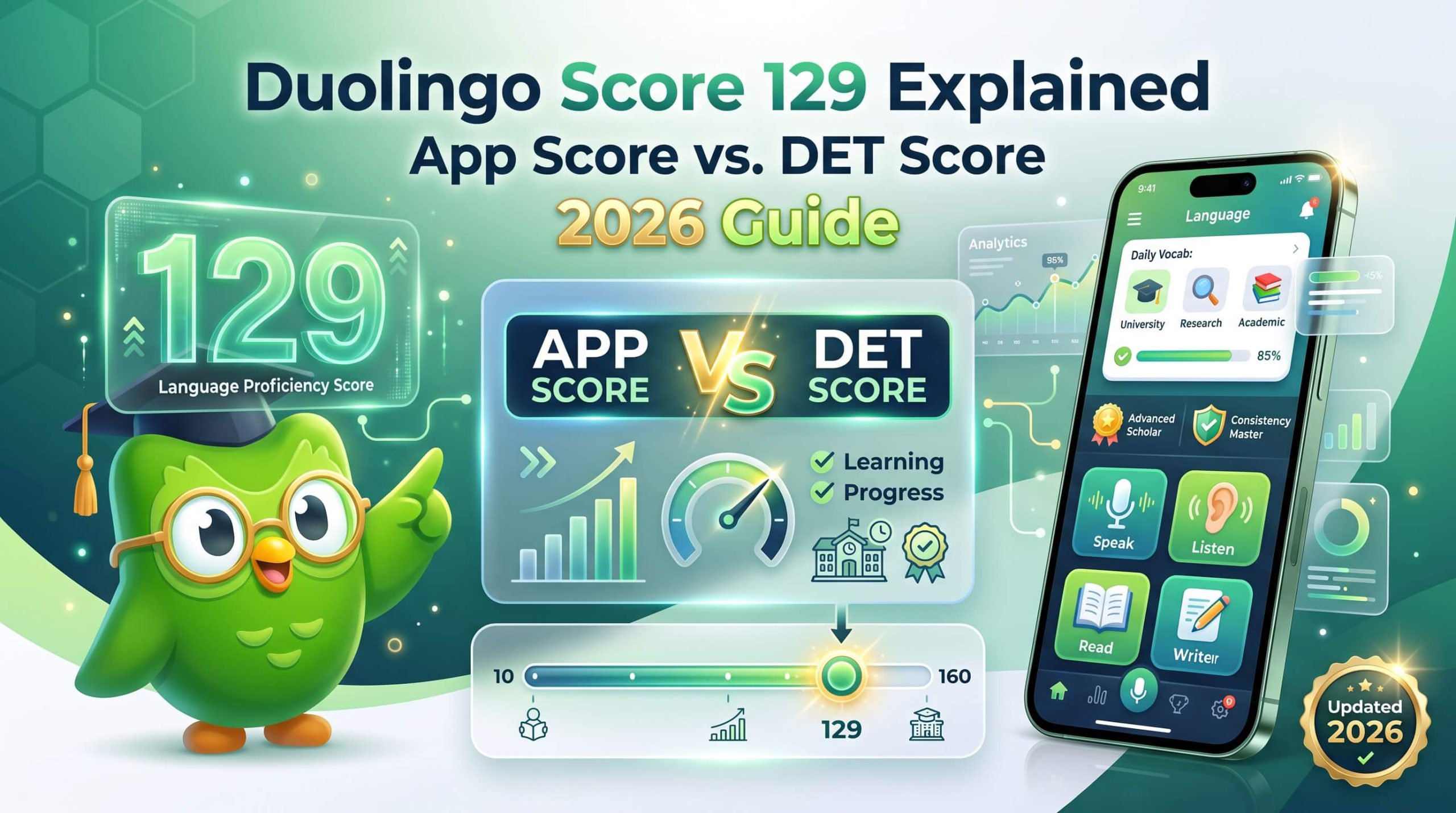
Here’s the quickest way to tell them apart: the in-app Score tops out at 130 for the most advanced courses (currently English, Spanish, and French), while the DET score runs on a wider 10–160 scale. If your 129 showed up inside the Duolingo learning app — next to your flag, on your profile, or in a “your score increased” notification — you’re one point away from the current maximum, deep in advanced territory. If your 129 arrived by email after you sat a proctored English exam, you’re looking at a certified academic result on a different scale entirely, and it means something different for admissions.
We’ll walk through both, starting with the one most people searching this exact number are probably asking about: the in-app Score.
What the In-App Duolingo Score of 129 Actually Means
The in-app Duolingo Score was introduced to give learners a clearer, more meaningful number than a daily streak. As Duolingo has explained on its own blog, a streak only tells you how many days in a row you’ve shown up — it says nothing about whether you can actually hold a conversation. The Score was built to fix that by measuring real course progress against the Common European Framework of Reference for Languages (CEFR), the internationally recognized standard for describing language ability from complete beginner (A1) to full mastery (C2).
Your in-app Score climbs as you complete lessons, units, and stories — not by logging in, but by genuinely advancing through the course material. According to Duolingo, reaching the top of the scale requires “hundreds of hours of exposure and practice,” which is why the company has been vocal about wanting learners to care more about their Score than their streak.
Where 129 Sits on the Scale
Independent trackers of Duolingo’s course structure (drawing on Duolingo’s own published breakdowns) place the in-app Score bands roughly as follows:
| Duolingo Score | CEFR Level | What You Can Do |
|---|---|---|
| 0–9 | Very early A1 | Use simple words and phrases in a few common situations |
| 10–19 | Early A1 | Talk about yourself, ask and answer simple questions |
| 20–29 | High A1 | Discuss your daily routine, order food, chat a little |
| 30–59 | A2 | Have basic conversations about familiar topics like weather or hobbies |
| 60–79 | Early B1 | Handle common travel situations, ask for directions |
| 80–99 | High B1 | Share opinions, tell stories, manage most daily situations |
| 100–114 | Early B2 | Discuss topics of interest in depth, understand news and jokes |
| 115–129 | High B2 | Express yourself in most situations; use the language for work, study, or academics |
| 130 | Top of current scale | Job-ready proficiency in English, Spanish, or French |
A score of 129 sits at the very top of the “High B2” band — the last CEFR level before C1 (advanced/proficient territory) — and is just one point below the current ceiling of 130. Duolingo describes this stage as the point where you’re an “independent user” of the language: you can interact with other speakers, follow fairly complex material, and express your own views across a wide range of topics, even if you occasionally search for a word or don’t catch every nuance.
Practically, this puts you close to the level Duolingo itself has said is enough to “get a job in that language.” You’re not yet at full native-like fluency, but you’re functioning comfortably in the language for work, study, and everyday academic or professional contexts — which is precisely why Duolingo built its most advanced courses to stop at 130 rather than push further into C1/C2 territory.
Why the Scale Currently Stops at 130 (Not Higher)
It’s worth understanding why 129 feels so close to “the end” — because for most courses, it currently is. As of Duolingo’s own reporting, only the English, Spanish, and French courses currently reach the full 130, corresponding to the “high B2” ceiling; other major courses (German, Italian, Portuguese, Japanese, Korean, Chinese) have been catching up but may not yet extend that far, depending on how much CEFR-aligned content has been built out for that language. If you’re studying one of these other courses, hitting a high score more quickly, or capping out below 130 entirely, isn’t a sign you’re doing anything wrong — it reflects how much advanced content currently exists in that specific course. Duolingo has indicated it continues to expand course content further up the CEFR scale over time.
One important myth worth debunking directly, because it trips up a lot of learners: your Score is not the same as your streak, and there’s no shortcut between them. You can build a 130-day streak with a few minutes of practice daily and still have a modest Score if you’re clicking through easy review lessons. Reaching a Score of 129 or 130, by contrast, requires genuinely progressing through advanced material — there’s no way to farm it with quick, repetitive sessions.
What a 129 on the Duolingo English Test (DET) Means
If your 129 instead came from a certified test result — the kind with a score report, subscores, and a video sample — you’re dealing with the Duolingo English Test, a completely different product built for academic and professional certification, not in-app gamification.
How the DET Scoring Scale Works
The DET reports an overall score from 10 to 160, in increments of 5 (so you’ll see 120, 125, 130 — never 122 or 127). Your result also comes with four subscores:
- Literacy (reading and writing combined)
- Comprehension (reading and listening combined)
- Conversation (speaking and listening combined)
- Production (writing and speaking combined)
Duolingo has been explicit that your overall score is not a simple average of these subscores — it’s calculated using a statistical model that evaluates your responses holistically, so a strong overall score can come from a variety of subscore combinations rather than one fixed formula.
Where 129 Sits on the DET Scale
On the 10–160 scale, a score of 129 lands in the upper-middle range, generally associated with CEFR levels spanning B2 into C1 territory. For context, third-party test-prep resources place scores in the roughly 120–129 range at around the top 25–40th percentile of test-takers — though we want to be upfront that this specific percentile figure comes from a third-party test-prep source rather than Duolingo’s own published statistics, so treat it as an approximate industry estimate rather than an official figure [VERIFY: exact current percentile distribution — this should be confirmed against Duolingo’s own official score-interpretation page, which was not fully accessible for detailed extraction at the time of writing].
What we can say with more confidence, based on Duolingo’s own materials: most competitive universities set English-proficiency thresholds somewhere in the 105–130 range, and a 129 comfortably clears the minimum bar used by the large majority of institutions that accept the DET at all, while sitting just below the top-tier bracket (130+) that the most selective programs sometimes request. As always, program-level requirements vary — a competitive law or journalism program may set the bar meaningfully higher than a technical or engineering program at the very same university, so checking your specific program’s stated minimum is essential rather than relying on a general “good score” benchmark.
Is 129 a Good Score?
In practical terms: yes, a 129 represents strong, near-fluent English proficiency. It’s well above the range most sources describe as the general “good score” threshold (typically cited around 110–120), and it sits just below the highest competitive bracket. For the overwhelming majority of universities and programs that accept the Duolingo English Test, a 129 will clear the English-proficiency requirement comfortably. If you’re applying to a small number of extremely selective programs that specifically request 130+, it may be worth knowing your subscores and deciding whether a retake is likely to move the needle — but for the vast majority of applicants, 129 is a genuinely strong result, not a borderline one.
How the DET Compares to IELTS and TOEFL
Because so many applicants are choosing between English tests, it helps to know roughly where a DET score of 129 lines up against the two most established alternatives. Duolingo publishes an official concordance table for this exact purpose, and third-party test-prep resources generally describe a DET score in the high-120s as comparable to an IELTS band in the roughly 7.0–7.5 range and a TOEFL iBT score in the high 90s to low 100s — though exact concordance figures should always be checked against Duolingo’s official published concordance table, since third-party conversion charts can vary slightly in how they round these approximate equivalencies [VERIFY: precise DET-to-IELTS-to-TOEFL concordance for the 125–130 band against Duolingo’s current official table].
The CEFR Framework, Explained Simply
Since both scoring systems anchor themselves to the CEFR, it’s worth understanding what that framework actually measures, because it’s the throughline connecting your in-app Score to your test score even though the two use different numeric scales.
The CEFR breaks language ability into six stages:
- A1–A2: Basic user (beginner to elementary)
- B1–B2: Independent user (intermediate to upper-intermediate)
- C1–C2: Proficient user (advanced to mastery)
A score of 129 — on either Duolingo scale — places you at the top edge of the B2 band, on the doorstep of C1. That’s a meaningful, well-defined stage: you’re independent enough to work, study, and socialize in the language without constant support, even though full native-level nuance is still ahead of you. Universities and employers value CEFR alignment specifically because it gives them a consistent way to interpret a score regardless of which test produced it, which is also why Duolingo underwent an external validation process — involving independent psychometric reviewers and a UK-based language-assessment research center — specifically to confirm that its score bands map accurately onto these CEFR levels. That kind of third-party validation is part of why institutions can treat a DET score with the same confidence as more traditional exams.
What to Do Next With Your 129
If this is your in-app Score: Keep going. You’re one point from the current ceiling in your course, and closing that final gap means engaging with the most advanced material the course offers — stories, longer conversations, and less repetitive review. There’s no faster path than genuine exposure; a longer streak alone won’t move this number.
If this is your DET score: Check the specific program requirement for your target university or scholarship rather than relying on a general benchmark, since requirements can differ significantly even within the same institution. If your target explicitly asks for 130+, look at your subscores to see where a retake might help most — Duolingo allows you to purchase up to a limited number of attempts within a 30-day window, and it’s free to send your existing certified score to as many accepting institutions as you like in the meantime, so there’s little downside to sending your 129 now while you decide whether to retest.
Frequently Asked Questions
Is a Duolingo Score of 129 the same as a Duolingo English Test score of 129?
No. They come from different products on different scales, even though they share a number. The in-app Score currently maxes out at 130 for the most advanced courses; the DET score runs from 10 to 160. Check where you saw the number to know which system applies to you.
Is 129 close to the maximum possible score?
On the in-app scale, yes — 129 is one point from the current 130 ceiling for English, Spanish, and French. On the DET’s 160-point scale, 129 is a strong upper-range score but well short of the test’s maximum.
Do universities accept a DET score of 129?
Generally, yes. Most institutions that accept the Duolingo English Test set minimums well below 129, and this score clears the vast majority of stated program requirements. Always verify your specific program’s minimum directly, since requirements vary by institution and by course.
Can I raise my in-app Score of 129 to 130 quickly?
Not through streaks or quick review sessions. Duolingo has been explicit that meaningful Score increases require genuine progress through advanced course content — there’s no shortcut, though the remaining gap at this stage is small.