
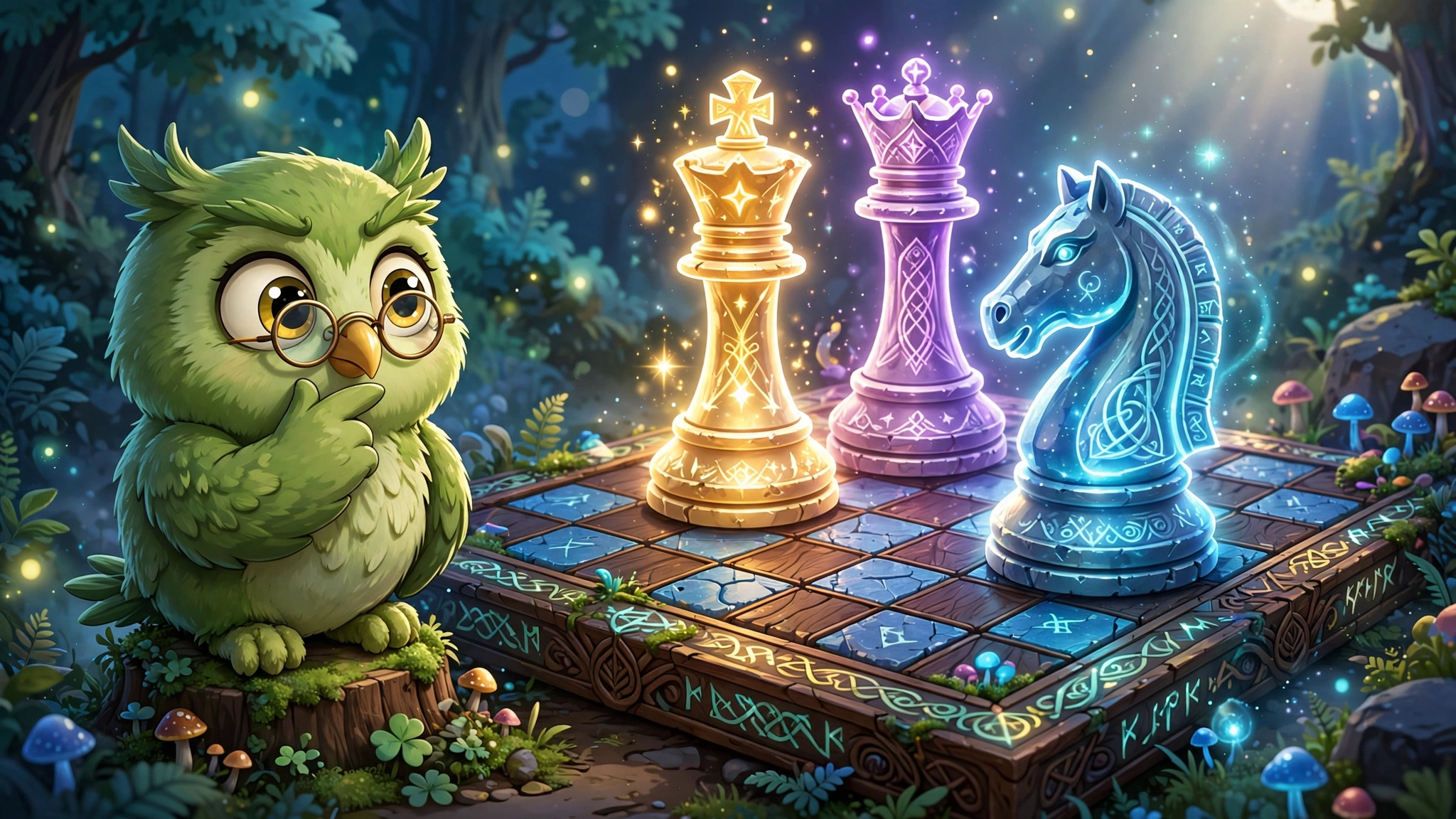
The green owl that taught you Spanish can now teach you chess. Duolingo has launched a full chess course — its first new subject since Math and Music arrived in 2023 — and it works exactly the way you’d expect: bite-sized lessons, a goofy coach, puzzles instead of lectures, and yes, streaks.
Whether you’ve never touched a chess piece or you know how the knight moves but freeze the moment someone says “en passant,” this guide explains everything: how the Duolingo chess course works, who Oscar is, what you’ll actually learn, how PvP matches and Elo ratings work, and how to start playing for free.
What Is the Duolingo Chess Course?
Duolingo announced its chess course in 2025 as part of its mission to become “a tutor in your pocket” for more than just languages. Chess is the company’s third non-language subject, following the Math and Music courses that launched in 2023.
The pitch is simple: traditional chess platforms are built for competitive players who already know the game. Duolingo’s course is built for learners — especially beginners who find chess intimidating. Instead of memorizing opening theory from a book, you learn by solving puzzles and playing short games, five minutes at a time.
The course is available on iOS and Android in most languages, and Duolingo has also rolled out chess on web, so you can play from your browser too.
How the Duolingo Chess Course Works
Duolingo teaches chess using the same “Duolingo Method” behind its language courses — learning by doing, not by reading. Here’s what that looks like in practice:
- Learning by doing: You build skills by actively solving puzzles and playing out tactics. No long text explanations — you move the pieces yourself.
- Personalized practice: The course asks about your skill level at the start and adjusts your path. Duolingo’s spaced repetition algorithm resurfaces tactics you’ve learned at just the right time so they stick.
- Scaffolded progression: Lessons start with heavily guided moves (“move your bishop here”) and gradually open up into real problem-solving (“find checkmate in two moves”).
- Focus on what matters: Instead of drowning you in theory, the course prioritizes essentials — how pieces move, key rules, and foundational tactics — so that by the end of Section 1 you can play a full game with confidence.
- Delight drives motivation: Playful visuals, bite-sized lessons, streaks, XP, and quests keep you coming back, just like the language courses.
If you make a wrong move, the app reacts the way a coach would — your virtual opponent responds to the mistake, and the app guides you with hints and visual cues (like arrows) until you find the right move.
Meet Oscar, Your Chess Coach
Oscar is Duolingo’s world character who serves as your in-game chess tutor. He walks you through every lesson with tips, hints, and encouragement — and he’s the opponent you’ll face in mini-matches and full games as you learn.
Oscar adapts to your level: early on he plays gently so you can practice new ideas without getting crushed, and the challenge ramps up as you improve. He’s also developed a bit of a personality among players — at one point quipping that he doesn’t play chess, he is chess.
What You’ll Learn: Curriculum Breakdown
The course starts at absolute zero and builds toward genuine playing strength. Here’s the rough roadmap:
| Stage | What You Learn | Format |
|---|---|---|
| The basics | How each piece moves, the board, special rules (castling, en passant, promotion) | Guided puzzles |
| Core tactics | Captures, checks, checkmates in one, forks, pins, skewers | Tactical puzzles |
| Putting it together | Checkmate in two, common patterns, basic strategy and piece values | Puzzles + mini-matches |
| Full games | Playing complete games against Oscar and real opponents | Mini & full matches |
By the end, Duolingo says learners work their way toward a 1500 Elo rating — a strong intermediate level that sets you up to hold your own against most casual players.
Puzzles vs Matches: The 75/25 Split
One of the most interesting design choices: roughly 75% of the course is puzzle-based. You’ll spend most of your time solving hands-on challenges — find the checkmate, capture the most material, escape the attack — which is exactly how chess skill is actually built.
The remaining 25% is matches: mini-games and full-length games where you apply everything in a real game setting, mostly against Oscar at first. Matches earn XP too (a full match can net you +50 XP), so they feed right back into your streak and leaderboard grind.
Play Against Real People: Chess PvP Mode
Once you’ve got the basics down, you can test yourself against actual humans. Duolingo’s Chess PvP mode lives in the Matches tab — tap “Play a Person” and the app pairs you with an opponent of a similar skill level.
- iOS: PvP launched in late 2025
- Android: PvP rolled out in early 2026, which Duolingo says massively improved matchmaking speed worldwide — especially for higher-rated players
- Friends: You can invite friends directly to a game, or let Oscar find you a random opponent at your Elo
- Coming next: Duolingo has teased play-with-friends improvements, game review features, and more advanced content
Elo Ratings Explained
Duolingo uses the standard Elo rating system — the same numbering chess federations use worldwide — to measure your skill and match you fairly. Here’s a rough guide to what the numbers mean:
| Elo Range | Level | What It Means |
|---|---|---|
| Below 800 | Beginner | Still learning how the pieces move |
| 800–1200 | Casual player | Can finish games, misses tactics |
| 1200–1500 | Intermediate | Duolingo course target — solid club-casual strength |
| 1500–2000 | Strong amateur | Beats most casual players comfortably |
| 2000+ | Expert+ | Tournament-level strength |
In versus mode you can see your match record and Elo, so you can watch yourself climb as the puzzles pay off.
Is Duolingo Chess Free?
Yes. Like all of Duolingo’s learning content, the chess course is completely free. You get the full curriculum, puzzles, matches against Oscar, and PvP without paying anything. A Super or Max subscription removes ads and adds perks like unlimited hearts, but the chess lessons themselves cost nothing.
How to Start the Duolingo Chess Course
- Open the Duolingo app (make sure it’s updated to the latest version) or go to duolingo.com on web.
- Tap the course/subject switcher (the flag or subject icon at the top).
- Choose Chess from the available courses.
- Answer the quick skill-level question so the app can place you correctly.
- Start with your first puzzle — Oscar will guide you from there.
If you don’t see Chess yet, update the app — the course rolled out gradually across regions and platforms.
Duolingo Chess vs Traditional Chess Apps
| Feature | Duolingo Chess | Chess.com / Lichess |
|---|---|---|
| Best for | Absolute beginners | Players who already know the rules |
| Teaching style | Guided puzzles, coach character, bite-sized | Lessons library, analysis tools, videos |
| Free tier | Full course free | Free with limits / fully free (Lichess) |
| Motivation | Streaks, XP, leagues, quests | Rating grind, tournaments |
| Advanced content | Up to ~1500 Elo (more coming) | Unlimited, up to grandmaster level |
The honest take: Duolingo won’t replace Chess.com for serious improvers. But if chess has always felt intimidating, it’s the friendliest front door the game has ever had — and plenty of players will graduate from Oscar to “real” chess apps with a solid foundation.
Tips to Learn Chess Faster on Duolingo
- Do a little daily. Chess skill is pattern recognition, and spaced repetition is exactly how patterns stick. Ten minutes a day beats a two-hour weekend binge.
- Don’t rush the puzzles. Before moving, ask: “What is my opponent threatening?” That one habit is worth 200 Elo points.
- Play the mini-matches. Puzzles teach patterns; games teach you to find them under pressure. Do both.
- Review your PvP losses. Losing to a real person shows you exactly which patterns you haven’t internalized yet.
- Learn piece values cold: pawn = 1, knight/bishop = 3, rook = 5, queen = 9. Every trade decision in chess starts here.
FAQs
Is the Duolingo chess course really free?
Yes. The entire chess curriculum — puzzles, lessons, matches against Oscar, and PvP — is free for all learners, like all Duolingo learning content.
Do I need to know how to play chess first?
No. The course starts from absolute zero: how each piece moves and the basic rules. It asks your skill level up front so experienced players don’t have to redo the basics.
What Elo can Duolingo chess get me to?
Duolingo designed the course to take learners to around a 1500 Elo rating — a strong intermediate level. Features like Elo placement tests and real-time coaching are planned for the future.
Can I play chess against friends on Duolingo?
Yes. You can invite friends to a game directly, or use PvP matchmaking (“Play a Person” in the Matches tab) to face a random opponent at a similar Elo rating.
Is Duolingo chess on iPhone and Android?
Yes — the course is available on iOS and Android, and Duolingo has also launched chess on web, so you can play from a browser.
Who is Oscar in Duolingo chess?
Oscar is Duolingo’s character who acts as your in-app chess coach. He guides you through lessons, gives hints, and serves as your AI opponent in mini-matches and full games.
Duolingo keeps expanding beyond languages — from a viral iPhone Duo roast to a full Brawl Stars crossover. Check out our latest Duolingo news and guides for more.