
Is Duolingo worth it anymore? If you have used the app for years, or you are thinking about starting, it is a fair question in 2026. The free version now limits how much you can practise on your phone, and Duolingo’s most expensive plan, Max, has been shut down. At the same time, the free version has got better, with free answer explanations and longer courses.
This guide gives you an honest answer, not a sales pitch. It covers what Duolingo is good at, what the research says, what it costs in 2026, whether it is a scam, what Reddit users think, and who should keep using it and who should move on.
Table of Contents
- Short Answer: Is Duolingo Worth It Anymore?
- What Duolingo Is in 2026
- What the Research Actually Says
- Is Duolingo Actually Helpful?
- Is Duolingo Good for Beginners?
- Advantages and Disadvantages of Duolingo
- Free vs Super vs Max in 2026
- Is Duolingo a Scam?
- What Reddit Says
- Should I Still Use Duolingo?
- How to Get the Most Out of Duolingo
- Frequently Asked Questions
- The Bottom Line
Key Takeaways
- Free Duolingo is worth it for beginners and for building a daily habit.
- It will not make you fluent on its own.
- Super is only worth paying for if ads or the energy limit stop you from practising.
- Max is gone — you cannot buy it anymore.
- The honest answer changed in 2026 in both directions.
Short Answer: Is Duolingo Worth It Anymore?
Yes, if you are a beginner or you need a daily habit. Duolingo is still the easiest free way to start a language and to practise a little every day. The lessons are short, the app reminds you to come back, and the streak keeps many people going for months when nothing else did.
No, if you want Duolingo alone to make you fluent. No app can do that by itself. It teaches vocabulary, basic sentences, and beginner reading and listening, but not real conversation, deep grammar, or thinking in the language. If fluency is your goal, Duolingo can be the first step, but not the only step. And you do not need to pay for it. It only removes ads and the energy limit, and that is worth paying for only if ads or the limit stop you from practising.
The word “anymore” matters, because 2026 changed the answer in both directions. The free version got better: answer explanations became free in January 2026, and nine big courses were extended in April and May 2026. It also got more limited: the energy system caps practice on your phone, and Max was shut down in November 2026.
What Duolingo Is in 2026
Duolingo is still the biggest language learning app in the world, and it is still growing. In the third quarter of 2026, it had 64.9 million daily active users and 153.1 million monthly active users, with 13.1 million paid subscribers. Those numbers come from Duolingo’s own shareholder letter, up from 58.7 million daily users and 140.6 million monthly users in the quarter before.
The app now covers more than 40 languages and more than 250 courses. In April and May 2026, nine of the biggest courses, English, Spanish, French, German, Italian, Portuguese, Japanese, Korean and Chinese, were extended to B2 level, upper-intermediate, with content up to a Duolingo Score of 129. Before that, most learners could only reach A2 in those courses. Beyond languages, Math, Music and Chess are now in the app, and in April 2025 it launched 148 AI-created courses, mostly at beginner level.
What the Research Actually Says
Some of Duolingo’s own research is genuinely encouraging. In Duolingo’s own efficacy studies, beginners reached about 90 percent accuracy on short spoken and written conversation tests after four to six weeks. Learners who completed five sections, about half of B1 content, knew as much as university students after five semesters of classes in French and Spanish reading and listening. And learners who finished A2 scored above A2 level in reading and listening on an independent test.
But one famous number needs a warning. You may have seen the claim that 34 hours of Duolingo equals one semester of university classes. That figure comes from a 2012 study commissioned and funded by Duolingo itself. Only 88 of the 156 starters were included in the results, there was no control group, and nobody was tested on speaking. The 34 hours is a mean, so the typical learner gained less than half as much, closer to 69 hours at a normal pace. The number is not fake, but it is not the full story either.
Independent research is more mixed. A peer-reviewed 2021 study by Jiang and colleagues, with 225 learners, found Duolingo learners’ reading matched fourth-semester university students, while their listening was lower. A 2025 independent study from the University of Sheffield, with 337 learners over 16 weeks, found Duolingo ahead of a classroom on general level and vocabulary, and the classroom ahead on listening. The honest summary: Duolingo works well for vocabulary, reading and basic skills, and less well for listening and speaking. Our guide on how effective Duolingo is goes further into the evidence.
Is Duolingo Actually Helpful?
Yes, for specific things. Duolingo is genuinely helpful for building vocabulary, for getting used to the sounds of a language, for basic reading and listening, and for turning study into a daily habit. The short lessons fit into a bus ride or a lunch break, and many learners say it is the only tool that ever got them to practise every single day. If you want a fuller answer, our guide on does Duolingo actually work looks at the same evidence from the other side.
Where it is less helpful is just as clear. Duolingo does not teach you to hold a real conversation, because you are mostly tapping answers rather than speaking freely. It does not explain grammar in much depth, so many learners can pick the right answer without understanding why it is right. And it does not teach you to think in the language, which only comes from reading, listening and speaking with real content. So the answer is split: Duolingo is helpful as a daily practice tool and a beginner’s on-ramp, not as your only teacher. Past A2 or B1, most learners get more from simple books, shows with subtitles, and speaking with a real person than from more Duolingo lessons.
Is Duolingo Good for Beginners?
Yes. For complete beginners, Duolingo is at its best. The lessons start gently, with pictures, sounds and single words, so you never feel lost on day one. There is no test to pass, no grammar book to read first, and no pressure to speak in front of anyone. That low-pressure start is what most beginners need.
The habit system helps beginners even more. A daily goal of 10 or 20 XP takes only a few minutes, and the streak gives you a reason to return tomorrow. Duolingo’s own data shows that learners who reach a seven-day streak are 2.4 times more likely to continue the next day, and around 43 million daily users had a streak of seven days or more at the end of 2025. Beginners stall predictably after a few months, usually around A2 level, when progress feels slower and lessons feel repetitive. The better move is to add a second source early: a simple graded reader, a show with subtitles, or a short weekly conversation. Our guide on learning a language with Duolingo explains how far the app alone can take you. Used as a beginner’s launchpad rather than a whole education, Duolingo is genuinely good for beginners.
Advantages and Disadvantages of Duolingo
The fairest way to judge Duolingo is to put both sides on the table. Here is the honest balance as of November 2026.
| Advantages | Disadvantages |
|---|---|
| Free to start, full course content included | Energy limits free practice on phones |
| Short lessons that fit into a busy day | Ads after every lesson on the free plan |
| Streaks and XP build a daily habit | Streaks and leagues can become the goal |
| 40+ languages and 250+ courses | Small courses are thin, and quality varies by language |
| Answer explanations free since January 2026 | Grammar is rarely explained in real depth |
| Nine big courses now go to B2 level | Little real speaking practice, and no real conversation |
| Practice Hub free since February 2026 | Paid plans only remove limits, they do not teach better |
Duolingo’s strengths are about starting and sticking with it: free, short, fun, and habit-forming. Its weaknesses are about depth: limited speaking, thin grammar, and a free plan that now interrupts you. If your goal is to start a language and build a habit, the left column wins. If your goal is fluency, the right column is why you need more.
Free vs Super vs Max in 2026
Duolingo has three tiers, but only two are still for sale. Prices vary by account and country, so check the price inside your own app before you pay.
| Plan | Price | What you get |
|---|---|---|
| Free | 0 dollars | Full courses, ads after lessons, 25 energy units on mobile, no limit on the web |
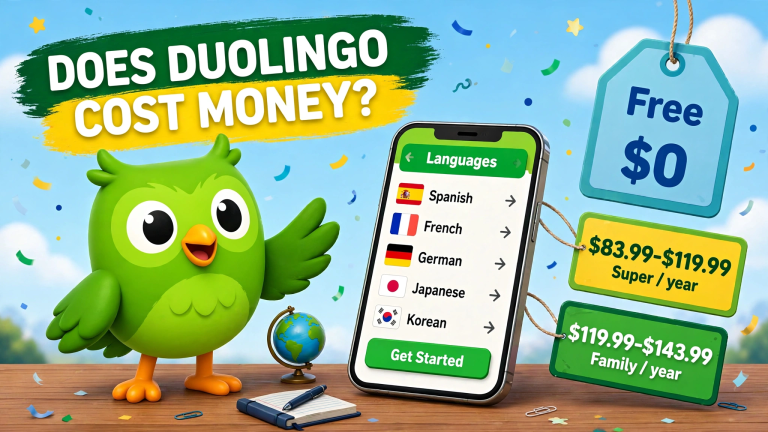
| Super | 12.99 to 13.99 dollars a month, or 83.99 to 119.99 dollars a year | No ads, unlimited energy and hearts, personalised practice, offline lessons |
| Super Family | 119.99 to 143.99 dollars a year for up to 6 accounts | All Super benefits for six people |
| Max | 29.99 dollars a month when it was sold | No longer sold — see the box below |
Max is gone — you cannot buy it anymore. On 3 November 2026, Duolingo announced in its Q3 2026 shareholder letter that it will sunset Duolingo Max and stop selling new Max subscriptions. Video Call got so cheap to run that Duolingo no longer needs a separate top tier for it. It is now rolling out to Super subscribers. Whether Roleplay will also come to Super is unconfirmed. If an article still tells you to buy Max, it was written before November 2026 and it is out of date. See our guides on what Duolingo Max was and the Max review.
Is Super worth paying for?
Super is worth paying for in one situation: when the free plan stops you from practising. If you hit the energy limit after two or three lessons on your phone, and ads break your focus, Super removes both problems for about 13 dollars a month. Our full breakdown of whether Super is worth it reaches the same conclusion: it is a convenience purchase, not a learning purchase. The lessons are the same on free and on Super. Use the free version for two weeks. If you run out of energy every day, Super is worth it for you. If you finish your daily goal first, or you practise on the web, where there is no energy limit, keep your money. Check the free tier first.
Is Duolingo a Scam?
No. Duolingo is a real, publicly traded company, listed on NASDAQ under the ticker DUOL, founded in 2011 and based in Pittsburgh. A scam company does not publish quarterly shareholder letters with the US Securities and Exchange Commission. The free version is genuinely free, the paid plans deliver what they advertise, and you can cancel a subscription.
Why do so many people ask? Three real reasons. First, billing. The most common complaints on Trustpilot are about subscriptions, not teaching: automatic renewal charges people did not expect, and refunds that are hard to get. That is a customer service problem, but it does not make the app a scam. Second, third-party scams that use Duolingo’s name. Gem generators, free Super scripts, and XP hacks are scams, and they can get your account banned. Our guide to cheats and tricks that can get your account banned explains which shortcuts are safe and which ones will cost you your streak. Never enter your Duolingo password on any site that is not Duolingo itself. Third, the energy system feels like a trick to long-time free users, because lessons that used to be unlimited now stop after a few. That is a business choice you are allowed to dislike, but selling convenience inside a free app is a business model, not a scam.
What Reddit Says
Reddit is where the most honest Duolingo opinions live, because nobody there is selling you anything. On the critical side, one widely shared post, “Duolingo became so bad, I wish there was an open alternative”, complains about the decline of the app, restrictive monetisation, and removed features. Another, “Why I wouldn’t recommend Duolingo”, argues that the app cares more about engagement than learning. The energy system drew the loudest anger: one post asking “So Now We’re Punished for Using the App?” collected around 3,000 upvotes. The most repeated criticism is about gamification: a 500-day streak can be protected with the easiest lesson while learning almost nothing.
But the positive side is just as real. The most quoted praise is simple: “It’s the only app that actually got me to practice every single day.” Refreshers who come back after years say the same thing: it is good for vocabulary and daily exposure, even if it is not enough on its own. In June 2026, Duolingo’s Streak Revival event brought back 15.4 million lapsed learners. Treat the complaints as a warning about the traps, not as a verdict on the app.
Should I Still Use Duolingo?
This question is for people who already use Duolingo and wonder whether to keep going. The answer depends on your goal, not on the app.
| Your situation | Verdict |
|---|---|
| Complete beginner, just starting out | Yes — this is where Duolingo is best |
| Learning for a trip, a few weeks away | Yes, for travel basics and useful phrases |
| Intermediate, past A2 or B1, feeling stuck | Keep it, but add real reading, listening and speaking |
| Serious learner aiming for fluency | Use it as a warm-up only |
| On a budget, using the free plan | Yes, especially on the web, with no energy limit |
| Paying for Super but rarely opening the app | Cancel it — it only helps if you practise |
One more thing matters: your language. Spanish and French go furthest in Duolingo, up to B2 level, so they are worth the longest stay. Japanese and Korean are thinner on grammar, so you will need a grammar source sooner. Smaller courses vary even more, so check how far your course goes before you commit months to it.
How to Get the Most Out of Duolingo
If you decide Duolingo is worth it for you, these six habits will make it worth far more. First, practise on the web when you can: no energy limit. Second, say every sentence out loud, even when the app does not ask. Speaking turns tapping into real practice. Third, treat the streak as a floor, not a goal. Ten XP a day keeps the habit alive. Fourth, use Stories, DuoRadio, and the Practice Hub, free for everyone since February 2026. Fifth, learn the grammar somewhere else: a short grammar guide, even one page a week, explains the rules Duolingo only shows by example. And sixth, add a second source once you pass A1: a graded reader, a podcast, or a weekly conversation. If Duolingo stops being your only source, it becomes a much better source. See our list of the best Duolingo alternatives, which work as companions as well as replacements.
Frequently Asked Questions
Is Duolingo worth it?
Yes, for beginners and for building a daily habit. No, as your only route to fluency. Super is only worth it if ads or the energy limit stop you.
Can you become fluent with Duolingo alone?
No. Duolingo teaches vocabulary, basic sentences, and beginner reading and listening, but not real conversation or deep grammar. It works well up to about A2 or B1 level. Our guide on can Duolingo make you fluent explains the limits in detail.
Is the free version of Duolingo enough?
For most learners, yes. The free version includes the full course content, and the web version has no energy limit. On a phone, free users get 25 energy units and usually manage two or three lessons in a row.
Is Duolingo actually useful?
Yes, for daily practice, vocabulary, and beginner basics. It is less useful as an advanced tool, because it does not teach real conversation or deep grammar.
Is Duolingo worth paying for?
Only if the free plan gets in your way. Super costs 12.99 to 13.99 dollars a month, or 83.99 to 119.99 dollars a year, and it removes ads and the energy limit. The lessons are the same either way.
Is Duolingo good for speaking?
Not on its own. Duolingo has speaking exercises where you repeat sentences, but it does not teach you to hold a conversation. Video Call, rolling out to Super subscribers, helps, but it is not a replacement for real conversation.
The Bottom Line
Is Duolingo worth it anymore? Yes, for what it has always been best at: starting a language for free and building a daily habit. The free version is still the best free starting point, and 2026 made it better, with free answer explanations, longer courses up to B2, and a free Practice Hub. It is not worth it as your only teacher, it is not worth paying for unless the limits stop you, and Max is gone.
The honest way to use Duolingo in 2026 is simple. Start free, practise a little every day, say the sentences out loud, and add a second source once you pass the beginner level. If the energy limit or the ads annoy you, try the web version before you pay. Judge Duolingo by what you learn, not by the number on the screen.