
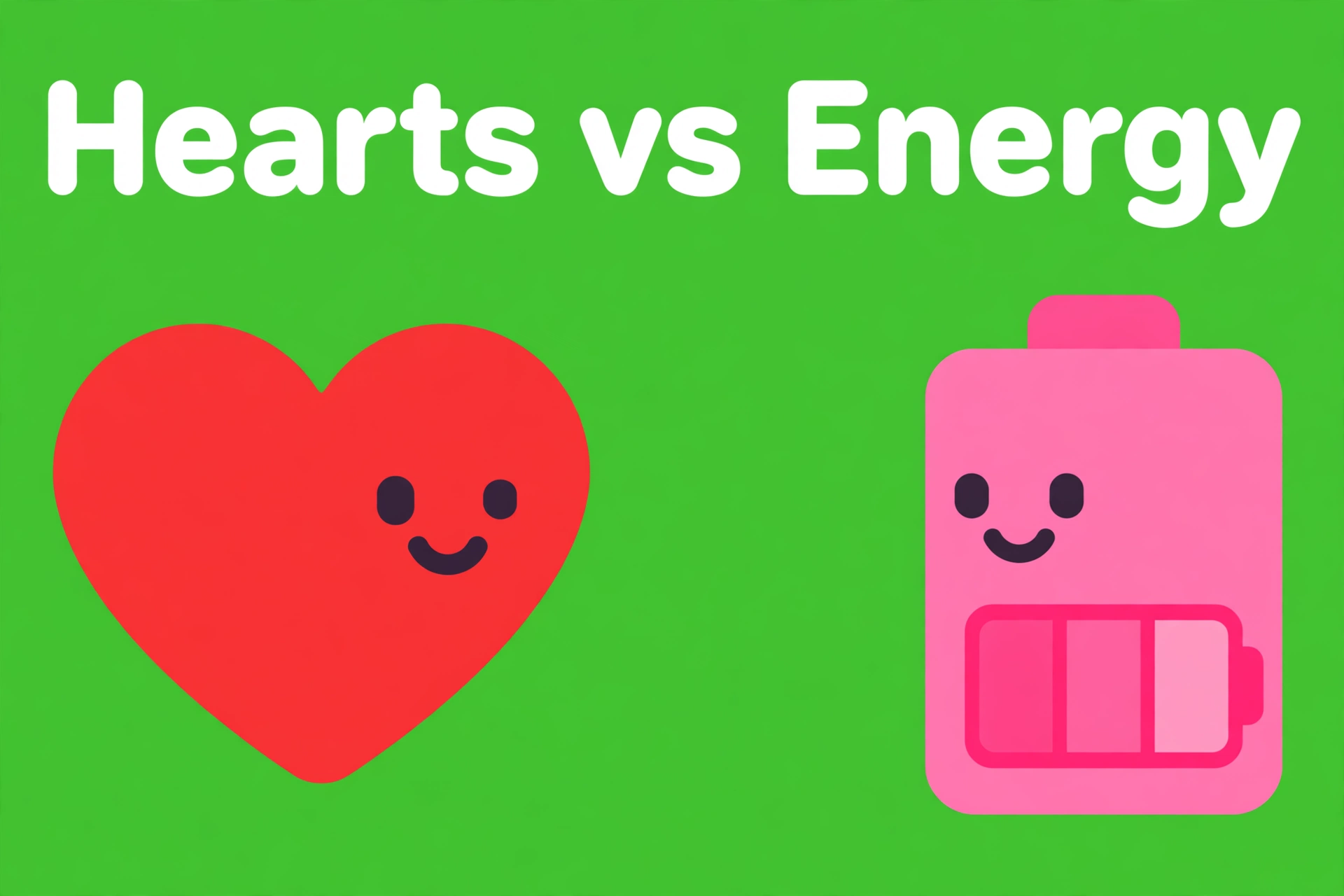
Duolingo Energy is better than Hearts for beginners and casual learners, because a mistake no longer ends your lesson halfway through. Hearts was better for accurate and heavy free learners, because only mistakes cost you anything — a careful learner could study for hours without hitting a limit. Neither system is free and unlimited: both decide how much you can learn before you have to wait, watch an ad, or spend gems. The desktop website is the one place where nothing has changed: it still uses Hearts, with no real daily limit.
This guide compares the two systems side by side: how each one works, what mistakes and refills cost, which one is better for your kind of learning, and what real learners think. For the deep guide to Energy itself, read the full Energy guide.
Table of Contents
- Energy vs Hearts: The Short Answer
- What Are Hearts in Duolingo?
- What Is Duolingo Energy?
- Energy vs Hearts Side by Side
- Does Duolingo Still Use Hearts in 2026?
- Why Did Duolingo Replace Hearts With Energy?
- Do Mistakes Still Cost You? Energy vs Hearts on Errors
- Hearts Refill vs Energy Refill: What It Costs in Gems
- How to Refill for Free (Both Systems)
- Which Is Better — Hearts or Energy?
- What Learners Actually Think
- Super Duolingo: Unlimited Hearts or Unlimited Energy?
- Frequently Asked Questions
Key Takeaways
- Energy is better for beginners — a mistake no longer cuts your lesson short.
- Hearts was better for accurate, heavy free learners — only mistakes cost, so a careful learner could do many lessons a day.
- A mistake costs about 1 extra Energy on top of the 1 unit per exercise — Duolingo never published exact numbers.
- A full Energy refill costs about 600–750 gems on iPhone and 350 gems on Android; a heart refill costs 350 gems in the Shop.
- Duolingo still uses Hearts on the desktop website — the only free way to study without an Energy limit.
Energy vs Hearts: The Short Answer
If you are just starting a language, Energy is better. You make a lot of mistakes, and under Hearts those mistakes could end a lesson before you had learned anything — Duolingo’s own data says beginners were twice as likely to run out of hearts mid-lesson. Under Energy, a mistake costs a little extra, but you can keep going and finish the lesson.
If you are an accurate learner who studies a lot every day without paying, Hearts was better. A careful learner almost never lost a heart, so there was no real daily limit. Under Energy, every exercise costs you, right or wrong, so even a perfect learner runs out after about two or three lessons.
For Super subscribers, it does not matter much: Super gives unlimited Energy on mobile and unlimited Hearts where Hearts still exists. For everyone else, neither system is better in every way — it depends on how you learn, how often you make mistakes, and how much you study.
What Are Hearts in Duolingo?
Hearts are Duolingo’s old “lives” system: you start each lesson with 5 hearts, every mistake costs 1 heart, and at 0 hearts the lesson ends. In the Legendary Challenge you only get 3 hearts.
The system was first called “health”, was renamed Hearts in May 2019, and came to the web version in September 2023.
Duolingo had hearts to pace your learning and reward accuracy: mistakes had a cost, so you slowed down and thought. And the system felt fair, because you could earn hearts back — about 1 heart every 5 hours, 1 heart per finished practice lesson, and 1 heart per ad. That earn-back is what many long-time learners miss most: under Hearts, extra practice refilled your hearts as you learned.
What Is Duolingo Energy?
Energy is the pink battery bar that replaced Hearts on the mobile apps — Duolingo’s blog post is titled “Why Duolingo Switched From Hearts to a Battery”. A full bar holds about 25 units, a community-measured number Duolingo never published.
Every exercise costs 1 unit, right or wrong. A mistake costs about 1 extra unit on top of that, based on the launch reporting (full detail in the mistakes section below). So even a perfect lesson is not free.
The system gives some Energy back. Every 5 correct answers in a row triggers a lightning animation worth 1 to 5 Energy, reward chests give you 5 Energy if your bar is below 22, and perfect lessons and adding a friend give bonuses too. Reviewing your mistakes at the end of a lesson costs no Energy.
The bar refills on its own at about 1 unit per hour, so a full bar takes about a day (some learners report up to 18 hours), and you start each day with a full battery. Energy is only on the mobile apps — the desktop website never got it and still uses Hearts.
Energy vs Hearts Side by Side
Here is the full comparison. Figures marked “about” are community-measured — Duolingo has never published them.
| Hearts (old, still on web) | Energy (current, mobile) | |
|---|---|---|
| Full amount | 5 hearts | About 25 units |
| What it costs | 1 heart per mistake only | 1 unit per exercise, plus about 1 extra per mistake |
| Correct answers | No effect, no earn-back | Streaks earn Energy back (1–5 per 5 in a row) |
| Mistake review at lesson end | Not a separate feature | Free, no Energy |
| Earn back by practising | Yes — 1 heart per finished practice lesson | No practice-to-earn equivalent |
| Natural refill | About 1 heart per 5 hours | About 1 unit per hour; full bar in about a day |
| Rewarded ad | Plus 1 heart | Plus 3 to 5 Energy |
| Gem refill (full) | 350 gems in the Shop, 450 gems mid-lesson | 350 gems on Android; about 600–750 gems on iPhone (check your own app) |
| Daily cap for a careful learner | None in practice — only mistakes cost | About 2–3 lessons a day (community reports) |
| Web (duolingo.com) | Hearts, no real daily cap | Still Hearts — Energy never came to web |
| Super | Unlimited hearts | Unlimited Energy |
| Can you switch back? | — | No opt-out, no toggle |
A worked example makes it concrete — simple arithmetic, not a Duolingo-published fact. A 10-question lesson costs about 10 Energy with no mistakes, or about 11 to 12 with a couple of mistakes at launch rates, so a full 25-unit bar covers roughly 2 to 3 normal lessons before streak bonuses. Under Hearts, the same careful learner could do many more, because only mistakes cost hearts.
Does Duolingo Still Use Hearts in 2026?
Yes — in three places. First, the desktop website: open duolingo.com on a computer and you still get Hearts, with no real daily cap. Second, a minority of mobile accounts still show Hearts. Third, Schools classrooms give students unlimited hearts — but Schools is closing, and the service ends on July 31, 2027.
How do you tell which system you have? Open the app and look at the top of the screen: a pink battery bar means Energy, red hearts mean Hearts. Do not guess from your phone type — the same account could show Hearts on Android and Energy on iOS, and the two did not sync.
There is no way to switch an Energy account back to Hearts — no toggle, no opt-out. The only way to use Hearts today is the desktop website, or a mobile account that still has Hearts. That missing opt-out is the most repeated complaint after the daily cap itself.
Why Did Duolingo Replace Hearts With Energy?
Duolingo’s official reason is about beginners. In its blog post from July 3, 2025, the company wrote that with Hearts, each mistake cost 1 heart for free learners — not the most effective way to support learning: beginners were still figuring things out and were twice as likely to run out of hearts mid-lesson — “really discouraging, especially since mistakes are a natural part of learning”. The same post says Energy is designed for a more balanced experience, and Duolingo’s data shows it helps more learners complete lessons.
Moses Wayne, a senior staff engineer, told The Verge the goal is to motivate you “to focus on things you’re getting right rather than penalizing for the things that you’re making mistakes on.”
Testing began in spring 2025 with a small group, and The Verge first reported the switch on May 12, 2025 — iOS first, Android later. Duolingo published its blog post, “Why Duolingo Switched From Hearts to a Battery”, on July 3, 2025, when Energy was still only available to a small number of users. The rollout widened through late 2025, and by May 2026 Hearts was partly discontinued. By late 2026, most mobile accounts showed the battery while the web still used Hearts. The blog also says Energy “is being actively tested and will improve over time” — which is why exact numbers were never published.
Do Mistakes Still Cost You? Energy vs Hearts on Errors
Under Hearts, the answer was simple: yes, a mistake costs 1 heart, and at 0 hearts your lesson ends. Under Energy, different guides say different things — so it is worth getting it right.
At launch, the reporting was clear: The Verge, on May 12, 2025, said each exercise costs one unit and a mistake costs one more, and the Duolingo Wiki says the same — 1 unit lost for a correct answer, or 1 to 2 for an incorrect one. So the honest statement is this: a mistake costs about 1 extra Energy.
Why “about”? Duolingo itself has never published exact Energy numbers — not in its blog post, and not anywhere else — and different test groups may see different amounts. Treat the launch figures as the best available evidence, not a promise about your own app. You may also see guides that say mistakes cost nothing under Energy, but that does not match the launch reporting. The simplest check is your own app: watch the battery bar right after a wrong answer.
Reviewing your mistakes at the end of a lesson costs no Energy. The system charges you for the mistake, but not for going back and learning from it.
Hearts Refill vs Energy Refill: What It Costs in Gems
Hearts are simple. A full heart refill costs 350 gems from the Shop, or 450 gems mid-lesson — the current figures from our heart refill costs guide. Older quoted prices, such as 650 gems, are outdated.
Energy is messier. On Android, a full refill costs 350 gems, and every source agrees on that. On iPhone, the reported price is about 600–750 gems — it varies by account, so check your own app before you trust any single number. Some of our recent articles say 600, and other sources, including the Duolingo Wiki, say 750. The price may have dropped during 2026, or different test groups may see different prices — either way, do not treat one figure as settled fact. To work out what your own study day costs, try the Hearts and Energy Planner.
A heart refill is cheap because a careful learner rarely needs one. An Energy refill is what a heavy free learner needs almost every day — which is why the iPhone price matters so much to the people who complain about Energy loudest. At 600 gems or more per refill, a free learner can spend weeks of saved gems in a few days.
How to Refill for Free (Both Systems)
On Energy, you earn Energy back by getting answers right in a row: every 5 correct answers triggers a bonus of 1 to 5 Energy, rewarded ads give you 3 to 5 Energy, and reward chests give you 5 Energy when your bar is below 22. Your bar also refills on its own, about 1 unit per hour, and starts each day full. What you cannot do is earn Energy back by practising — there is no practice-to-earn equivalent on Energy accounts. That is a real loss compared with Hearts, and it is the subject of our guide on why practice to earn hearts no longer works.
On Hearts, where it is still available, you earn hearts back by finishing a practice lesson on old material, watching an ad for 1 heart, or waiting about 5 hours per heart. The universal workaround works for both systems: switch to duolingo.com on a computer, where Hearts has no real daily cap. For the full list, see our free-methods guide.
Which Is Better — Hearts or Energy?
There is a winner for each kind of learner.
Beginners: Energy wins. When you are starting a new language, you make a lot of mistakes — that is normal. Under Hearts, those mistakes could end your lesson before you had learned anything. Under Energy, a mistake costs a little extra, but you can keep going and finish the lesson.
Accurate intermediate learners: Hearts was better on cost, but Energy has a real upside. If you rarely make mistakes, Hearts barely cost you anything, while Energy charges you for every exercise. But streak bonuses reward accuracy: long runs of correct answers earn Energy back, so a very accurate learner stretches the bar further than a careless one.
Heavy free learners: Hearts was better, clearly. If you study for hours every day without paying, Hearts let you do it — only mistakes slowed you down. Energy caps you at about 2 to 3 lessons a day, and then you wait, watch ads, or spend gems. One Spanish learner put it plainly: three perfect lessons with zero mistakes, then forced to wait 18 hours, pay with gems saved over years, or watch ads.
Casual learners: Energy wins. One or two short lessons a day rarely touches the bar, which refills by tomorrow, while Hearts could still end a session on a bad day.
So the verdict stands: Energy is better for beginners and casual learners, Hearts was better for accurate and heavy free learners. Duolingo traded a system that was kind to careful, heavy learners for one that is kind to new and casual ones.
What Learners Actually Think
Learners are divided, but the loudest voices are unhappy. A Reddit post asking “So now we’re punished for using the app?” gathered around 3,000 upvotes, and one learner with a 700-day streak quit over the change. A poll of more than 11,000 learners found about half dislike Energy. Free learners report only 3 to 4 lessons a day, and 6 to 7 takes 4 to 5 ads. One learner said 600 gems for a refill “would take me weeks, if not months, to earn”.
The most repeated grievance after the cap itself is that there is no opt-out. Learners feel like unwilling participants in a test, and some are leaving for less gamified apps, or doing lessons on the desktop website instead.
It is not all one-sided. Some learners prefer Energy, especially beginners who no longer get cut off mid-lesson. A lawsuit filed in October 2026 alleges executives pushed Energy as a way to make money while telling investors they put user growth first — allegations, not established facts. One opinion piece on the site argues the heart system should go entirely; this article’s verdict is different: the problem is not that either system exists, it is that each one is kind to a different kind of learner.
Super Duolingo: Unlimited Hearts or Unlimited Energy?
Super gives you unlimited on both systems: unlimited Energy on mobile, and unlimited Hearts on the web and on mobile accounts that still use Hearts. If you pay for Super, the question stops mattering — your bar never runs out.
Super costs about $12.99 to $13.99 a month, or about $83.99 to $119.99 a year in the US. Max is being phased out: Duolingo announced in November 2026 that it will stop selling new Max subscriptions, and Video Call is moving to Super.
Two details are worth knowing. First, unlike Hearts-era Super, unlimited Energy reportedly cannot be turned off by the user. Second, Schools classrooms give students unlimited hearts until the program closes on July 31, 2027. For more, see our guide to the free plan limits.
Frequently Asked Questions
Did Duolingo change hearts to energy?
Yes. Testing began in spring 2025, the change was first reported on May 12, 2025, and Duolingo published its own explanation on July 3, 2025. The rollout widened through late 2025, and by May 2026 Hearts was partly discontinued on mobile. There was no further switch in 2026 — the desktop website still uses Hearts.
Can I get hearts back or switch back to hearts?
There is no toggle and no opt-out, so you cannot switch an Energy account back to Hearts. The only way to use Hearts today is the desktop website at duolingo.com, or a mobile account that still has Hearts.
Why does Duolingo have hearts?
Hearts were a lives system that paced your learning and rewarded accuracy. Each mistake cost 1 heart, and at 0 hearts the lesson ended. You could earn hearts back by practising old lessons, watching ads, or waiting. The idea was that mistakes should cost you, so you slow down and think.
Why does Duolingo have energy?
Duolingo replaced Hearts because beginners were twice as likely to run out of hearts mid-lesson — discouraging when mistakes are a natural part of learning. Energy charges every exercise a small amount instead, so a mistake no longer ends the lesson, and correct-answer streaks earn Energy back.
What are batteries in Duolingo?
The battery is Energy itself. Duolingo’s blog post is titled “Why Duolingo Switched From Hearts to a Battery”, and the pink battery bar at the top of the mobile app is what replaced the red hearts. When learners talk about “batteries” in Duolingo, they mean the Energy bar.





One Comment