
Last updated: November 2026
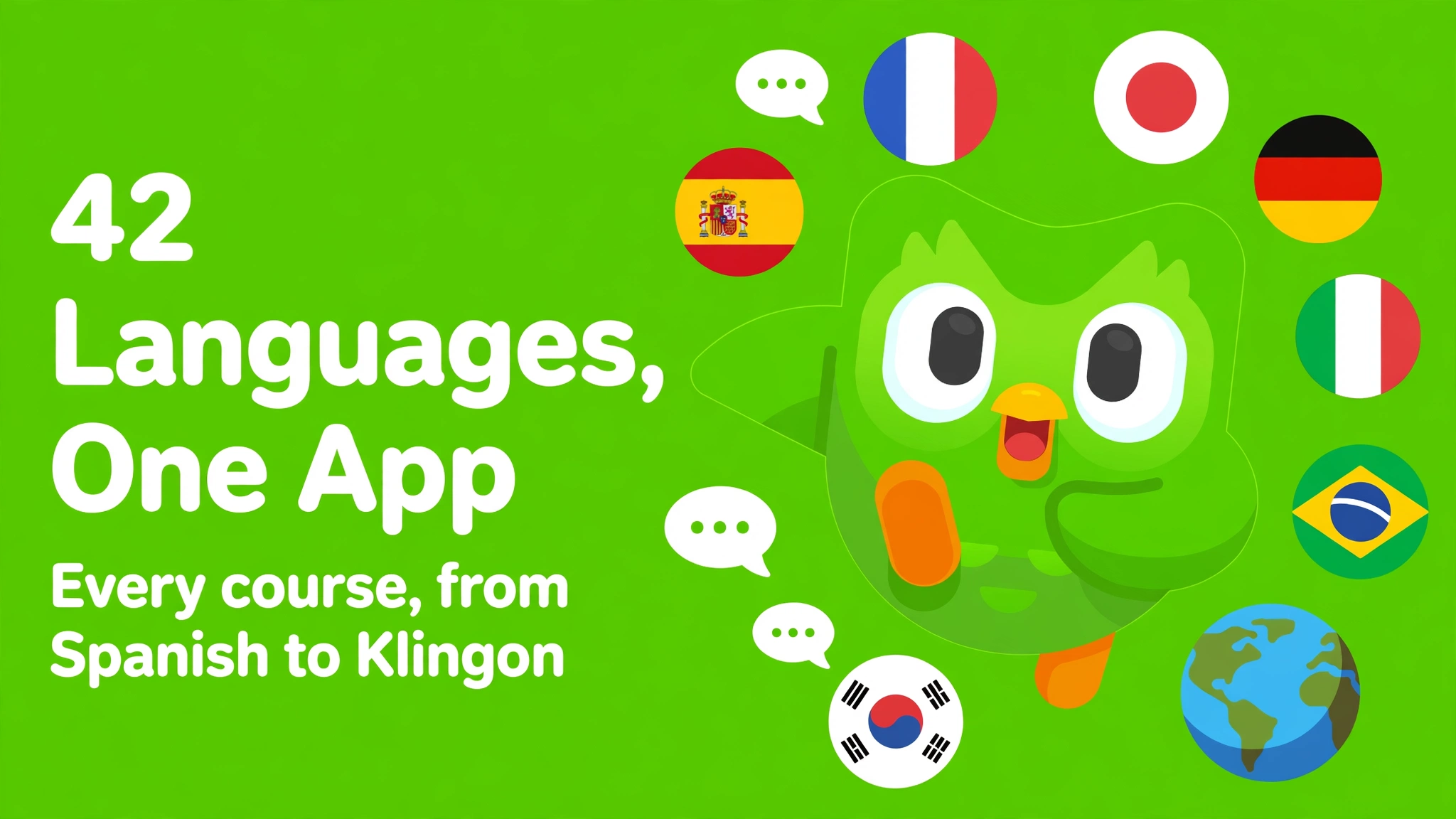
Duolingo is the most downloaded education app in the world, and its language catalogue is the reason most people open it. The app teaches 42 languages across more than 250 courses, from Spanish and French to Hawaiian, Navajo, Klingon, and High Valyrian. Every course is free, and the app’s 140.6 million monthly users and 58.7 million daily users make it the biggest language learning platform on earth.
But the catalogue is uneven. Nine courses now teach through upper-intermediate B2 level. Others are short introductions of a few dozen units. This guide walks through everything Duolingo teaches, how deep each course goes, and how to use the catalogue well. For the straight count and the full list, see our list of all Duolingo languages.
What Is Duolingo?
Duolingo launched in 2011 as a free language learning app built around short, game-like lessons. You earn experience points (XP), keep a daily streak, compete in weekly leagues, and work through a single learning path of sections, units, and lessons. Lessons cover reading, writing, listening, and speaking through translation, matching, listening, and speaking exercises.
The app is free with ads. On most mobile accounts, free study is limited by Energy: you start each day with 25 Energy, and every exercise uses some of it. On the web, study is unlimited, and the old Hearts system still applies there. Super, the paid plan, costs about $12.99 a month or about $83.99 a year in the US, and removes ads and the Energy limit. Super Family is about $119.99 a year for up to six people. Super does not unlock extra language lessons: every course, including all B2 content, is free.
How Many Languages Does Duolingo Teach?
Duolingo teaches 42 languages in total, with 39 available to English speakers. Counting every pairing of a language you learn with a language you learn from, there are more than 250 courses. In April 2025 Duolingo launched 148 new courses built with generative AI, the largest expansion in its history, but that expansion added course pairings, not new languages. No new language joined the roster.
The catalogue has been stable for years. Duolingo has not announced any new languages, and its recent work has gone into deepening the courses it already has rather than adding more. Xhosa, once listed as in early development, has not launched, and Duolingo has given no date for it.
The Nine Deep Courses: Up to B2
The most important change to the catalogue came on 22 April 2026, when Duolingo announced that nine of its most popular courses now teach advanced content through B2 on the CEFR scale, a Duolingo Score of 129. Before that, most learners in those courses could only reach A2, a Score of 59. The advanced content is free for most learners.
| Language | Highest Level | Notes |
|---|---|---|
| English | B2 (Score 129) | Taught from more than 25 base languages; the most studied language in 154 countries |
| Spanish | B2 (Score 129) | The longest course, about 991 units in 8 sections; about 42 million learners |
| French | B2 (Score 129) | About 994 units and about 1,147 Stories; rebuilt in 2025 and 2026 |
| German | B2 (Score 129) | One of the oldest and most complete courses |
| Italian | B2 (Score 129) | A long, well-supported course |
| Portuguese | B2 (Score 129) | Brazilian Portuguese |
| Japanese | B2 (Score 129) | 8 sections, about 1,030 units; hiragana, katakana, and kanji |
| Korean | B2 (Score 129) | The fastest-growing language on Duolingo, up 12 percent in the 2025 Language Report |
| Chinese (Mandarin) | B2 (Score 129) | Grew 9 percent in the 2025 Language Report |
These nine courses also have the most extras: Advanced Stories, DuoRadio listening episodes, and Explain My Answer, which is free for all learners in these courses. No Duolingo course teaches past B2. There is no C1 or C2 content anywhere on the platform, and the Duolingo Score is a measure of how much of a course you have covered, not a certificate.
For detailed reviews of two of the biggest courses, see our Duolingo Japanese review and our Duolingo French review. For Spanish, see our guide to how many sections the Spanish course has.
The Full Catalogue by Region
European Languages
European languages make up most of the catalogue. The Romance languages are Spanish, French, Italian, Portuguese, and Romanian, plus Latin. The Germanic languages are German, Dutch, Swedish, Danish, and Norwegian. The Slavic languages are Russian, Polish, Ukrainian, and Czech. Greek, Finnish, Hungarian, Irish, Welsh, Scottish Gaelic, and Turkish complete the European list.
Depth varies widely here. Spanish, French, German, Italian, and Portuguese reach B2. The rest are shorter. Norwegian has about 165 units, Czech about 63, and Finnish about 29. These shorter courses are good introductions, but they will not take you to an intermediate level.
Asian Languages
Duolingo teaches Japanese, Korean, Chinese (Mandarin), Hindi, Vietnamese, Indonesian, Arabic, and Hebrew. Japanese, Korean, and Chinese are among the nine B2 courses. The others are shorter: Arabic has about 36 units, for example. Hindi is one of the most learned languages on the platform, but its course is still much shorter than the big nine.
Some major Asian languages are missing. Tagalog, Thai, Bengali, Urdu, Tamil, Telugu, and Persian are not offered, and Duolingo has not announced plans to add them. Cantonese exists, but only for Mandarin Chinese speakers, not for English speakers.
African Languages, Languages of the Americas, and the Pacific
African languages are the least represented part of the catalogue: Swahili, with about 53 units, and Zulu, with about 19. From the Americas, Duolingo teaches Haitian Creole and Navajo. Navajo is the shortest course on the platform, at about 7 to 13 units. From the Pacific, there is Hawaiian, with about 30 to 50 units.
These courses matter beyond their size. Hawaiian and Navajo are languages fighting for revival, and Duolingo is one of the few places a beginner can start learning them for free. But learners should know the limits: a course of a dozen units is an introduction, not a path to fluency.
Fictional Languages and Constructed Languages
Duolingo teaches two fictional languages and one constructed language. Klingon, from Star Trek, and High Valyrian, from Game of Thrones and House of the Dragon, are real, complete courses, built with the people who created the languages. Esperanto, the constructed language built in the 19th century as a universal second language, takes learners to about A2 level. Yiddish, a Germanic language with Hebrew script, is also sometimes grouped here, though it is a natural language, not a constructed one.
Learning from a Language Other Than English
Duolingo’s courses are not only for English speakers. English is the most taught language on the platform, with courses for speakers of more than 25 languages, including Spanish, French, German, Arabic, Chinese, Hindi, Japanese, Korean, Portuguese, Russian, Turkish, Ukrainian, and Vietnamese. The quality and depth of these English courses vary by base language.
A few language pairs exist only from a non-English base. Catalan and Guarani are available for Spanish speakers. Cantonese is available for Mandarin Chinese speakers. Swedish is available for Arabic speakers. If you speak one of these languages, it is worth checking the course list in your own language, because you may find a course that English speakers cannot see.
Beyond Languages: Math, Music, and Chess
Duolingo is no longer only a language app. It also offers courses in Math, Music, and Chess inside the same app, using the same short-lesson, gamified format. These are separate from the language catalogue and much smaller than the language courses, but they are part of the same free app. Music teaches reading music and playing simple tunes, Math teaches arithmetic and logic, and Chess teaches the rules and basic strategy.
How Good Is Duolingo for Learning a Language?
Duolingo is very good at the things it is designed for, and honest about its limits if you know where to look.
Strengths
- It is free, and the full course is free. Every language, including all B2 content, is available without paying.
- It builds a daily habit. Short lessons, streaks, leagues, and reminders keep learners coming back, and daily practice is what actually moves a language forward.
- It covers a huge range of languages. 42 languages, including endangered and fictional ones, is more than any other free app offers.
- The big courses are genuinely deep now. Since April 2026, nine courses teach through B2, with Stories, DuoRadio, and free Explain My Answer.
- Practice Hub is free for everyone. Since 18 February 2026, all learners can review their words and mistakes, not just Super subscribers.
Limitations
- It will not make you fluent on its own. Duolingo teaches reading, writing, listening, and some speaking, but fluency needs real conversation with people, listening at natural speed, and reading and writing outside the app.
- Grammar explanations are thin. The app mostly teaches by example. For hard grammar, such as Japanese particles or French verb forms, most learners need a book or a dedicated grammar resource.
- Speaking practice is limited. There are speaking exercises and an AI Video Call feature, but no real conversation. Video Call is moving to all Super subscribers by the end of 2026.
- Course depth varies enormously. A B2 course and a 13-unit course are both listed the same way in the app. Check the section count before you commit months to a language.
- Some sentences sound unnatural. Translations do not always match how native speakers talk. If a sentence looks odd, check it elsewhere.
Duolingo for Schools and the English Test
Two parts of Duolingo often confuse new learners, so here is the current position on both.
Duolingo for Schools is closing on 31 July 2027. Teachers who use it should plan to move their classes before that date. Duolingo has not announced a replacement classroom product.
The Duolingo English Test (DET) is a separate product: an online English proficiency test that costs $70, with a two-test bundle at $118 and Fast Results at $40. It is accepted by thousands of universities worldwide, but it is generally not accepted for visa applications. If you need an English test for a visa, check the visa rules first, because the DET usually does not meet them. Duolingo Max, the higher subscription tier that once included AI features, is being sunset in November 2026 and should not be bought or counted on.
How to Get Started and Make the Most of It
- Pick your language for a real reason. Travel, family, work, or genuine interest will keep you going longer than novelty.
- Check the depth before you commit. If you want to reach an intermediate level, one of the nine B2 courses is the safest choice. A short course is fine for a taster.
- Take the placement test if you already know some of the language. It puts you further along the path, but it cannot be undone, so take it when you are fresh.
- Do a little every day. Streaks work because daily practice works. Even 10 minutes a day beats an hour once a week.
- Use the extras. Stories, DuoRadio, and the Practice Hub are free, and they train reading and listening far better than drills alone.
- Use Explain My Answer. It is free now in the big courses, and it is the closest thing Duolingo has to a grammar explanation.
- Supplement from the start. Add a grammar book, real listening such as shows and podcasts, and real conversation with native speakers. Duolingo is the daily core of a plan, not the whole plan.
Frequently Asked Questions
How many languages can you learn on Duolingo?
42 languages in total, with 39 available to English speakers. Duolingo’s own marketing rounds this to “40+ languages”.
What is the best language to learn on Duolingo?
There is no single best language. Spanish, French, German, Japanese, and Italian have the deepest courses, reaching B2. The best choice is the language you have a reason to learn and will stick with.
Can Duolingo make you fluent?
Not on its own. It can teach you through B2 in its nine biggest courses, which is a strong foundation, but fluency needs real conversation, listening, and reading outside the app.
Is Duolingo really free?
Yes. Every language course is free with ads. Super removes ads and the Energy limit on mobile, but it does not unlock extra lessons.
Does Duolingo teach Klingon?
Yes, Klingon from Star Trek and High Valyrian from Game of Thrones are both real Duolingo courses, along with the constructed language Esperanto.
What languages does Duolingo not have?
Many, including Tagalog, Thai, Bengali, Urdu, Tamil, Persian, and Maori. Duolingo has not announced any new languages.


2 Comments