
Last updated: November 2026
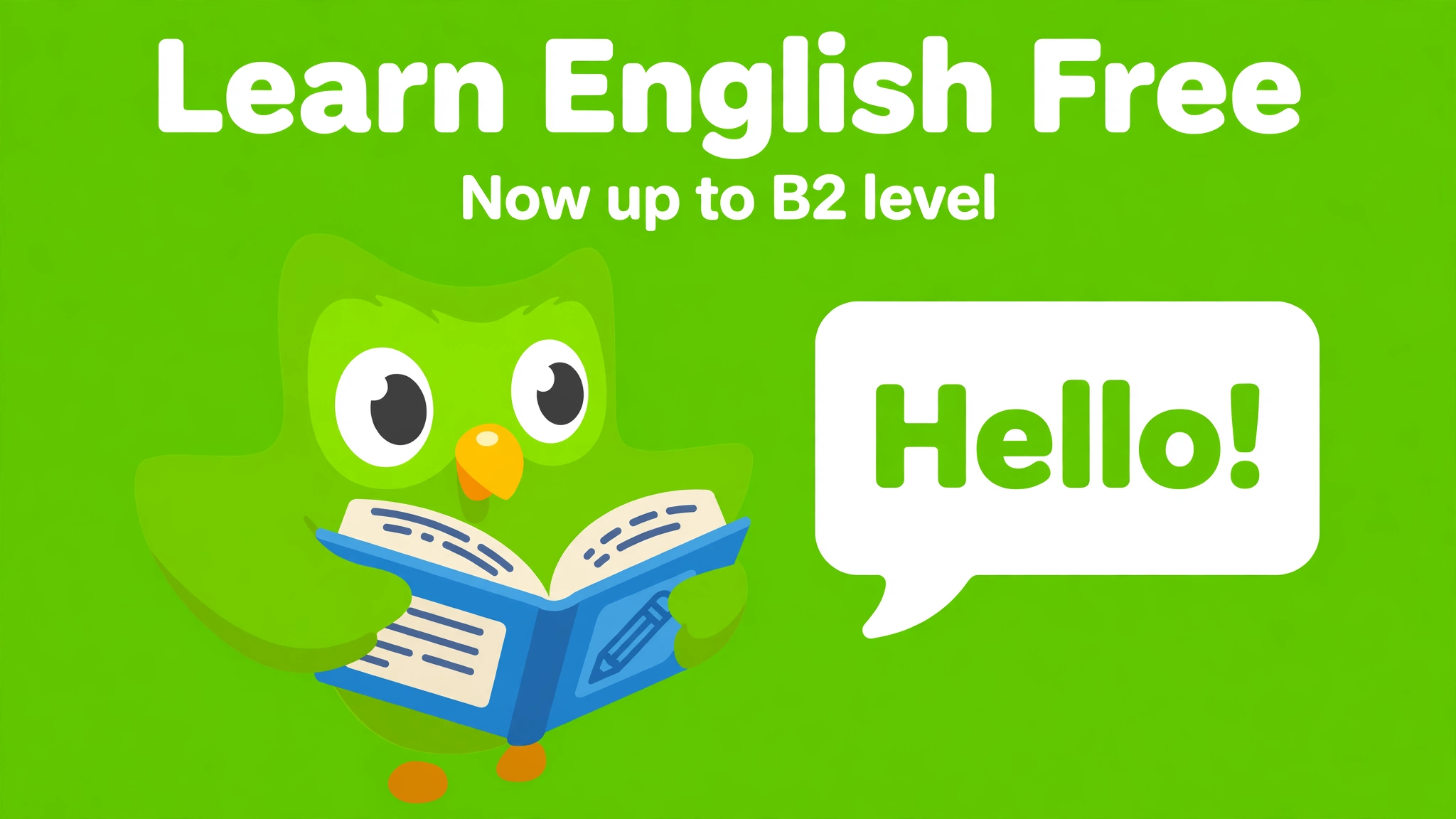
Yes, you can learn English on Duolingo. English is the most studied language on the app, and Duolingo offers English courses for speakers of many different first languages, all free. In April 2026, Duolingo extended its biggest courses, including English, to teach content through CEFR level B2, an upper-intermediate level. Before that change, most learners could only reach A2.
That is the honest short answer. The longer answer matters more: Duolingo can take you from zero to a solid intermediate level, but it will not make you fluent on its own. You still need real speaking and listening practice with people. This guide explains how far the English course goes, what it teaches well, where it stops, and how to get the most out of it.
How Duolingo Teaches English
Duolingo’s English course is built like a game. Short lessons, usually a few minutes each, teach vocabulary and grammar in small steps. You earn XP, keep a daily streak, and compete in Leagues with about 30 other learners. The course is divided into sections, then units, then lessons. Each section matches a level on the CEFR scale, the international standard that runs from A1 (beginner) to C2 (mastery).
Lessons mix several exercise types:
- Translation: translate sentences between English and your own language.
- Listening: hear a sentence and type what you heard, or pick the matching words.
- Speaking: repeat sentences aloud. The app checks your pronunciation with speech recognition.
- Multiple choice and fill in the blank: pick the right word or finish the sentence.
- Stories: short interactive dialogues with native-speaker audio, for reading and listening.
- DuoRadio: short audio episodes that train your ear for real spoken English.
The app adapts to you. If you get something wrong, it shows the same idea again later. If you already know English, you can take a placement test at the start and skip the beginner sections.
How Far Can You Go? English on Duolingo Reaches B2
On April 22, 2026, Duolingo announced that its nine biggest courses now teach advanced content through CEFR level B2, which it ties to a Duolingo Score of 129. English is one of the nine, along with Spanish, French, German, Italian, Portuguese, Japanese, Korean, and Chinese. Before that change, Duolingo says most learners in those courses could only reach A2, a Duolingo Score of 59.
| CEFR Level | Duolingo Score | What It Means in Plain Words |
|---|---|---|
| A1 | Up to about 30 | Introduce yourself, order food, understand very slow speech |
| A2 | 30 to 59 | Simple conversations about shopping, travel, and daily routines |
| B1 | 60 to 99 | Handle most travel situations, give opinions on familiar topics |
| B2 | 100 to 129 | Understand complex texts, argue a point, talk fluently on many topics |
Two things are important here. First, B2 is the ceiling. No Duolingo course teaches C1 or C2 content. Second, the level describes the course material, not you. Finishing B2 lessons does not prove you have B2 ability in every skill, and it is not a certificate. Your reading, listening, speaking, and writing can sit at different levels.
How long does it take? Duolingo’s own 2024 research report said learners took about 200 hours on average to reach the end of A2, over about 276 days. Reaching B2 takes far longer. Cambridge English guidelines put B2 at roughly 500 to 600 guided learning hours in total, which is about 33 to 39 months at 30 minutes a day. Your own time will vary with your first language, how much you study, and how much English you meet outside the app.
English Courses for Speakers of Other Languages
Duolingo does not have one English course. It has many, one for each language you learn from. Duolingo said in January 2023 that it had 24 English courses for speakers of different first languages. The biggest is English for Spanish speakers, which had more than 37 million learners at that time.
That matters, because the course you get depends on your first language. The most popular pairs, such as English for Spanish speakers, have the most content and the newest features. Smaller pairs may have less material. If your first language is Spanish, Portuguese, French, German, Italian, Japanese, Korean, or Chinese, you are learning from one of the nine biggest courses, and you get the full B2 path. Other courses may stop at a lower level, and Duolingo has not published where each one ends.
Whatever your first language, the course is free. Super, the paid plan at about $12.99 to $13.99 a month or about $83.99 to $119.99 a year in the US, adds extras such as no ads and offline lessons, but it does not change the English lessons themselves. The B2 content, including advanced Stories and DuoRadio episodes, is free for all learners.
What Duolingo English Does Well
- It is free and always available. You can start in minutes, on your phone or on the web, with no teacher and no timetable.
- It builds a daily habit. Streaks, XP, and leagues keep most learners coming back. A short lesson every day beats a long lesson once a month.
- It teaches vocabulary in context. New words appear inside sentences, not in bare lists, and the app repeats them until they stick.
- It covers reading and listening well. Stories and DuoRadio give you real English to read and hear, beyond single sentences.
- It explains mistakes. Explain My Answer, which became free for all learners on January 1, 2026, tells you why an answer was wrong instead of just marking it wrong.
- It has free review tools. The Practice Hub, free for all learners since February 18, 2026, lets you review words and grammar you have already met.
An early Duolingo-funded study, often quoted since 2012, found that 34 hours on Duolingo was roughly equal to a semester of university language classes. That study tested Spanish, not English, and it measured beginners, so treat it as a rough sign that the app works for starters, not as a promise for every learner.
Where Duolingo English Falls Short
Duolingo is honest about its own limits in a way its marketing is not always. Here is what the app does not do well:
- Free speaking practice is limited. You repeat sentences, but you rarely build your own sentences in a real conversation. Speaking to a person is a different skill from repeating a prompt.
- Writing is mostly fill in the blank. You do not write paragraphs, emails, or essays, so your writing stays behind your reading.
- There is no C1 or C2 content. If you need advanced English for university or a professional job, Duolingo alone will not get you there.
- It does not test you. Finishing the course gives you no certificate. Employers and universities will not accept a Duolingo Score as proof of English.
- Cultural context is thin. The app teaches sentences, not how people actually talk at work, in a job interview, or with friends.
The fair conclusion is the one Duolingo’s own researchers have stated: the app works best for beginners and lower-intermediate learners, and it works best as a daily habit plus other practice, not as your only resource.
Duolingo English vs the Duolingo English Test
Do not confuse the two. The English course is the free app that teaches you English. The Duolingo English Test (DET) is a separate paid exam that certifies your English level. It costs $70, or $118 for a two-test bundle, with a $40 Fast Results option. It is accepted by thousands of universities and institutions, but it is generally not accepted for visa applications.
Studying on the app builds the skills the test measures, but the app alone is not test preparation. If you need a DET score, use dedicated test practice as well, and check with your institution before you book.
How to Learn English on Duolingo: 7 Tips That Work
- Do a little every day. Set a small daily goal, such as 10 to 15 minutes, and protect your streak. Consistency matters more than long sessions.
- Take the placement test. If you already know some English, skipping the beginner sections saves weeks of easy lessons.
- Use Stories and DuoRadio, not just the path. The main path teaches sentences. Stories and DuoRadio teach you to follow real English.
- Say every speaking exercise out loud. Do not skip them or whisper. Your mouth needs the practice as much as your eyes do.
- Read Explain My Answer. When you get a question wrong, read why. That is where the grammar actually sinks in.
- Review in the Practice Hub. Use it to revisit words and mistakes instead of always pushing forward to new lessons.
- Add real English outside the app. Watch shows with English subtitles, read simple news, and talk with a language partner or tutor. This is the step that turns app English into real English.
Free vs Super for English Learners
| Feature | Free | Super |
|---|---|---|
| Full English course, including B2 content | Yes | Yes |
| Stories and DuoRadio | Yes | Yes |
| Explain My Answer | Yes, free since Jan 1, 2026 | Yes |
| Practice Hub | Yes, free since Feb 18, 2026 | Yes |
| Ads | Yes | No |
| Energy limits on mobile (25 points) | Yes | No, unlimited Energy |
| Offline lessons | Limited cached lessons only | Offline lessons included, but not the whole course |
The free plan teaches the same English as Super. Paying removes ads and limits, it does not unlock extra English. See our guide on how to download Duolingo lessons for what offline access really covers in 2026.
Frequently Asked Questions
Can you learn English on Duolingo for free?
Yes. The full English course, including the B2 content, Stories, DuoRadio, Explain My Answer, and the Practice Hub, is free. Super only removes ads and limits.
Can Duolingo make you fluent in English?
Not on its own. Duolingo’s English course teaches content through B2, which is upper-intermediate, not fluency. Real fluency also needs lots of listening to real speech and speaking with people, which the app can only partly provide.
What level of English can you reach on Duolingo?
Duolingo says its English course now teaches content through CEFR B2, a Duolingo Score of 129. Before April 2026, most learners could only reach A2. No course teaches C1 or C2 content, and finishing the course is not a certificate of B2 ability.
Is Duolingo good for learning English from Spanish?
Yes, it is one of the best pairs on the app. English for Spanish speakers is Duolingo’s biggest English course, with more than 37 million learners, and it has the full B2 path.
Does Duolingo prepare you for the Duolingo English Test?
Partly. Daily study builds reading, listening, and vocabulary, but the test also measures speaking and writing under time pressure. Use dedicated DET practice as well if you need a score.
Conclusion
You can learn English on Duolingo, and for most learners it is the best free place to start. The course is free, it now reaches B2 in its biggest courses, and its Stories, DuoRadio, and free review tools are genuinely useful. But treat it as a foundation, not a finish line. Pair it with real listening, real reading, and real conversations, and the English you build in the app will turn into English you can actually use.