
Last updated: November 2026
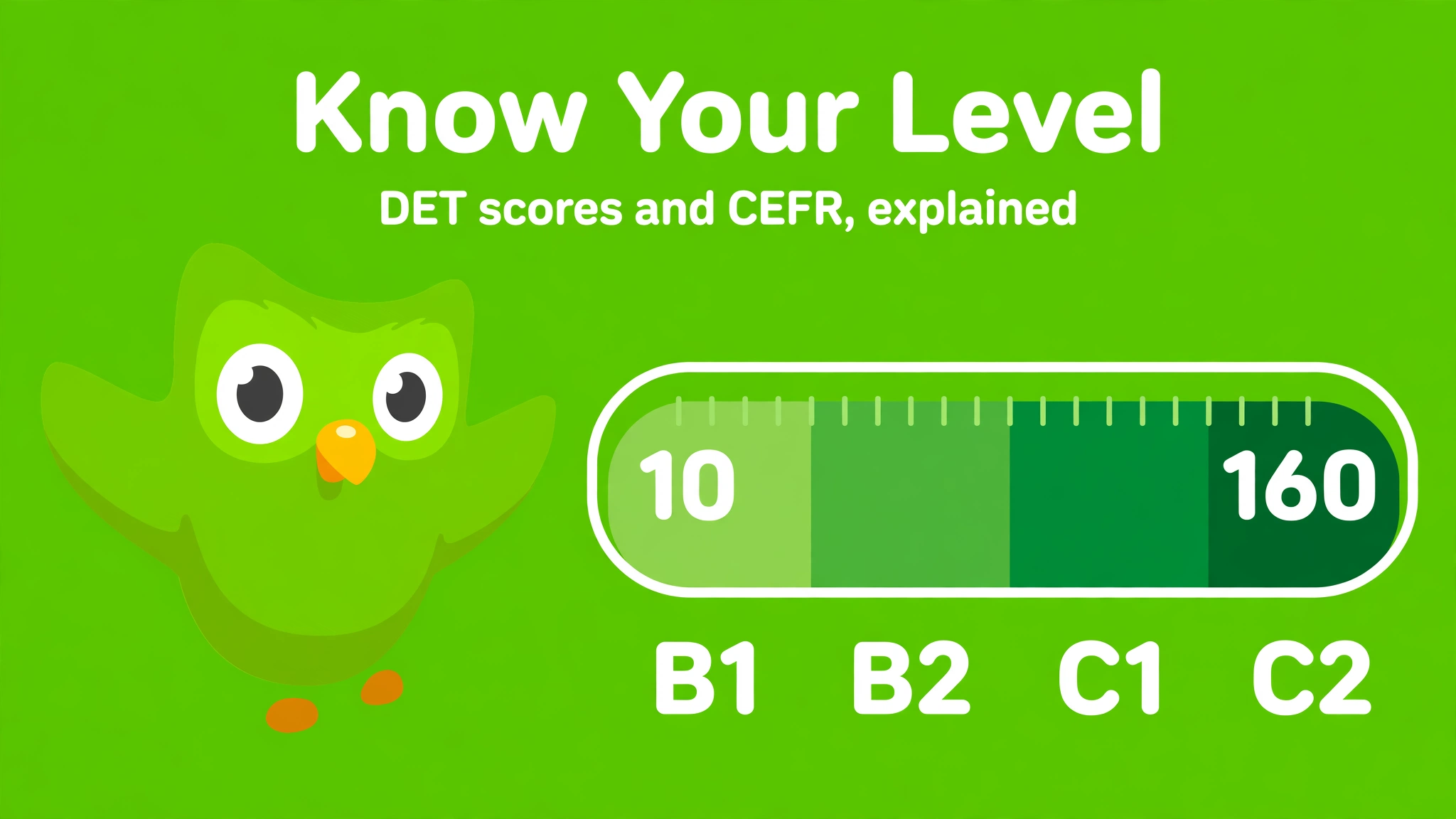
A language proficiency test measures what you can actually do in a language: read it, write it, understand it when you hear it, and speak it. The Duolingo English Test, usually called the DET, is Duolingo’s version of that test. It is a one-hour online English test you take at home, and it gives you a score from 10 to 160.
Quick answer: The Duolingo Language Proficiency Test is the Duolingo English Test (DET). It costs $70 for one test in 2026, takes about one hour, and your results arrive within 48 hours. Your score runs from 10 to 160 and maps to the CEFR levels B1 to C2. It is accepted by more than 6,500 institutions for university admission, but it is generally not accepted for visas.
This guide explains what a proficiency test measures, how the DET works, what your score means on the CEFR scale, and how the DET compares with IELTS, TOEFL, and PTE. If you want the full step-by-step guide to the test itself, read our Duolingo Language Test guide. If you want to know how to get the certificate itself, read our Duolingo Certification guide.
Here is what we will cover:
- What a language proficiency test measures
- What the Duolingo English Test measures
- How the DET is scored, and what the subscores mean
- DET scores and CEFR levels
- DET vs IELTS vs TOEFL vs PTE
- DET score conversions: IELTS and TOEFL
- Which test should you take?
- How to prepare for the DET
- What the DET does not do
- FAQs
What a Language Proficiency Test Measures
A proficiency test does not check how many lessons you finished or how many words you memorized. It checks how well you can use the language in real situations. Almost every serious proficiency test measures the same four skills:
- Reading: can you understand written English, from short messages to long academic texts?
- Writing: can you write clearly, from a short answer to a longer essay?
- Listening: can you understand spoken English at normal speed?
- Speaking: can you speak clearly enough for another person to follow you?
Results are usually reported against the CEFR, the Common European Framework of Reference for Languages. The CEFR describes ability in six levels, from A1 (beginner) to C2 (mastery). Universities and employers use CEFR levels because they mean the same thing no matter which test you took. A B2 in English means roughly the same ability whether you proved it with the DET, IELTS, or TOEFL.
That is the key idea of this guide: a proficiency test is a measuring tool, not a course. Finishing Duolingo lessons helps you learn, but only a test like the DET gives you a score that a university can read and trust.
What the Duolingo English Test Measures
The DET is a computer-adaptive test. That means the questions change based on your answers. Answer well, and the next questions get harder. Struggle, and they get easier. This lets the test find your level in about 45 minutes of scored questions, instead of the two to three hours that IELTS and TOEFL take.
The whole test takes about one hour: around 5 minutes of setup, about 45 minutes of adaptive questions, and about 10 minutes for a Writing Sample and a Speaking Sample. You take it at home on your own computer, with a webcam, a microphone, and a phone as a second camera. Since September 2025, the second camera is required: your phone records your screen, keyboard, and upper body from a second angle for the whole test.
The test checks all four skills through short question types, such as reading a word and choosing the real English words, filling in missing letters, listening and typing what you hear, reading a sentence aloud, and writing or speaking about a topic for a few minutes.
How the DET Is Scored, and What the Subscores Mean
Your DET result has one overall score from 10 to 160, reported in steps of 5, so every score ends in a 0 or a 5. There is no pass or fail. Your score simply shows your level, and each university sets its own minimum. Most undergraduate programs that accept the DET ask for 115 to 120, but the exact number depends on the program.
The overall score is the average of your four individual subscores, rounded up to the nearest 5. The four individual subscores are Reading, Writing, Listening, and Speaking, each on the same 10 to 160 scale. You also get four integrated subscores that combine pairs of skills:
| Subscore | What it measures |
|---|---|
| Literacy | Reading and Writing together |
| Comprehension | Reading and Listening together |
| Conversation | Listening and Speaking together |
| Production | Writing and Speaking together |
The Writing Sample and Speaking Sample at the end are not graded. They are shared with the institutions you send your score to, so admissions staff can see a real sample of your writing and speaking. Your results arrive within 48 hours, or within about 12 hours if you pay for the Faster Results add-on. Results are valid for two years.
Do not confuse your DET score with your Duolingo app score. The Duolingo app shows a Duolingo Score for each course, and in the nine biggest courses a score of 129 equals CEFR B2. That app score is a learning progress measure. It is not a DET score, and no university accepts it as proof of English. Only a certified DET result counts.
DET Scores and CEFR Levels
Duolingo publishes its own alignment between DET scores and CEFR levels, based on a study reviewed by the Chartered Institute of Linguists. This is the mapping to use. Many third-party charts online disagree with it, and they are usually wrong. The most common error is claiming that C1 starts at 125. On Duolingo’s own chart, 125 is still B2, and C1 starts at 130.
| DET score | CEFR level | What it means |
|---|---|---|
| 155-160 | C2 | Mastery: near-native command, above almost every requirement |
| 130-150 | C1 | Advanced: competitive and postgraduate entry |
| 100-125 | B2 | Upper-intermediate: the most common university minimum |
| 60-95 | B1 | Intermediate: pathway and foundation programs |
| 10-55 | Below the validated range | Duolingo publishes no validated CEFR level for scores under 60 |
Two things in that table catch people out. First, there is no gap: scores move in steps of 5, so 95 is the top of B1 and 100 is the bottom of B2. Second, Duolingo’s validated study covers B1 to C2 only. Any chart that gives an exact CEFR label to a score under 60 is filling in a blank that Duolingo left empty.
DET vs IELTS vs TOEFL vs PTE
All four tests measure the same thing: whether you can handle English at university level. They differ in price, length, format, and where they are accepted. The DET is the cheapest and shortest by far. Its weakness is acceptance: it is accepted in fewer places than IELTS or TOEFL, and generally not for visas.
| Feature | Duolingo English Test | IELTS Academic | TOEFL iBT | PTE Academic |
|---|---|---|---|---|
| Cost | $70 worldwide | About $215-260, set locally | About $200-250, set by country | About $210-230, set locally |
| Length | About 1 hour | About 2 hours 45 minutes | About 90 minutes (2026 format) | About 2 hours |
| Where you take it | At home, online only | Test center, computer or paper | Test center or at home | Test center, computer |
| Score scale | 10-160 | Bands 0-9 | Bands 1-6 (since Jan 2026) | 10-90 |
| Results | Within 48 hours | 1-5 days on computer | Within about 72 hours | Typically within 48 hours |
| Score valid | 2 years | 2 years (commonly) | 2 years | 2 years |
| Accepted by | 6,500+ institutions | 12,500+ institutions | 13,000+ institutions | About 3,500+ institutions |
| Visa use | Generally no | Yes, including UKVI version | Limited, not for UK visas | Yes for Australia, limited elsewhere |
Prices for IELTS, TOEFL, and PTE change by country, so check the booking page for your location before you decide. The DET price is the same worldwide in US dollars: $70 for one test, or $118 for a two-test bundle. The TOEFL changed in January 2026: it now reports scores on a 1 to 6 band scale instead of the old 0 to 120 scale, although score reports still show the old 0 to 120 number alongside it until 2028.
DET Score Conversions: IELTS and TOEFL
Duolingo publishes concordance tables that line DET scores up against IELTS and TOEFL. A concordance is a statistical comparison, not an exact conversion. It shows the score on another test that represents a similar level. No university admits you on a converted score: they publish a DET minimum and read your actual DET result against it.
| DET score | CEFR | IELTS Academic | TOEFL iBT (old 0-120 scale) |
|---|---|---|---|
| 155-160 | C2 | 8.5-9.0 | 119-120 |
| 140-150 | C1 | 7.5-8.0 | 110-118 |
| 130-135 | C1 | 7.0 | 100-109 |
| 120-125 | B2 | 6.5 | 87-97 |
| 100-115 | B2 | 5.5-6.5 | 65-86 |
| 60-95 | B1 | 4.5-5.5 | 32-64 |
| 10-55 | Below validated range | 0-4.0 | 0-31 |
The TOEFL column uses the old 0 to 120 scale, because that is the scale Duolingo’s published tables were built on. Since January 2026, TOEFL reports on the new 1 to 6 scale, so treat the TOEFL column as a rough guide, not a current score.
Which Test Should You Take?
The right test is the one your destination accepts. Check that first, before price or convenience. A cheap test that your university does not accept is wasted money.
- Take the DET if every university on your list accepts it, you want the cheapest and fastest option, and you do not need a test for a visa. It is strongest for undergraduate admission in the US and Canada.
- Take IELTS if you need a visa, especially a UK student visa, or if any university on your list does not accept the DET. IELTS is accepted almost everywhere for both study and immigration.
- Take TOEFL if you are applying mainly to US universities and graduate programs, and your programs list TOEFL first. It is the long-time standard for US admissions.
- Take PTE if you are heading to Australia, where it is widely accepted for study and visas, or if you want fast computer-based results from a test center.
One rule covers all four: check the English requirement page of your exact program, not just the university. Acceptance is decided program by program. Some universities accept the DET for undergraduate admission but not for graduate programs. Duolingo’s own directory of accepting institutions is a good starting point, but the university’s own page is the final answer.
How to Prepare for the DET
Cramming does not work well on an adaptive test, because memorizing answers cannot raise your real level. The best preparation is improving your English and learning the format. Duolingo offers a free practice test on the DET website, with sample questions and an estimated score range. The official Test Readiness Guide explains every question type and the test-day rules.
- Take the free official practice test first, so the short question types feel familiar on test day.
- Work on all four skills, not just your strongest one. A weak subscore pulls your overall score down, because the overall score is an average.
- Practice speaking out loud and writing under time pressure, since the Speaking and Writing Samples are shared with universities.
- Set up your test room in advance: a quiet, well-lit, private room, a computer with a camera and microphone, and a charged phone for the second camera.
- Know the retake rules before you buy: you can buy up to three tests in any rolling 30-day period, and you must wait for your result before starting a new attempt. One test credit allows up to three starts to complete and upload the test, and gives at most one certified result.
What the DET Does Not Do
Three common misunderstandings are worth clearing up. First, the DET is not a visa test. It is generally not accepted for student visas in the UK, Australia, Canada, or New Zealand, even when the university itself accepts it for admission. Admission and visa rules are separate questions, so check both.
Second, the DET only tests English. Duolingo teaches 40-plus languages in its app, but the DET is an English-only test. There is no DET for Spanish, French, or any other language.
Third, a DET score is not a course certificate. It proves your English level on the day you took the test, and it expires after two years. It does not certify that you finished a Duolingo course. In fact, the Duolingo app gives no certificate at all for finishing a course. The only certified proof Duolingo offers is the DET certificate, which we explain in our Duolingo Certification guide.
FAQs
What is the Duolingo Language Proficiency Test?
It is the Duolingo English Test (DET): a one-hour, online, adaptive English proficiency test you take at home. It measures reading, writing, listening, and speaking, and reports a score from 10 to 160.
What score do I need on the DET?
It depends on your program. Most undergraduate programs that accept the DET ask for 115 to 120, which sits at the top of CEFR B2. Competitive and postgraduate programs often ask for 125 to 135 or higher. Always check your exact program’s requirement.
Is a DET score of 120 good?
Yes. A score of 120 is CEFR B2 and roughly equals IELTS 6.5. It meets the minimum at many universities, but some competitive programs ask for more.
How much does the DET cost in 2026?
$70 for one test, or $118 for a two-test bundle ($59 per test). Faster Results, which delivers your score in about 12 hours instead of 48, costs an extra $40. Confirm the final amount at checkout on the DET website, since prices can change.
Is the DET easier than IELTS or TOEFL?
It is shorter, cheaper, and taken at home, which makes it feel easier. But it measures the same skills, and the adaptive questions adjust to your level, so a weak area still shows up in your score. Easier to take is not the same as easier to score high on.
Is the DET accepted for visas?
Generally no. It is not accepted for student visas in the UK, Australia, Canada, or New Zealand. Ireland is a reported exception for the Irish student visa, but confirm the current rule with the Irish authorities before relying on it. Always treat admission and visa requirements as two separate checks.
How long is a DET score valid?
Two years from the test date. After that, you can no longer share the result or view the certificate.
Conclusion
A language proficiency test answers one question: how good is your English right now? The DET answers it in about an hour, for $70, with a score from 10 to 160 that maps cleanly to CEFR levels B1 to C2. It is the fastest and cheapest of the major tests, and it is accepted by more than 6,500 institutions. Its limits are real, though: fewer institutions accept it than IELTS or TOEFL, and it generally does not work for visas. So check your exact program’s requirement first, then pick the test that every place on your list accepts. If that test is the DET, our Duolingo Language Test guide walks you through the format, and our Duolingo Certification guide explains how to get your certificate and share it.




One Comment