
Last updated: November 2026
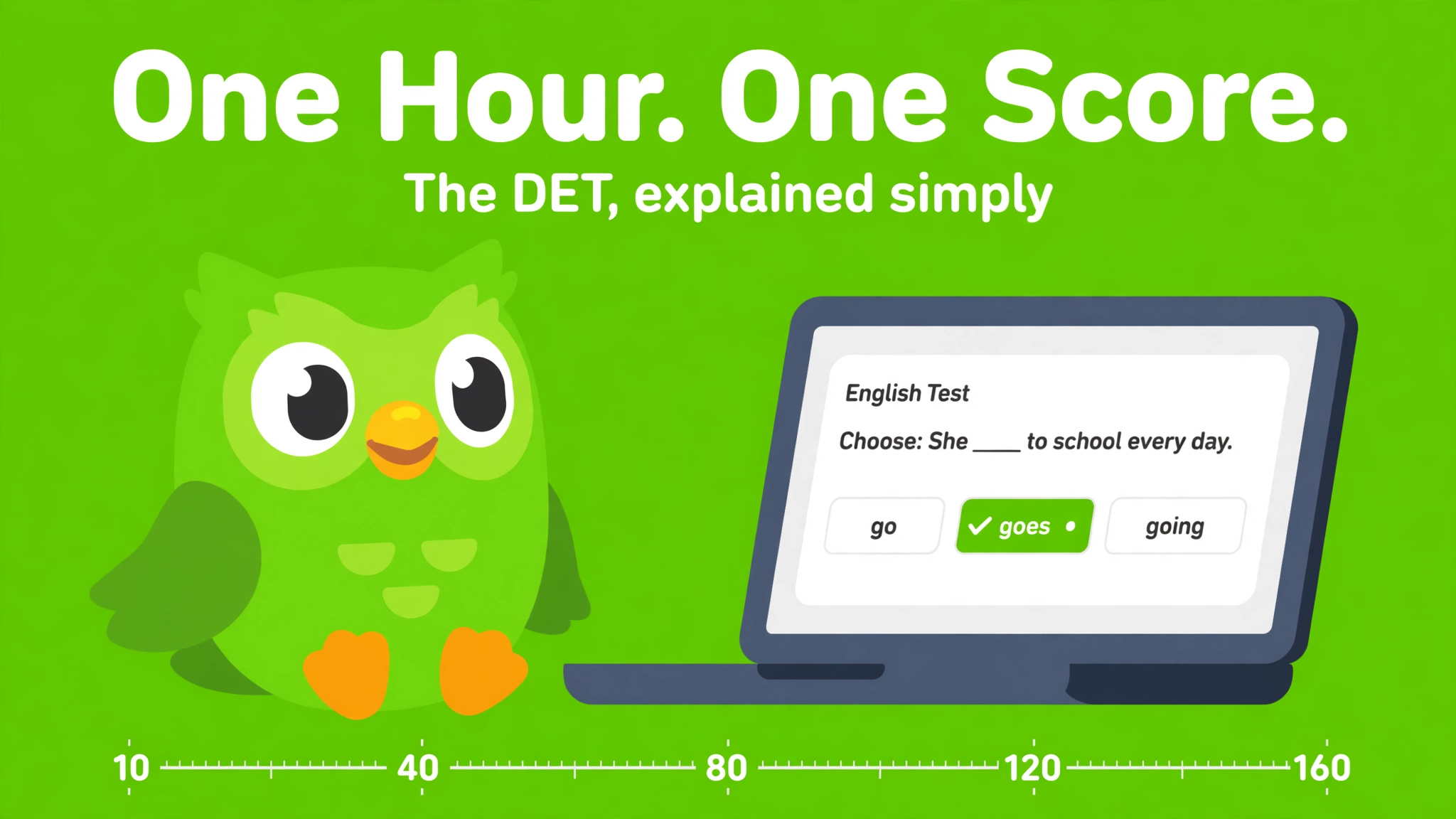
The Duolingo English Test, usually called the DET, is a one-hour English test you take online at home, on your own computer. It checks your reading, writing, listening, and speaking, and it gives you one score from 10 to 160. Universities use it instead of TOEFL or IELTS for admission. It costs $70 for one test, and you usually get your result within 48 hours.
This guide explains the test itself: what it is, what it costs, how it works, how it is scored, and where it is accepted. For the full detail on each question type, see our guide to how the Duolingo English Test is structured in 2026. For the full price breakdown, including fee waivers, see our guide to Duolingo English Test costs in 2026. To understand what the score means, see our guide to the Duolingo language proficiency test, and for the certificate itself, see how Duolingo certification works.
The short version: The DET is a real, proctored English exam, not a quiz inside the Duolingo app. It is separate from the free language app and from a Super subscription. You take it at home in about an hour, with no appointment and no test centre. More than 6,500 institutions accept it for admission, but it is generally not accepted for visa applications, so check the visa rules for your country before you book.
The Duolingo English Test at a Glance
| Detail | What it is in 2026 |
|---|---|
| Full name | Duolingo English Test (DET) |
| What it measures | English reading, writing, listening, and speaking |
| Where you take it | At home, on your own computer, any time, no appointment |
| How long it takes | About one hour |
| Price | $70 for one test, $118 for a two-test bundle |
| Score range | 10 to 160, in steps of 5 |
| Results | Usually within 48 hours, or about 12 hours with Fast Results |
| Result valid for | Two years |
| Accepted by | More than 6,500 institutions worldwide, for admission |
| Accepted for visas | Generally no, check your destination country |
What the Duolingo English Test Is, and What It Is Not
The DET is a standalone English proficiency exam run by Duolingo. It has nothing to do with the lessons, streaks, or XP in the Duolingo app, and it is not included in a Super subscription. You pay for it separately, you book it on the DET website, and you get a certified score that institutions can verify.
It is also different from the free English course on the app. The app teaches English, and its courses now reach CEFR level B2, but finishing a course gives you no certificate. Employers and universities will not accept an in-app score as proof of English. Only the DET gives you a certified result. Studying on the app can build the skills the test measures, but the app alone is not test preparation.
Do not confuse the two scores either. The app shows a Duolingo Score up to 130 that tracks your course progress. The DET reports a score from 10 to 160 after a proctored exam. They share a name, but they are different scales for different purposes.
How Much the Test Costs in 2026
| Option | Price | What you get |
|---|---|---|
| One test | $70 | One certified test, results within 48 hours, free score sending |
| Two-test bundle | $118 | Two tests for $59 each, useful if you plan to retake |
| Fast Results upgrade | About $40 extra | Results in about 12 hours instead of 48 |
| Sending scores | Free | Send your result to as many institutions as you like at no extra cost |
| Practice test | Free | Unlimited practice with an estimated score range, with a free DET account |
The single-test price was $65 until February 2025, when Duolingo raised it to $70. It is still $70 in November 2026. The price is shown in US dollars worldwide, so confirm the final amount at checkout in your DET account, because local tax can apply. There is no student discount on the test itself. Duolingo does run an Access Program that gives out more than 10,000 fee waivers a year through partner schools, universities, and non-profits, but you cannot apply for a waiver directly.
How the Test Works: Three Stages in About an Hour
| Stage | Time | What happens | Scored |
|---|---|---|---|
| 1. Introduction and setup | About 5 minutes | Camera, speaker, and microphone check, government photo ID, phone set up as a second camera, room scan, rules review | No |
| 2. Adaptive test | About 45 minutes | Short reading, listening, writing, and speaking questions in mixed order, difficulty changes with your answers | Yes |
| 3. Writing Sample and Speaking Sample | About 10 minutes | One longer written answer and one longer spoken answer, both sent to the schools that receive your results | Not scored, shared with schools |
The test is computer-adaptive. That means the difficulty of some questions changes based on how you answer. Get several right and the next ones get harder. Struggle and the next ones get easier. The test keeps adjusting until it has a clear picture of your level, so two people can take very different tests and still get fair scores. The number of questions also varies. If the system becomes confident about your level quickly, your test can be shorter.
One warning: most study material published before mid-2025 describes a format that no longer exists. The test was changed on 1 July 2025. Read Aloud was removed, and Listen, Then Speak was replaced by Interactive Speaking, a short spoken conversation with a Duolingo character. If your practice book still teaches Read Aloud, it is out of date.
All 13 Question Types
Duolingo lists 13 question types in its 2026 Question Guide. Eleven appear in the adaptive stage, and the Writing Sample and Speaking Sample close the test. The table below is a short summary. For the full timing and tips for each type, see our guide to how the Duolingo English Test is structured in 2026.
| Question type | What you do | Skill |
|---|---|---|
| Read and Select | Decide if each word on screen is a real English word or a convincing fake, 15 to 18 words | Reading |
| Fill in the Blanks | Finish one word in a sentence when only its first half is shown, 6 to 9 items | Reading |
| Read and Complete | Type the missing endings of several words in a short paragraph, 3 to 6 items | Reading |
| Listen and Type | Type the exact sentence you hear, up to three plays, 6 to 9 items | Listening |
| Interactive Reading | Six questions on one passage, two sets | Reading |
| Interactive Listening | Listen to a campus situation, fill in missing words, choose replies, then write a short summary, two sets | Listening, summary also affects Writing |
| Write About the Photo | Describe a photo in writing, three items, one minute each | Writing |
| Interactive Writing | Answer a written question, then answer a follow-up about a new angle of the same topic | Writing |
| Speak About the Photo | Describe a photo out loud, one item, 90 seconds to speak | Speaking |
| Read, Then Speak | Answer a written question about your experience or opinion out loud, 90 seconds to speak | Speaking |
| Interactive Speaking | A short spoken conversation on two topics with a Duolingo character, 6 to 8 questions, 35 seconds per answer | Speaking |
| Writing Sample | Write about an experience or opinion, five minutes, sent to schools | Writing, unscored |
| Speaking Sample | Speak about an experience or opinion, three minutes, video sent to schools | Speaking, unscored |
Seven of the 13 types are adaptive: Read and Select, Fill in the Blanks, Read and Complete, Listen and Type, Interactive Reading, Interactive Listening, and Interactive Speaking. The others are fixed tasks with set timings.
How Scoring Works: 10 to 160
Every DET score runs from 10 to 160, in steps of 5. You get an overall score and four individual subscores: Reading, Listening, Writing, and Speaking. The overall score is the average of the four individual subscores, rounded to the nearest 5. You also get four combined subscores, each one the average of two individual subscores.
| Combined subscore | Made from | What it shows |
|---|---|---|
| Literacy | Reading and Writing | How well you read and write English |
| Comprehension | Reading and Listening | How well you understand English you read or hear |
| Conversation | Listening and Speaking | How well you follow and take part in spoken English |
| Production | Writing and Speaking | How well you produce English yourself, in writing and speech |
Written answers are judged on content, how clearly ideas connect, grammar, and vocabulary. Spoken answers add fluency and pronunciation. There is no fixed weight for each question type, so no single task decides your score.
What Your Score Means: the CEFR Mapping
Duolingo publishes its own mapping of DET scores to CEFR levels, the international scale from A1 to C2. Duolingo labels this mapping provisional, because its alignment studies are still ongoing and future tables may change as research develops. Use it as a guide, not an exact exchange rate.
| DET score | CEFR level (provisional) | What it means |
|---|---|---|
| 10 to 55 | A1 to A2 | Basic English, below the range Duolingo has validated in detail |
| 60 to 95 | B1 | Can handle everyday communication and simple study tasks |
| 100 to 125 | B2 | Upper-intermediate, the most common university minimum |
| 130 to 150 | C1 | Advanced, competitive and postgraduate entry |
| 155 to 160 | C2 | Mastery, near-native command, above almost every requirement |
Watch the boundary at 125. A score of 125 is still B2. C1 starts at 130, not 125. Many third-party charts get this wrong, and it matters if your target programme asks for C1.
What Counts as a Good Score?
There is no single passing score. Each university sets its own minimum, and the minimum changes by programme. As a rough guide, 100 to 110 meets the minimum at many universities, often for undergraduate programmes. A score of 115 to 125 is strong and meets the requirement at most competitive programmes, including many graduate programmes. A score of 130 and above is very strong, usually above the minimum everywhere the DET is accepted.
Check two things on each programme page: the overall minimum and any minimum per skill. Some programmes ask for 120 overall but also want at least 110 in Writing, for example. A high overall score does not help if one subscore is below the line.
For a rough comparison, Duolingo’s own concordance puts a DET score of 160 at IELTS 8.5 to 9, a score of 120 at IELTS 6.5, and a score of 100 at IELTS 5.5. These are approximations from Duolingo’s own studies, not promises. No institution admits you on a converted score. They publish a DET minimum and read your actual DET result against it.
DET Compared With IELTS and TOEFL
| Detail | Duolingo English Test | IELTS | TOEFL iBT |
|---|---|---|---|
| Price | $70 | About $240 or more in most countries | About $200 or more in most countries |
| Test time | About 1 hour | About 2 hours 45 minutes | About 2 hours |
| Where | At home, no appointment | Test centre or at home, booked in advance | Test centre or at home, booked in advance |
| Results | Within 48 hours | 3 to 13 days, depending on format | 4 to 8 days |
| Score scale | 10 to 160 | 0 to 9 bands | 1 to 6 since January 2026, with the old 0 to 120 score still shown |
| Accepted for visas | Generally no | Yes, including UK, Canada, Australia, and New Zealand | Yes, in most destinations |
The price and speed gap is the main reason the DET has grown so fast. The trade-off is acceptance. IELTS and TOEFL are accepted almost everywhere for study and immigration. The DET is accepted by more than 6,500 institutions for admission, but not by immigration authorities. If you need one score for both admission and a visa, the DET is usually the wrong choice.
Where the Test Is Accepted, and Where It Is Not
Duolingo says more than 6,500 institutions now accept the test, and that number keeps growing. Acceptance is strongest in the United States and Canada, solid in the UK and Ireland, and more selective in Australia and mainland Europe. Even inside one university, acceptance is decided programme by programme, and the lists change. Always check your own programme page before you book.
| Country | Accepted for study | Visa position |
|---|---|---|
| United States | Yes, widest for undergraduates, most often 115 to 120 | No specific English test is mandated for the F-1 visa, follow your university’s admission requirements |
| Canada | Yes for undergraduate study, usually 120, graduate acceptance is lower | Not accepted for Express Entry permanent residence, which takes CELPIP General, IELTS General Training, or PTE Core |
| United Kingdom | Mixed, check each university, Oxford, Cambridge, UCL, and LSE do not list it | Not a UK-approved SELT, so it cannot substitute for a Secure English Language Test |
| Australia | Rarely, only a few universities accept it, with limits | Not an approved test for Australian visa purposes, and at-home tests are excluded |
University acceptance and visa recognition are two different questions. A university can accept the DET for admission while the visa authority of the same country refuses it. Check both before you pay, especially for the UK, Canada, and Australia.
Test Day Rules and Technical Requirements
The DET is a proctored test, even though you take it at home. Breaking the rules can get your result cancelled, so take them seriously.
- Computer only. You need a desktop or laptop with a front-facing camera, microphone, and speakers. You cannot take the test on a phone or tablet.
- Second camera. You use your phone as a second camera that records your computer and keyboard during the test. Both cameras must be working before the test starts.
- Government photo ID. You show a passport, driving licence, or national ID card during setup.
- Quiet, private, well-lit room. You must be alone, with your face and ears visible and uncovered for the whole test.
- Nothing else on your desk. No mobile phone except the one used as the second camera, no notes, no books, no headphones, and no second screen.
- Stay in the test window. Do not open other programs, copy and paste, or look away from the screen for long stretches.
Proctoring rules were tightened in September 2025, with the second-camera setup and room scan now part of onboarding. Run the equipment check on the same computer and in the same room you plan to test in, well before test day. Duolingo has no phone support and no general support email, so if something goes wrong, help comes from support.duolingo.com and the in-app Help section only.
Results, Retakes, and Sending Scores
Results usually arrive within 48 hours, or about 12 hours with the Fast Results upgrade. Results stay valid for two years from the test date. Sending scores is free, and you can send your result to as many institutions as you like.
One test credit gives you up to three attempts to complete and upload the test, which covers technical failures. If your result is not certified, the outcome matters. An ID problem usually needs only a new ID, not a retake. A technical error or a simple rule violation usually allows a free retake if attempts remain on your credit. Misconduct is different: it uses up your credit, and only misconduct outcomes can be appealed, within 72 hours, once only.
How to Practice for Free
Duolingo offers a free practice test of about 45 minutes. It uses the same question types and the same adaptive format as the real test, you can take it as many times as you like, and you get an estimated score range at the end. You need a free DET account to use it. Duolingo also publishes a free 2026 Question Guide that explains every question type with timing and tips, plus free practice question volumes with audio and answers.
A good plan is to take the practice test first, find your weakest skill, drill that skill for a week or two, and then take the practice test again to see if the range moved. Your practice test gives an estimated score range, not an exact score. If your practice range sits below your target programme’s minimum, that is the gap you need to close before you pay for the real test.
Who Should Take the DET, and Who Should Not
Take the DET if your target universities accept it, you need a result fast, and you want to keep the cost low. It is a strong choice for undergraduate admission in the United States and Canada, where acceptance is widest.
Do not take the DET if you need a score for immigration or a visa, if your target university does not list it, or if your programme asks for IELTS or TOEFL by name. In those cases, the $70 you save will not help, because the score will not count. Check your programme page and your destination country’s visa rules first, then book.
Frequently Asked Questions
How much does the Duolingo English Test cost in 2026?
One test costs $70, and a two-test bundle costs $118. Fast Results costs about $40 extra. Confirm the price at checkout, because Duolingo shows the price in your account.
How long is the Duolingo English Test?
About one hour: around 5 minutes of setup, 45 minutes of adaptive questions, and 10 minutes for the Writing Sample and Speaking Sample.
How many question types are in the DET?
There are 13 question types in total. Eleven appear in the adaptive stage, and the Writing Sample and Speaking Sample come at the end.
How is the Duolingo English Test scored?
Scores run from 10 to 160 in steps of 5. You get an overall score plus four individual subscores in Reading, Listening, Writing, and Speaking, and four combined subscores. The overall score is the average of the four individual subscores, rounded to the nearest 5.
What is a good Duolingo English Test score?
It depends on your programme. Many universities ask for 100 to 110, competitive programmes often ask for 115 to 125, and 130 or above is very strong. Always check the minimum on your own programme page, including any per-skill minimum.
How long do DET results take?
Usually within 48 hours, or about 12 hours with the Fast Results upgrade. Results stay valid for two years.
Is the Duolingo English Test accepted everywhere?
No. Duolingo says more than 6,500 institutions accept it, but not every programme does. Check each university page, and remember the DET is generally not accepted for visa applications.
Can I take the DET on my phone?
No. You need a computer with a camera, microphone, and speakers. Your phone is used only as a second camera that records your computer during the test.
Is the DET part of the Duolingo app or Super?
No. The DET is a separate paid product. It is not included in the free app or in a Super subscription, which costs about $12.99 to $13.99 a month in the US.
Can I use the DET for a Canadian study permit or Express Entry?
A Canadian school may accept the DET for admission, but the DET is not an approved test for Express Entry permanent residence, which takes CELPIP General, IELTS General Training, or PTE Core. Check the study permit rules separately from the university rules.