
Last updated: November 2026
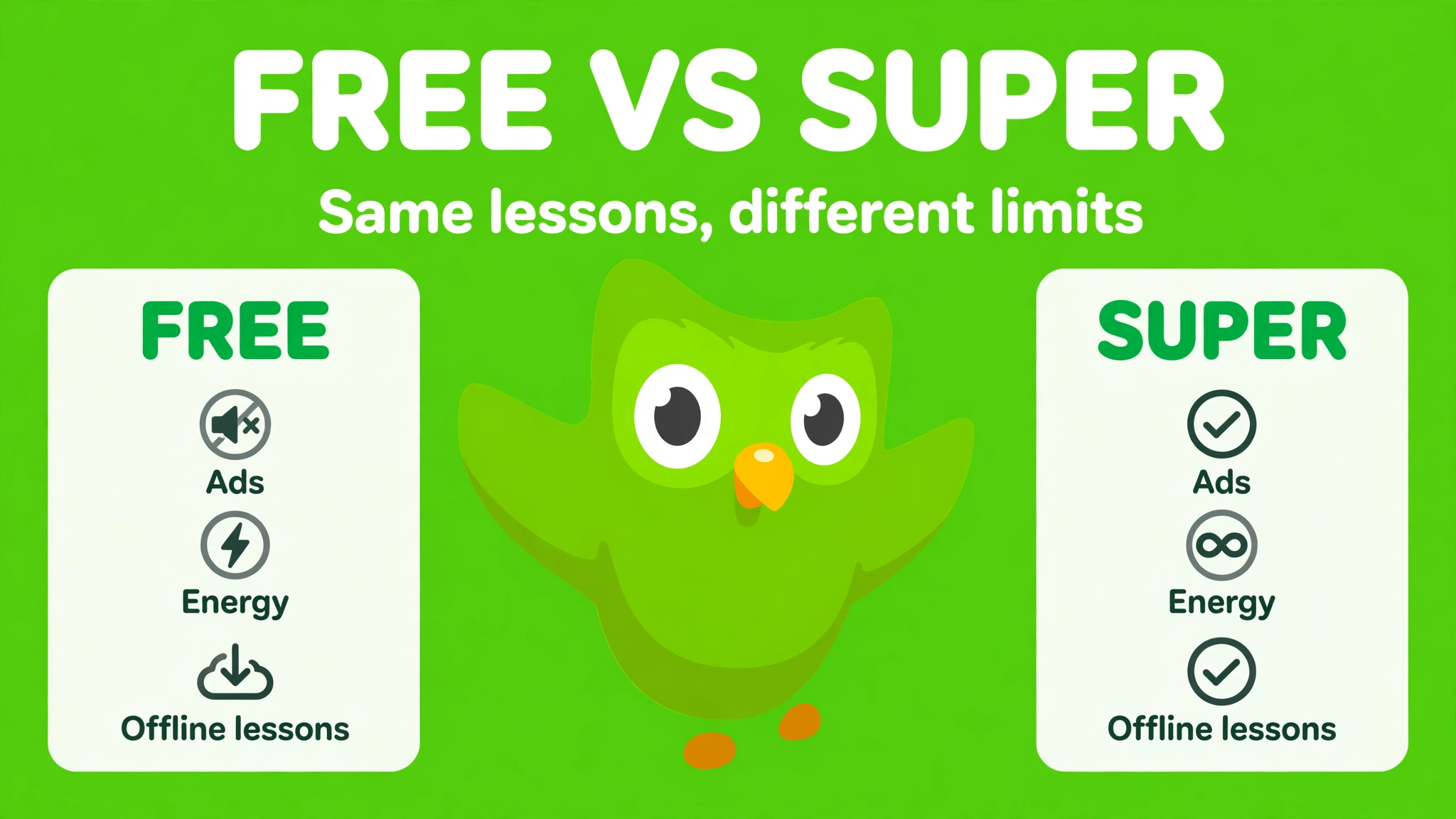
Duolingo paid vs free — which one should you choose? The short answer: the lessons are the same on both plans. Super Duolingo does not unlock extra languages, extra levels, or a better course. What it does is remove the limits and interruptions from the free plan: ads, the daily energy cap on mobile, and the caps on practice features.
Free Duolingo costs $0 and gives you every lesson in every course, with ads and a daily energy limit on mobile. Super costs about $12.99–$13.99 a month or about $83.99–$119.99 a year, and removes the ads and the energy limit. If you study a few minutes a day on the web, free is often enough. If you study daily on your phone and the limits keep stopping you, Super is the upgrade that fixes that.
This is the head-to-head comparison: free vs Super, feature by feature, with the 2026 prices. If you want the full cost breakdown instead, read Does Duolingo Cost Money? Super, Family & Free Prices 2026. If you want to know whether the free plan alone is enough, read Is Duolingo Really Free? Free vs Super in 2026.
Here is what we will cover:
- The side-by-side comparison table
- Ads, energy and mistakes — the three limits that matter most
- Offline lessons and practice features
- Super prices in 2026
- Who should stay free, and who should pay
- FAQs
Duolingo Paid vs Free: The Comparison Table
This table compares the free plan with Super Duolingo (formerly Duolingo Plus, renamed in June 2022) as they work in November 2026.
| Feature | Free Duolingo | Super Duolingo (paid) |
|---|---|---|
| Price | $0 | About $12.99–$13.99 a month, or about $83.99–$119.99 a year |
| All lessons and courses | Yes — every course, 40+ languages | Yes — the same lessons, nothing extra |
| Ads | Yes — ads between lessons | No ads |
| Energy / mistakes (mobile) | Limited — 25 energy a day on most mobile accounts; every exercise uses energy | Unlimited energy — study as long as you like |
| Energy / mistakes (web) | No energy limit on the web version | No energy limit on the web version |
| Offline lessons | No | Yes — download lessons and study without internet |
| Personalised practice | Limited | Full — targeted practice on your mistakes, plus progress quizzes |
| Explain My Answer | Yes — free for everyone since 1 January 2026 | Yes |
| Practice Hub | Yes — free for everyone since 18 February 2026 | Yes |
| Legendary Levels | Limited attempts | Unlimited attempts, with extra XP |
| Monthly streak repair | No — free users use Streak Freezes bought with gems instead | Yes — one free repair a month |
| Video Call (AI conversation) | No | Rolling out to Super by the end of 2026 |
| Streak, XP, leagues | Yes — all included | Yes — all included |
Two things in that table surprise most people. First, Explain My Answer and the Practice Hub used to be paid features, and both are now free for everyone. Second, the web version has no energy limit at all — so a free user on a computer can study far longer than a free user on a phone.
Ads: The Most Visible Difference
On the free plan, you see ads between lessons. They are short, but they break your flow — especially if you do several lessons in a row. Super removes them completely.
Ads are also how the free plan pays for itself. Duolingo’s model is simple: advertisers and the small share of users who pay for Super keep the lessons free for everyone else. If ads do not bother you, there is no reason to pay just to remove them. If they break your concentration every few minutes, that alone can be worth the price.
Energy and Mistakes: The Limit That Matters Most
This is the biggest change to the free plan in recent years, and the old version of this article described it wrong — it talked about hearts. Here is how it works now.
On most mobile accounts, the old hearts system (5 hearts, one lost per mistake) has been replaced by energy: you start the day with 25 energy, and every exercise uses energy whether you answer it right or wrong. When it runs out, you wait for it to recharge, watch an ad, spend gems, or stop for the day. In practice, most free users get about 2–3 lessons — roughly 15–20 minutes — before hitting the limit. Some accounts still have hearts, and the rollout is not identical for everyone, so your experience may differ slightly.
Super removes the limit entirely: unlimited energy, so mistakes never stop a lesson and a long session never hits a wall. That is the real thing you are paying for — not better lessons, but the freedom to keep going.
| Situation | Free | Super |
|---|---|---|
| One short lesson a day (mobile) | Fine — rarely hits the energy limit | Fine — no difference |
| Several lessons in a row (mobile) | Stops after about 2–3 lessons | No limit |
| Studying on the web | No energy limit — study as long as you like | No energy limit — no difference |
| Lots of mistakes in one lesson | Costs energy on every exercise, right or wrong | No cost — mistakes never stop you |
Free workarounds exist: switch to the web version for longer sessions, watch an ad for a small energy refill, or spend gems on a full refill. But if you study daily on your phone, those workarounds get old fast.
Offline Lessons and Practice Features
Super lets you download lessons and study without internet — useful on a plane, a train, or anywhere with weak signal. Free users cannot download lessons.
Super also gives you full personalised practice: targeted review of the mistakes you make, plus progress quizzes. Free users get a limited version. Two features that used to sit in this paid list no longer do: Explain My Answer (free for all since 1 January 2026) and the Practice Hub (free for all since 18 February 2026). And Super adds unlimited Legendary Level attempts and one free streak repair a month — free users protect their streak with Streak Freezes bought for about 200 gems each instead.
One feature to be careful about: the AI Video Call. It used to be a Duolingo Max feature, and it is moving into Super, with unlimited Video Call reaching all Super subscribers by the end of 2026. Max itself is no longer sold — new Max sales stopped in November 2026 — so do not buy anything sold to you as a new Max plan.
Super Prices in 2026
Duolingo publishes no price list, so every price below is the range US users are actually seeing in late 2026. Your price may differ by account, device, country, and the test Duolingo is running. Always check your own checkout screen before you pay.
| Plan | Price (US, late 2026) | Best for |
|---|---|---|
| Free | $0 | Casual learners, web users |
| Super, monthly | About $12.99–$13.99 a month | Trying Super for a month or two |
| Super, yearly | About $83.99–$119.99 a year (about $7.00–$10.00 a month) | Daily learners — the best value for one person |
| Super Family, yearly | About $119.99–$143.99 a year for up to 6 people | Families or groups — about $20–$24 per person a year |
Ignore the old prices in the previous version of this article — $9.99 a month and $59.99 a year are years out of date, and $59.99 a year no longer appears on US accounts. Note also that a few September 2026 account checks reported a higher monthly price of $16.99 on some accounts, so the range above is the common range, not a guarantee. Yearly billing saves roughly $72 a year against the common monthly prices. And before you pay anything, try the free trial — usually 1 week on the web or 14 days in the app stores — and cancel at least 24 hours before it ends if you do not want to be charged.
Who Should Stay Free, and Who Should Pay?
Stay free if: you study once a day for a few minutes, you mostly use the web version, ads do not bother you, and you rarely run out of energy. The free plan teaches you the same lessons as Super.
Pay for Super if: you study daily on your phone, you regularly hit the energy limit, ads break your focus, you want offline lessons for travel, or you want unlimited Legendary attempts and the monthly streak repair. Pay yearly, not monthly, and consider the Family plan if two or more people will use it — even two people on a Family plan pay less per person than two individual plans.
Try before you decide: the free trial gives you the full Super experience for a week or two. Use it during a normal study week, not a holiday, so you can tell whether the limits were really what slowed you down. If you cancel, you go back to the free plan and keep all your progress — see Do I Keep Duolingo Free After Cancelling Super? (2026).
Frequently Asked Questions
Is Duolingo free really free?
Yes. Every lesson in every course is free, with no time limit. The free plan has ads and a daily energy limit on mobile, but the lessons themselves are never locked behind a payment.
Does Super Duolingo teach you more than free?
No. The lesson content is identical on both plans. Super removes restrictions — ads, the energy cap, offline limits — and adds practice tools. It does not add lessons, languages, or levels.
Is Super worth it in 2026?
It is worth it if you study daily on your phone and the energy limit or ads keep stopping you. It is not worth it if you study a little each day on the web, where there is no energy limit and the free plan already does the job.
What happens if I cancel Super?
You keep Super until the end of the period you paid for, then you go back to the free plan. Your progress, XP, streak, and completed lessons all stay. You do not lose anything you learned.
Can I switch between free and Super?
Yes. You can subscribe, cancel, and re-subscribe at any time. Cancelling stops the next payment; it does not delete your account or your progress.
The Bottom Line
Free Duolingo and Super Duolingo teach the same lessons. Free costs nothing and comes with ads and a daily energy limit on mobile. Super costs about $12.99–$13.99 a month or $83.99–$119.99 a year and removes those limits, adds offline lessons, full personalised practice, unlimited Legendary attempts, and a monthly streak repair. Choose free if you study a little each day; choose Super if the limits are what slow you down — and try the free trial first.


Thx for the detailed breakdown! Been using free Duolingo for 187 days straight (Swedish streak!) but those hearts are killing my motivation when I make mistakes. Thinking about upgrading to Super – is the family plan worth it if it’s just me and my husband learning?
Hi Emma! Amazing streak you’ve got going with Swedish! The family plan is absolutely worth it for two people – at $119.99/year for up to 6 users, you’re each paying less than $5/month. Plus, a little friendly competition with your husband might boost your motivation even more! Those unlimited hearts make a huge difference when tackling challenging grammar.
Good day
I am interested in the annual plan for a Duolingo at 60% off, but I can only do that if I can pay, as stated, R39.00 per month, rather than the full amount in one payment.
Please
Thank you.
Hi there, thank you for your interest and your question. Currently, the discounted annual plan—with the 60% off rate—is typically set up as a one-time full payment rather than a monthly installment option. I understand that paying R39.00 per month would be much more convenient, and your feedback is definitely valuable.
My recommendation is to check your account settings in the Duolingo app or visit the payment options section to see if there’s been an update or any regional alternatives available. Sometimes promotional plans can differ by region, so contacting Duolingo’s customer support might give you the most up-to-date answer regarding installment options.
I hope this helps clarify the situation. Thanks again for reaching out, and happy language learning!
How do I pay for superduolingo without using in-app purchases as Duolingo wants me to do? I do not believe that system to be safe if my phone gets hacked or stolen.
Hey there, thanks for reaching out with your concerns. From what I’ve gathered, Duolingo mainly processes its Super Duolingo (or Duolingo Plus) subscriptions through in-app purchases on app stores like Apple’s and Google’s. This means that if you’re using the mobile app, the transaction is generally handled by the respective app store—which can understandably raise concerns if you’re worried about your phone’s security.
One alternative you might consider is subscribing directly through Duolingo’s website (duolingo.com) using a desktop or laptop. In some cases, signing up from the website might offer a payment option that doesn’t rely on the in-app purchase systems, allowing you to use a credit or debit card directly. This can give you extra peace of mind if you’re not comfortable with the in-app purchase setup. However, availability of this option can vary based on your region and the platform’s current policies.
If that option isn’t visible or available, I’d recommend contacting Duolingo’s customer support directly—they might have additional insights or alternative methods for users with specific concerns about mobile security.
Hope this helps clarify your payment options and eases your worries a bit!
Good day . I would like to enquire how Duolingo app would deduct payment from my bank account without following my knowledge . The bank has authorized payment . How do I get a refund since i have Uninstalled the app. For information, the app was downloaded by my daughter through my cellphone. Thank you. L. M. Machiba
Hello LM Machiba, thanks for reaching out with your concerns. It sounds like your situation is a bit frustrating, so let’s see if we can clear things up.
Typically, if a Duolingo subscription is active, the charge will continue automatically as set by the app store where the purchase was made (like Apple’s App Store or Google Play). Even if the app has been uninstalled, the subscription remains active until you cancel it. Since your daughter downloaded the app on your phone, it may have led to a subscription that you weren’t fully aware of.
Here are a few steps you might consider:
• Check your subscription settings on the app store linked to your device. For instance, on an iPhone, you can go to Settings → your name → Subscriptions to see if Duolingo is still active. The same goes for Android devices using the Google Play Store.
• If you believe the charge was unauthorized or that the subscription should be canceled, use the app store’s refund or dispute process. Both Apple and Google have procedures in place where you can request a refund or challenge a charge that wasn’t knowingly approved.
• In addition to contacting the app store support, you might also consider reaching out to Duolingo’s customer support directly. Explain the situation—that the app was downloaded by your daughter—and ask if they can help process a refund or clarify any details regarding the payment. You can typically reach them via their support webpage or through the email provided in the app.
I hope these steps help! Don’t hesitate to contact the relevant support teams if you need further assistance.
I did the trial version of Super and decided I did not want to pay. How do I ensure I am not being charged for the Super version?
Hello there! To avoid being charged after your Duolingo Super trial, you’ll need to cancel the subscription before the trial period ends. Here’s what you can do:
• If you activated the trial on your mobile device (via the App Store for iOS or Google Play for Android), open your device’s subscriptions settings. From there, locate your Duolingo subscription and cancel it. This stops the trial from automatically converting to a paid subscription.
• If you signed up through the Duolingo website, log into your account on duolingo.com and check your subscription settings. Disable auto-renewal there.
Once you cancel, you should receive a confirmation email or see the cancellation reflected in your account details. Make sure to cancel before the trial period ends, otherwise, you might be billed for the next term.
Hope this helps clarify things and lets you rest easy knowing you’re not getting charged inadvertently!
thanks for comparing everything so clearly! i use duolingo to practice my english everyday (sorry for mistakes) and was wondering if super is worth it. the unlimited hearts would help me a lot because i make many mistakes still. maybe will try the free trial first to see if i like it!