
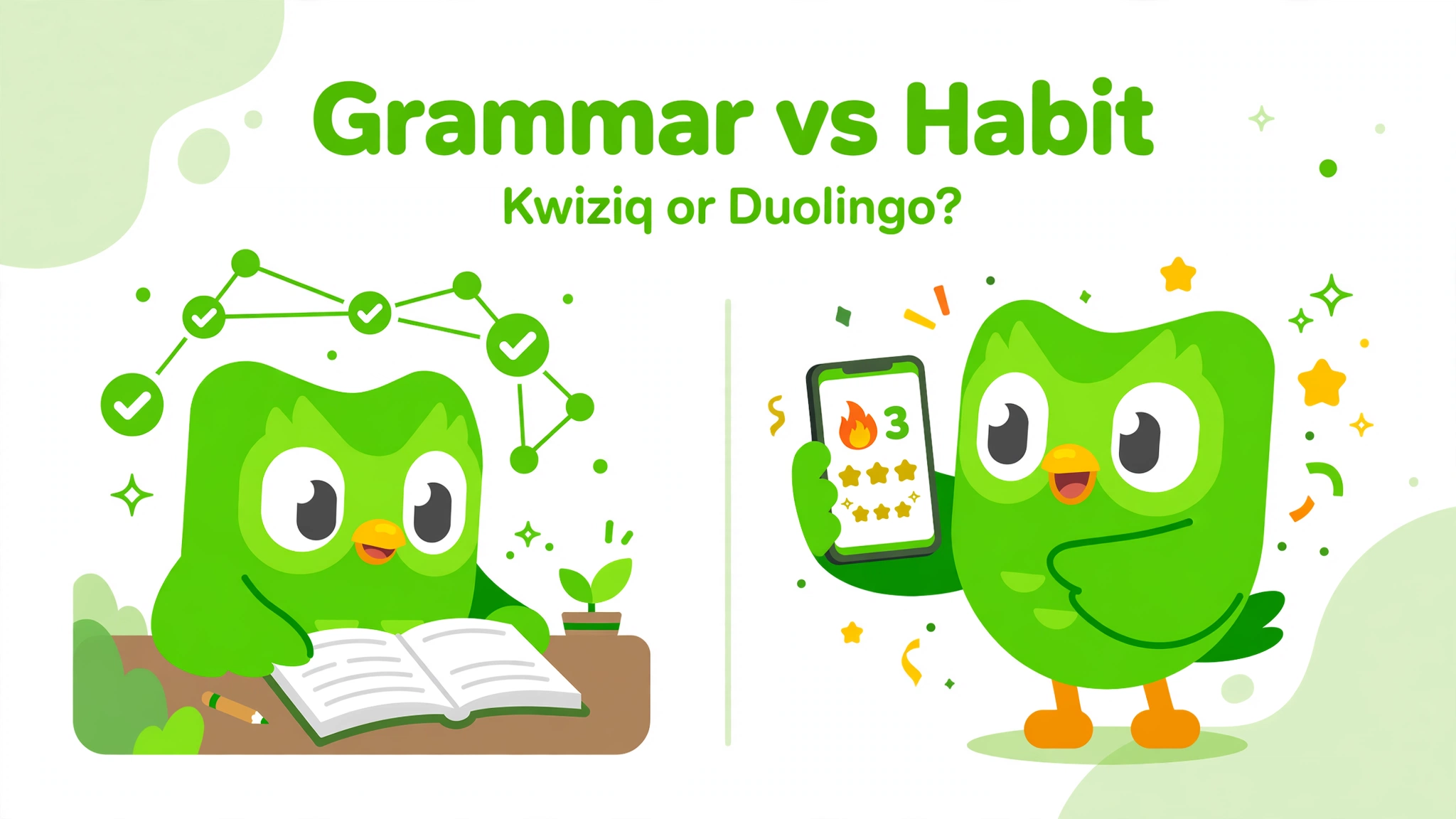
Is Kwiziq better than Duolingo? The honest answer is: not overall — but it is better at one specific job. If you keep making the same French or Spanish grammar mistakes and you cannot see why, Kwiziq finds the exact grammar point behind the mistake and drills it until it sticks. Duolingo does not do that. What Duolingo does better is everything around the grammar: it keeps you practising every day, it covers more than 40 languages, and its free plan costs nothing.
So the real question is not which app wins. It is which job you need done. Most learners who ask this question are stuck on grammar, not on motivation. For them, the best answer is usually both: Duolingo for the daily habit, Kwiziq for the grammar gaps. This guide compares the two side by side — what each one teaches, what each one costs, and who should pick which — so you can decide in a few minutes.
Table of Contents
Key Takeaways
- Kwiziq is not better than Duolingo overall — it wins only at fixing grammar gaps in French and Spanish.
- Kwiziq covers French and Spanish only, while Duolingo covers more than 40 languages.
- Kwiziq finds your weak grammar points with short adaptive quizzes and maps them to your CEFR level.
- Duolingo wins the daily habit — free, gamified, with speaking and listening practice built in.
- The best setup for most learners is both: Duolingo every day, Kwiziq for the grammar that keeps tripping you up.
What Is Kwiziq?
Kwiziq is a grammar coach for French and Spanish. It does not try to be a full language course. Instead, it tests what you already know with short adaptive quizzes — called kwizzes — and works out exactly which grammar points you have mastered and which ones you keep getting wrong. The results feed into a personal map, called the Brainmap, which shows your strengths and gaps by CEFR level, from A0 up to C1. A study plan is then built around the gaps, not around a fixed course order.
The French library is deep: as of mid-2026 it held 482 teacher-written grammar lessons, more than 5,000 quiz questions and nearly 14,000 voiced verb conjugations. Each quiz is short — usually around ten questions — and every wrong answer comes with a clear explanation of the rule behind it. That is the whole point of the tool: it does not just mark you wrong, it shows you the rule you missed, then tests that rule again later.
There are two things to know before you sign up. First, Kwiziq teaches French and Spanish only. For Spanish you pick either the Spain or the Latin America variety when you start, and you cannot study both at once. Second, Kwiziq has no speaking practice at all. Its writing practice is self-marked rather than corrected by a teacher, and its listening work comes through dictation and reading challenges. If speaking is your main goal, Kwiziq will not help you with it.
The free plan gives you 10 kwizzes a month, plus a level test, a basic Brainmap and a personalised study plan. That is enough to test whether the format suits you. Premium removes the limit: unlimited kwizzes, unlimited exercises, weekly writing and listening challenges, unlimited notebooks and the full Premium Brainmap.
What Duolingo Does Differently
Duolingo is built for a different job: getting you to practise a little bit every day, for months. Its lessons are short and game-like, with XP, streaks, leagues and daily goals that pull you back the next morning. That habit loop is the main reason it works for so many people. A tool you open every day beats a tool you open once a week, however good the second one is.
Duolingo also covers far more ground. It offers more than 40 languages, from Spanish and French to Japanese, German and Welsh, and its free plan costs nothing — with ads and an Energy limit on how much you can practise in one sitting. The paid plan, Super, removes the ads and the Energy limit, adds unlimited hearts and offline lessons, and costs about $13 a month when paid monthly. You can read the details in our guide to Duolingo’s free plan and how the paid tiers compare.
Where Duolingo is weaker is grammar. Its courses teach mostly through examples and pattern-spotting, and the grammar explanations are short. Most Duolingo courses also stop at around B2 level, so an advanced learner runs out of road. And Duolingo never tells you, in one place, exactly which grammar points you have mastered and which ones you have not. That gap is precisely what Kwiziq is built to fill.
Duolingo does include speaking and listening practice inside its lessons, which Kwiziq does not. Its Practice Hub, free for every learner since February 2026, also reviews your mistakes, your shaky words and your weak listening in one place. So for a beginner, or for someone learning a language Kwiziq does not cover, Duolingo is the obvious starting point.
Kwiziq vs Duolingo at a Glance
The table below sums up the comparison. Neither app does everything, and that is the point: they are built for different jobs.
| Feature | Kwiziq | Duolingo |
|---|---|---|
| Languages | French and Spanish only | More than 40 languages |
| Main strength | Finding and fixing grammar gaps | Daily habit, streaks, gamified lessons |
| Grammar depth | 482 French lessons, A0 to C1, with a Brainmap of your gaps | Short explanations; most courses stop near B2 |
| Speaking practice | None | Yes, inside lessons |
| Listening practice | Dictation and reading challenges | Yes, inside lessons and the Practice Hub |
| Free plan | 10 kwizzes a month | Full courses free, with ads and an Energy limit |
| Paid plan | Premium from about $11 a month on the annual plan | Super about $13 a month, or $84 to $120 a year |
| Best for | Intermediate learners fixing grammar | Beginners and daily practice in any language |
Where Kwiziq Wins: Grammar Gaps
Kwiziq wins in exactly one place, and it wins clearly: it finds the grammar you have not learned properly and fixes it. Most learners at intermediate level have the same problem. They can hold a simple conversation, but they keep making the same mistakes — the subjunctive in French, por versus para in Spanish, or the wrong past tense — and no amount of extra Duolingo lessons seems to fix it. That is because Duolingo teaches by repetition, not by diagnosis. It shows you the same pattern again and hopes it sticks.
Kwiziq starts from the other end. A kwiz tests a single grammar point, and the Brainmap records the result. Over time it builds a picture of your French or Spanish in CEFR terms: which points are solid, which are shaky, and which you have never met. The study plan then points you at the shaky ones first. When you get a question wrong, the explanation names the rule, shows examples, and links to the full lesson. The next kwiz on that point comes back later, so the fix is tested rather than assumed.
This matters most at B1 and B2 level. At that stage, progress slows down because the mistakes are specific, not general. A beginner needs vocabulary and basic sentences; an intermediate learner needs someone to point at the three or four grammar points that keep costing marks. Kwiziq does that job well, and nothing in Duolingo does it at all.
There is one more group Kwiziq suits: exam learners. If you are preparing for a DELF, DALF or DELE exam, the CEFR-mapped Brainmap tells you where you stand against the level you need. That is a clearer picture than Duolingo’s XP total, which measures how much you practised, not what you know.
Where Duolingo Wins: Habit and Breadth
Duolingo wins everywhere else, and the biggest win is the habit. Its streak, XP and leagues are designed to make you open the app every day, and for most people that daily contact matters more than any single lesson. Grammar knowledge you never practise fades; a short daily session keeps the language alive. Kwiziq has a study plan, but it has no streak, no leagues and no daily goal pulling you back. If you are the kind of learner who needs a nudge, Duolingo gives you one and Kwiziq does not.
Breadth is the second win. Kwiziq teaches two languages. Duolingo teaches more than 40, so if you are learning German, Italian, Japanese or Portuguese, Kwiziq is not even an option. Even for French and Spanish learners, Duolingo is the better first step: its courses take you from zero to a solid intermediate level, with listening and speaking practice included. Kwiziq assumes you already have a working base and does not teach from scratch.
Cost is the third win. Duolingo’s full courses are free, with ads and an Energy limit. You can learn a language for months without paying anything, and the free plan is genuinely usable. Kwiziq’s free plan is a taster — 10 kwizzes a month runs out fast if you are studying seriously. Our guide to Duolingo’s free plan explains what the free tier includes and where its limits bite.
Finally, Duolingo covers skills Kwiziq skips. Speaking practice, listening in context, and the Practice Hub’s review of your own mistakes all live inside Duolingo. A learner who only uses Kwiziq would still need somewhere else to practise speaking and to keep new words fresh. Duolingo is that somewhere else.
Price Comparison
Prices change, and both companies run sales, so treat the numbers below as the picture on 21 November 2026 and check the live pricing page before you pay. Kwiziq was running a 35% off sale on the day we checked, so both the sale price and the regular price are shown.
| Plan | Kwiziq Premium (French, USD) | Duolingo Super (USD) |
|---|---|---|
| Free | $0 — 10 kwizzes a month | $0 — full courses, with ads and an Energy limit |
| Monthly | $20.39 a month (regular $31.49) | About $13 a month |
| Every 3 months | $17.00 a month (regular $26.33) | No 3-month plan |
| Annual | $10.83 a month (regular $16.75) | $83.99 to $119.99 a year |
| 2-year plan | $8.58 a month (regular $13.21), $205.99 every 2 years | No 2-year plan |
| Money-back guarantee | 7 days | Varies by store and platform |
Two things stand out. First, on the annual plan the two paid products cost roughly the same — about $11 a month for Kwiziq Premium on sale, against about $7 to $10 a month for Super paid yearly. The difference is small, so price should not decide this for you. Second, the monthly price is where Kwiziq gets expensive: $20.39 a month on sale, $31.49 at the regular price, is a lot for a tool that only covers grammar in two languages. If you do pay for Kwiziq, the annual or two-year plan is the only sensible choice.
Spanish pricing is shown in euros rather than dollars, and the amounts are similar in scale. Kwiziq also changes its prices by region, so the figure on your own pricing page is the one that counts. And remember that Duolingo’s free plan costs nothing at all, while Kwiziq’s free plan is capped at 10 kwizzes a month — so the free comparison is not close.
Who Should Pick Which
The choice depends on where you are and what is blocking you. Work through the three cases below and pick the one that sounds like you.
Pick Duolingo only if you are a beginner, or you are learning a language other than French or Spanish. Kwiziq cannot help you here at all. Duolingo’s courses, its daily habit loop and its free plan are the right start, and its speaking and listening practice cover skills Kwiziq never touches. If you are still building basic sentences, grammar diagnosis is the wrong tool — you need input and repetition first.
Pick Kwiziq as well as Duolingo if you are learning French or Spanish at intermediate level and the same grammar mistakes keep coming back. This is the learner Kwiziq is built for. Keep Duolingo for the daily habit and for speaking and listening, and add Kwiziq’s free plan first: 10 kwizzes a month will show you whether the Brainmap finds real gaps. If it does, the annual Premium plan is the one to buy. Exam learners preparing for DELF, DALF or DELE fit here too, since the CEFR map shows where they stand against the level they need.
Pick neither paid plan if you only study a few minutes a day. A casual learner gets everything they need from Duolingo’s free plan and Kwiziq’s free 10 kwizzes a month. Paying for either one only makes sense when you are using it several times a week. If you want more ideas for what else is out there, our round-up of the best Duolingo alternatives covers the wider field, from full courses to conversation practice.
How to Use Both Together
Using both sounds like extra work, but in practice it takes less than half an hour a day. The trick is to give each tool one job and not let them overlap.
Start the day with Duolingo. Do your daily goal — 10 to 20 minutes of lessons, enough to keep the streak alive and the words fresh. Use the Practice Hub once or twice a week to review the mistakes and shaky words Duolingo has collected for you. That is the habit layer, and it runs on its own. Our daily practice tips explain how to get the most out of those minutes.
Then add Kwiziq two or three times a week, for about 15 minutes. Take the kwizzes your study plan suggests, read the explanation for every wrong answer, and let the Brainmap update. Do not try to finish the whole grammar library: the point is to fix the two or three points that are actually weak, not to study everything. When a point turns green on your Brainmap, move on.
One warning: do not pay for both at once before testing the free tiers. Run Duolingo free and Kwiziq free for two weeks first. If the Brainmap finds gaps that matter to you, then pay for Kwiziq annual. If it finds nothing new, you have your answer — Duolingo alone is enough, and you just saved the subscription.
Frequently Asked Questions
Is Kwiziq better than Duolingo for French?
For grammar, yes. Kwiziq tests your French grammar point by point and shows you exactly what you have not mastered. For everything else — daily practice, speaking, listening, vocabulary and motivation — Duolingo is better. Most French learners get the best result from both, not from one.
Is Kwiziq better than Duolingo for Spanish?
The same answer applies. Kwiziq covers Spanish as well as French, and its grammar diagnosis works the same way. Just remember to pick the right variety when you sign up: Spain or Latin America. Duolingo still wins for the daily habit and for speaking and listening practice.
Is Kwiziq free?
Partly. The free plan gives you 10 kwizzes a month, a level test, a basic Brainmap and a personalised study plan, and it stays free. Premium is needed for unlimited kwizzes and the full Brainmap. On the annual plan it costs about $11 a month at the sale price we saw in November 2026, or about $17 a month at the regular price.
Does Kwiziq have speaking practice?
No. Kwiziq has no speaking exercises. Its listening work comes through dictation and reading challenges, and its writing practice is self-marked. If speaking is a priority, use Duolingo’s speaking lessons or a conversation partner alongside it.
Can Kwiziq replace Duolingo?
No. Kwiziq is a grammar coach, not a full course. It does not teach from zero, it does not cover speaking, and it only teaches French and Spanish. A learner who drops Duolingo for Kwiziq alone would lose the daily habit, the vocabulary work and the speaking practice. The two tools do different jobs.
Is Kwiziq worth paying for?
It is worth paying for if you are an intermediate French or Spanish learner and the free plan’s Brainmap finds gaps that matter to you. It is not worth paying for if you are a beginner, if you study only a few minutes a day, or if you are learning a language Kwiziq does not cover. Try the free plan for two weeks before you decide.
The Bottom Line
Kwiziq is not better than Duolingo — it is better than Duolingo at one thing. It finds the French or Spanish grammar points you keep getting wrong and drills them until they stick, with a CEFR map that shows your real level. Duolingo is better at everything around that: the daily habit, the speaking and listening practice, the free price and the 40-plus languages. For most learners the answer is not either-or. Use Duolingo every day to keep the language alive, and add Kwiziq when your grammar needs a proper diagnosis. Start with both free plans, and only pay for Kwiziq when its Brainmap proves it found something worth fixing.