
Last updated: November 2026
You are writing your Duolingo English Test answers and you stop at a comma. Should it go here? Does it even matter for your score?
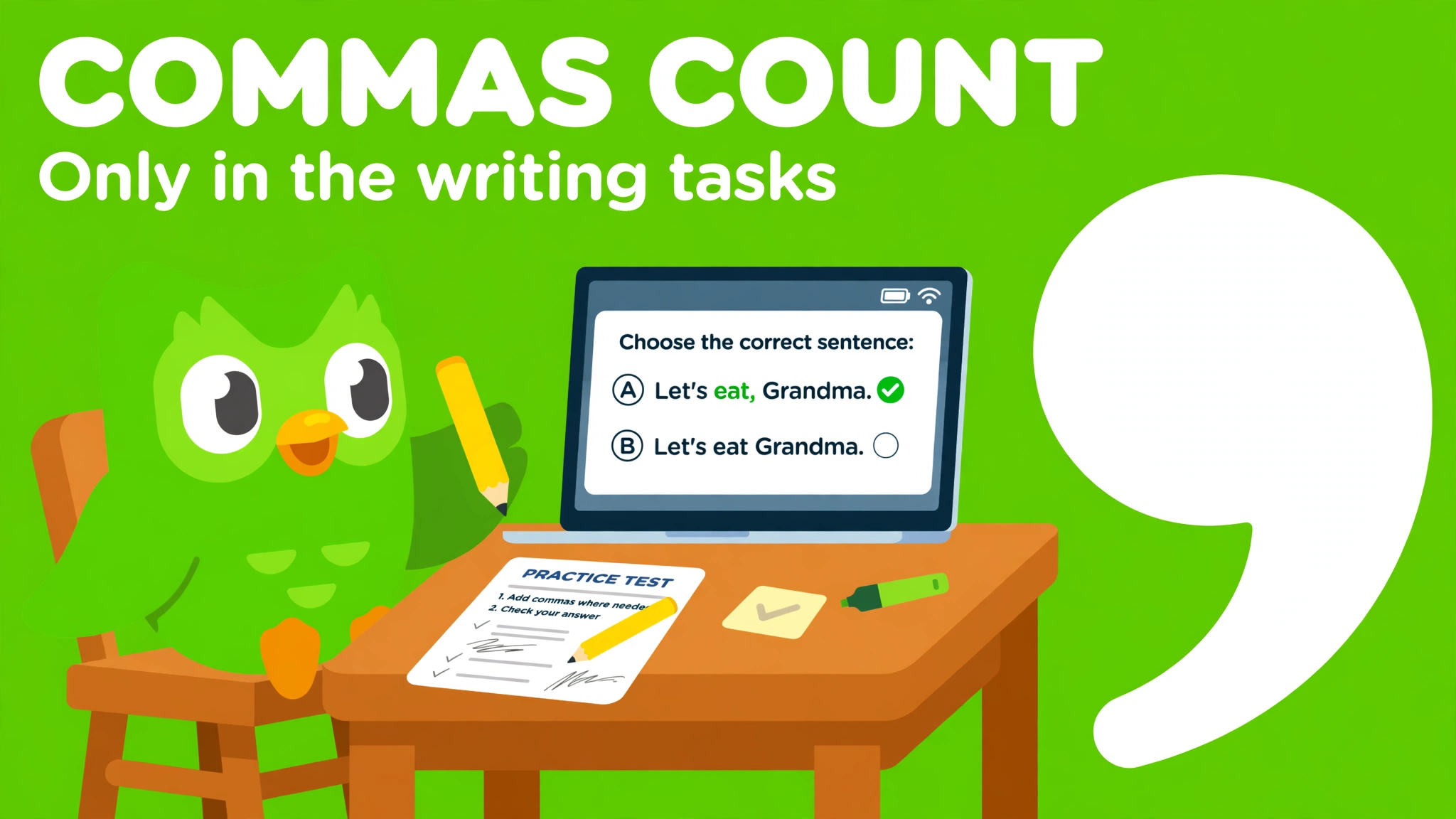
Yes, commas matter — but only in the writing tasks. In Interactive Writing, Write About the Photo and the Writing Sample, punctuation is part of your Grammar score. In the reading and listening tasks, there is no place to use a comma at all. One missing comma will not fail you, but repeated comma mistakes make your writing hard to follow, and that does cost points.
Here is what we will cover:
- Where commas matter in the test, and where they do not
- How punctuation is scored
- The 5 comma rules that matter most
- The 3 comma mistakes that cost points
- How to practise commas before test day
- FAQs
Where Do Commas Matter in the Duolingo English Test?
The Duolingo English Test (DET) has 13 question types. You only type free sentences in three of them. Those are the only places a comma can help or hurt you.
| Question type | Do commas matter? | Why |
|---|---|---|
| Interactive Writing | Yes — most | Two written answers, 5 minutes plus 3 minutes. Punctuation is scored as part of Grammar. |
| Write About the Photo | Yes | You write sentences about a photo for 1 minute. Clear punctuation helps the reader follow you. |
| Writing Sample | Yes | A 3 to 5 minute written answer. It is not scored, but universities read it. |
| Listen and Type | Barely | You type the sentence you hear. The words matter most. Add the comma if you hear a clear pause, but do not stress over it. |
| Read and Select, Listen and Select, Fill in the Blanks, Read and Complete | No | You click, choose or type single words. There is no sentence to punctuate. |
| Speaking tasks | No | You speak, so commas do not exist. Pauses and intonation do the same job. |
So the honest answer is narrow: commas matter in about 11 minutes of a 1-hour test — the free-writing tasks. Everywhere else, they are irrelevant.
How Is Punctuation Scored?
Duolingo scores every writing answer on four criteria. Punctuation sits inside the Grammar criterion:
| Criterion | What it checks |
|---|---|
| Content | Is your answer relevant, complete and on topic? |
| Discourse coherence | Do your ideas connect in a clear order? |
| Grammar | How wide is your range of sentence structures, and how accurate are they? Punctuation counts here. |
| Lexis | Is your vocabulary varied and precise? Spelling counts here. Both US and UK spelling are accepted. |
The key phrase in Duolingo’s scoring guide is this: do punctuation errors make the message difficult to understand? A single missing comma in a clear sentence is a small slip. A comma splice that joins two full sentences, or a missing comma that changes the meaning, is a bigger problem because the reader has to work to understand you.
Interactive Writing is worth about 22% of your Writing subscore (11% for Step 1 and 11% for Step 2), and Write About the Photo, which appears three times, is worth about 33%. So punctuation in these tasks feeds a real share of your score — but it is one small part of one criterion, not the whole test.
Interactive Writing: The Timing
This is the task where commas matter most, so know its shape:
| Step | Time | What to do |
|---|---|---|
| Step 1 | 30 seconds to plan, then 5 minutes to write | Answer the prompt. Aim for about 120 to 130 words. |
| Step 2 | 3 minutes, no planning time | Answer a follow-up on the same topic. Aim for about 70 to 80 words. Add new ideas, do not repeat Step 1. |
There is only one Interactive Writing task per test, and the two steps are scored together. Save the last 30 to 45 seconds of each step to proofread — that is when you catch comma mistakes.
The 5 Comma Rules That Matter Most
You do not need every comma rule in English. These five cover almost everything you will write in the test.
1. Use a comma after an introductory phrase
When a sentence starts with a time phrase, a place phrase or a linking word, put a comma after it.
Correct: In my opinion, online classes are better for working students.
Correct: Last year, my family moved to a new city.
Wrong: In my opinion online classes are better for working students.
2. Use a comma before and, but or so when they join two full sentences
If both sides could stand alone as a sentence, put a comma before the joining word.
Correct: I wanted to study abroad, but the cost was too high.
Correct: She practised every day, and her score went up.
Wrong: I wanted to study abroad but the cost was too high.
Do not use a comma when the second part is not a full sentence: “I wanted to study abroad but could not afford it.” No comma needed there.
3. Use commas around extra information
If you can remove a phrase and the sentence still works, put commas around it.
Correct: My teacher, Mrs Khan, helped me prepare for the test.
Correct: The library, which is near my home, opens at 8 in the morning.
4. Use a comma between items in a list
Correct: I need a passport, a laptop and a quiet room for the test.
The final comma before “and” (the Oxford comma) is optional. Both styles are accepted. Pick one and stay consistent.
5. Use a comma to separate a name or a direct address
Correct: Thank you, Professor, for your help.
Correct: Ali, can you check my answer?
The 3 Comma Mistakes That Cost Points
1. The comma splice
Joining two full sentences with only a comma is the most common serious mistake.
Wrong: I like reading, it helps me learn new words.
Correct: I like reading, because it helps me learn new words.
Correct: I like reading. It helps me learn new words.
2. The run-on sentence with no comma at all
Long sentences without any punctuation are hard to read. If your sentence has two ideas, break it or join it properly.
Wrong: I studied for three months I took the test twice my score improved a lot.
Correct: I studied for three months, took the test twice, and my score improved a lot.
3. A comma that changes the meaning
Commas can change what a sentence means. Compare these two:
Without comma: The students who studied hard passed the test. (Only the ones who studied passed.)
With commas: The students, who studied hard, passed the test. (All of them studied, and all of them passed.)
In a test answer, a misplaced comma like this confuses the reader — and a confused reader is exactly what the Grammar criterion penalises.
What To Do Instead: A Simple Comma Plan
- Write short, clear sentences first. A correct short sentence always beats a long broken one. Mix in one or two longer sentences to show range, but only when you are sure of the commas.
- Use the five rules above and nothing fancy. You do not need semicolons or complex comma patterns to score well.
- Proofread the last 30 seconds. Read your answer once, slowly. Fix comma splices and run-on sentences first — they cost more than a missing comma after “However”.
- Do not add commas where you pause when speaking. Speaking pauses and written commas are not the same thing. If you are unsure, leave the comma out. A missing comma is usually a smaller error than a wrong one.
- Practise with the official practice test. Take the free practice test on the Duolingo English Test website and write your answers under the real timers. Then read them back and check only the commas.
For the full picture of the test, see our guides: Duolingo English Test Question Types and Duolingo English Test Preparation. The test costs $70 — see Duolingo English Test Fees for the full price breakdown.
Frequently Asked Questions
Does a comma matter in the Duolingo English Test?
Yes, in the writing tasks. Punctuation is part of the Grammar score for Interactive Writing and Write About the Photo. It does not matter in the reading, listening or speaking tasks, because you never type a sentence there.
Can one comma mistake fail me?
No. One small slip will not fail you. The score drops when punctuation errors keep happening and make your writing hard to understand. Content, vocabulary and clear ideas matter more than any single comma.
Do I need perfect punctuation for a high score?
No, but you need good control. High-scoring answers use a mix of short and long sentences with mostly correct punctuation. A few small slips are normal even at high scores.
Is the Oxford comma required?
No. Both styles are accepted. Use it or leave it out, but be consistent in the same answer.
Does US or UK punctuation matter?
No. Duolingo accepts both US and UK spelling and punctuation conventions. Pick one and use it throughout your answer.
Do commas matter in Read and Select or Listen and Type?
No. In Read and Select you only click Yes or No for single words. In Listen and Type you type the words you hear — the words are what count. Commas only matter where you write your own sentences.
The Verdict
Commas matter, but only in a small part of the test. Learn the five rules above, avoid comma splices and run-on sentences, and save time to proofread. Do that, and punctuation will help your score instead of hurting it — and you can spend the rest of your preparation on the ideas, vocabulary and clear sentences that matter far more.


