
Last updated: November 2026
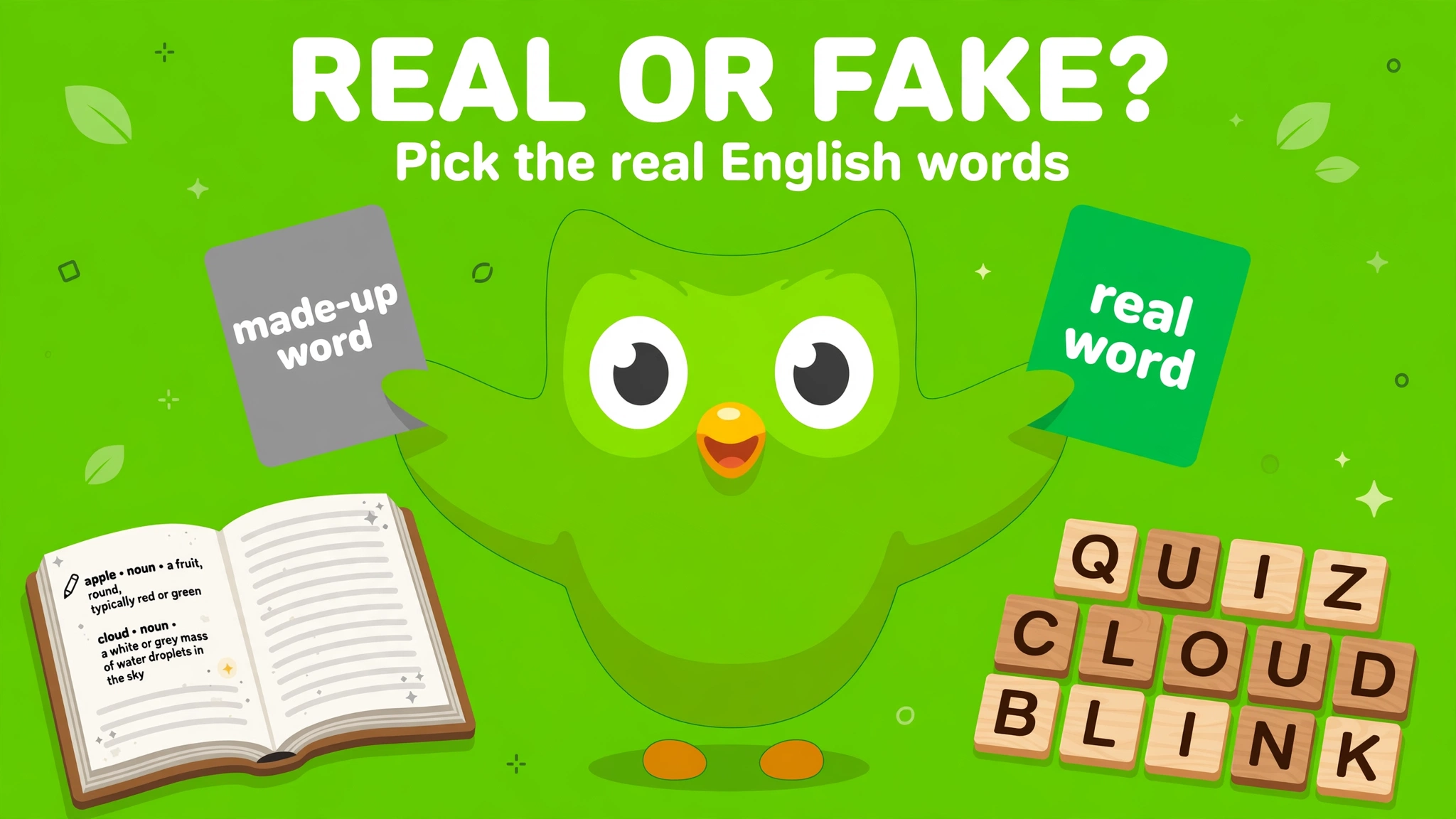
You are taking the Duolingo English Test and a word appears on your screen. Is it a real English word, or a fake one? You have five seconds to decide.
There is no such thing as an “original English word” in the test. The question type is called Read and Select. It shows you words one at a time and asks: “Is this a real English word?” Some are real words. Others are made-up words that only look like English. Your job is to click Yes or No for each one, in 5 seconds.
Here is what we will cover:
- What Read and Select really is
- How the task works, step by step
- Real words vs made-up words, with examples
- How it is scored
- 7 tips to get more answers right
- How to practise
- FAQs
What Is Read and Select?
Read and Select is the first question type in the Duolingo English Test. It tests your vocabulary — not by asking you to define words, but by checking whether you can recognise real English words at speed.
The test shows you a series of words, one at a time, in the centre of the screen. For each word you must decide whether it is a real English word or a fake word, and click Yes or No. As soon as you answer, the next word appears.
| Fact | Detail |
|---|---|
| Words per test | 15 to 18 words, in one set |
| Time per word | Exactly 5 seconds |
| Your answer | Click Yes (real word) or No (fake word) |
| When it appears | In the first half of the test |
| What it counts toward | Reading, Literacy and Comprehension subscores |
| Adaptive | Yes — the words get harder or easier based on your answers |
The Duolingo English Test is a fully online, adaptive test. It takes about 1 hour, costs $70, and reports a score from 10 to 160. Read and Select is one of 13 question types. For the full list, see our guide: Duolingo English Test Question Types.
Real Words vs Made-Up Words
The fake words in this task are not random letters. They are called pseudowords — words that follow English spelling and sound rules, so they look and sound like they could be real. That is what makes the task hard.
| Real English words (click Yes) | Made-up words (click No) |
|---|---|
| files, mountain, birthday | brelt, frimble, wanture |
| consultation, heinous, alabaster | hobar, thirther, docuse |
| prevaricate, despite, although | leadine, quarnish, sprogle |
Notice how the fake words feel familiar. “Frimble” sounds like “frivolous” and “nimble”. “Wanture” sounds like “want” plus “adventure”. Your brain wants to say Yes. The test is checking whether you actually know the word, or are only guessing from how it sounds.
Two things to know:
- There is no fixed number of real words. Any mix is possible. Judge each word on its own — do not try to guess a pattern, like “three real, then one fake”.
- Both British and American spelling count as real. “Colour” and “color”, “organise” and “organize” are all real English words.
How Is Read and Select Scored?
Each answer is marked right or wrong. There is no partial credit — you cannot be “almost right” on a Yes or No question. If you do not answer within 5 seconds, the word is marked wrong.
Duolingo’s scoring guide says you are not penalised more for a wrong answer than for skipping — so never leave a word unanswered. A guess gives you a 50% chance. A blank gives you nothing. When the timer is nearly out, pick the answer that feels most likely and move on.
Because the task is adaptive, the words change with your level. If you answer well, you will see harder, rarer words — sometimes words at the level of advanced academic vocabulary. If you struggle, the words get simpler. So a high score does not mean seeing only easy words. It means recognising hard words too.
Do not memorise lists of fake words. The test draws from a huge bank, and the fake words change every time. The only reliable way to improve is to grow your real vocabulary, so real words feel familiar and fake ones feel wrong.
7 Tips to Get More Answers Right
1. Trust your first feeling
You have 5 seconds. If a word feels like one you have seen before, click Yes. If it feels strange or made up, click No. Overthinking in 5 seconds usually makes things worse.
2. Say the word in your head
Real words usually sound smooth. Fake words often sound slightly off when you say them silently — an odd ending, a strange stress, a combination of letters English rarely uses. If it sounds wrong, it probably is wrong.
3. Look for real word parts
Real words are often built from parts you know: prefixes like “un-“, “re-“, “pre-” and suffixes like “-tion”, “-ness”, “-ly”. A fake word may have a real-looking part but combine it in a way English never does. “Wanture” has a real start (“want”) but the ending does not make a real word.
4. Do not guess Yes just because a word looks long
Long words feel impressive, but length proves nothing. “Prevaricate” is real. “Quarnish” is not, even though it looks just as long and serious. Judge the word, not its size.
5. Answer every single word
Never let the timer run out. A blank is always wrong. A fast guess is right half the time.
6. Read real English every day
The best preparation is exposure. Read news articles, short stories or academic texts in English for 20 minutes a day. The more real words you have seen, the faster your Yes feels certain — and the faster a fake word feels wrong.
7. Learn word families, not single words
When you learn “consult”, also learn “consultation”, “consultant” and “consultative”. Real words come in families. Fake words do not. Knowing the family makes the real word easy to spot.
How to Practise Read and Select
| Practice method | How to do it |
|---|---|
| Official practice test | Take the free practice test on the Duolingo English Test website. It uses the same question types and the same 5-second timer. You can repeat it as often as you like. |
| 5-second flash drills | Make a list of 18 words, mixing real and fake ones. Show yourself one word at a time for 5 seconds and answer Yes or No. Then check your answers. |
| Vocabulary reading | Read one article a day and write down 5 new real words. Use each one in a sentence the same day. |
| Full mock tests | Take full-length mock tests under real conditions to practise the whole test, not just this one task. See our guide: How to Practise Mock Tests for the Duolingo English Test. |
Frequently Asked Questions
What is an original English word in the Duolingo English Test?
The test itself does not use the phrase “original English word”. What people mean is the Read and Select question type, where you decide whether each word shown is a real English word or a made-up one. Real words are words found in standard English dictionaries. Made-up words only look like English.
How many Read and Select questions are there?
There are 15 to 18 words in one set, and one set per test. You get 5 seconds for each word.
What happens if I do not answer in 5 seconds?
The word is marked wrong and the next word appears. Always answer, even if you have to guess.
Are British spellings accepted as real words?
Yes. Both British and American spellings count as real English words in Read and Select.
Can I practise Read and Select on its own?
Yes. The official Duolingo English Test practice page lets you practise this question type on its own, or as part of a full-length practice test.
Does Read and Select affect my overall score a lot?
It feeds your Reading, Literacy and Comprehension subscores, which feed your overall score. It is one of 13 question types, so it matters — but no single task decides your score alone.
The Verdict
Read and Select is a vocabulary recognition test, not a memory test. You cannot memorise the answers, because the words change every time. What you can do is read real English every day, learn word families, trust your first feeling in the 5 seconds you get, and answer every single word. Do that, and the real words will feel familiar — and the fake ones will stand out.