
Last updated: November 2026
You want to learn Mandarin Chinese, and Duolingo is free. So the real question is not whether Duolingo teaches Mandarin. It does. The real question is whether it teaches it well enough to be worth your time.
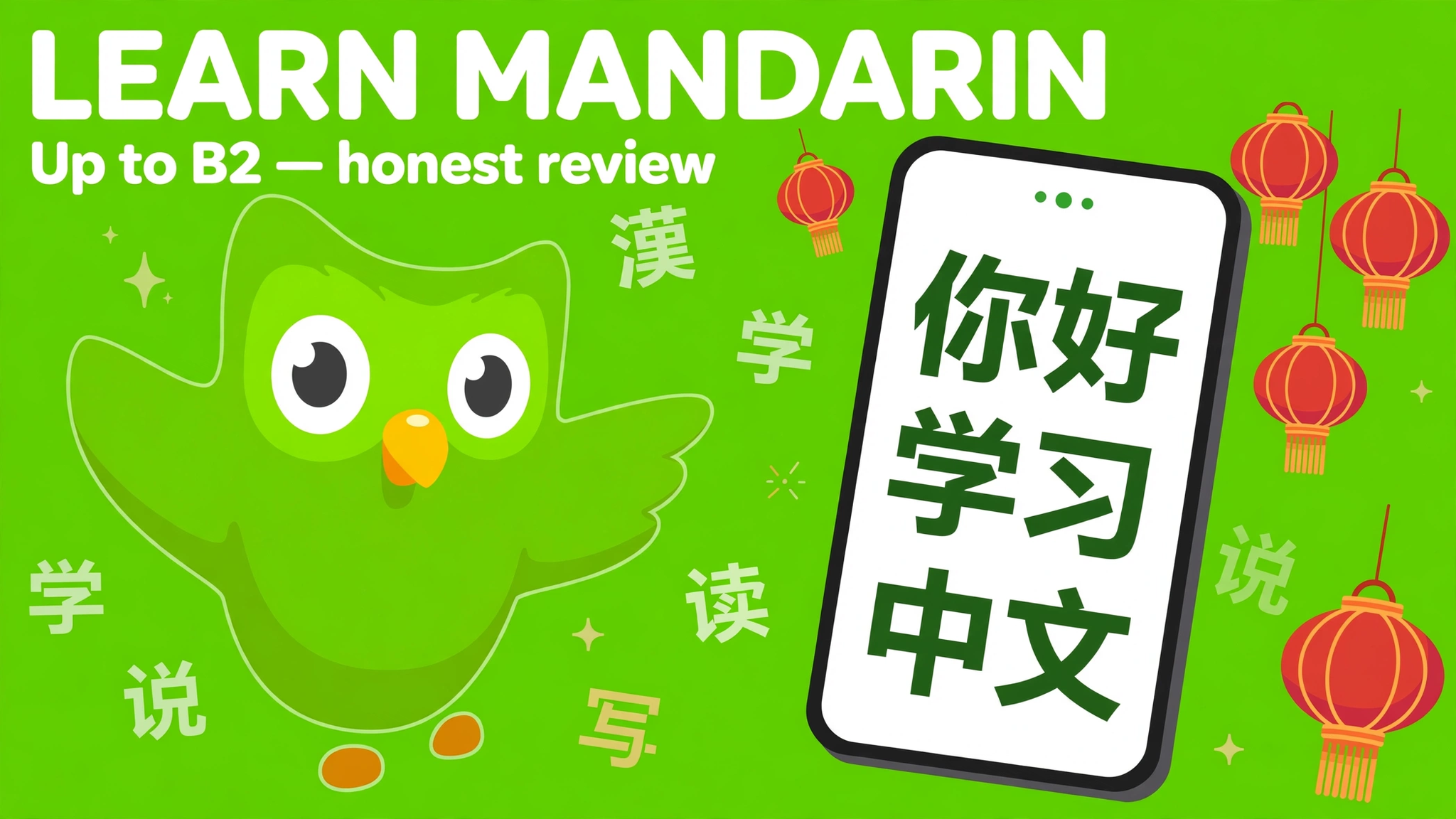
Yes, Duolingo teaches Mandarin Chinese, and it is a good free way to start. The course is big now — 8 sections and over 1,000 units, up to CEFR B2 level by Duolingo’s own measure. But it is weak where Mandarin is hardest: tones, speaking, and grammar. Use it to build a daily habit and learn your first characters, then add a serious course or tutor if you want to get past beginner level.
This guide covers what the Mandarin course teaches, how far it takes you, where it falls short, and what to pair it with.
Here is what we will cover:
- Does Duolingo teach Mandarin Chinese?
- What the course covers: characters, pinyin, and tones
- How far does it take you?
- Where Duolingo falls short for Mandarin
- Is Super worth it for Chinese?
- What to use instead or alongside Duolingo
- FAQs
Does Duolingo Teach Mandarin Chinese?
Yes. Duolingo has a full Mandarin Chinese course for English speakers. It uses Simplified Chinese characters, the writing system used in mainland China, Singapore, and Malaysia. The course is free, with ads and a daily energy limit on the mobile app. The web version on desktop has no energy limit.
Duolingo also teaches Cantonese, which uses Traditional Chinese characters. Cantonese and Mandarin are different spoken languages, so do not mix them up. If your goal is Mandarin, pick the Mandarin course, not Cantonese.
The course is much bigger than it used to be. In 2026 Duolingo expanded its biggest courses, Chinese included, so the Mandarin path now runs to CEFR B2 (upper intermediate) by Duolingo’s own measure, with 8 sections and over 1,000 units. There are also Stories and DuoRadio listening episodes, plus a Characters tab for practising hanzi.
What the Course Covers: Characters, Pinyin, and Tones
Mandarin is hard for English speakers for three reasons: the characters, the tones, and the sounds. Here is how Duolingo handles each one.
Chinese characters (hanzi)
Duolingo teaches characters from your very first lesson, which is a strength. Many courses start with pinyin only and delay characters for months. Duolingo does the opposite: you see, match, and tap characters from day one. There is a Characters tab with over 300 character lessons, and you can practise writing characters stroke by stroke.
The weakness is depth. Most exercises ask you to recognise a character or pick it from tiles. You rarely have to produce a character from memory, and the meaning of each character is not always explained well. You learn what characters look like faster than you learn what they mean.
Pinyin
Pinyin is the romanised spelling of Mandarin sounds, and Duolingo uses it throughout the course. Every new word shows its pinyin and its tone marks, so you always know how a word is meant to sound. This makes the first weeks much easier than a characters-only course.
The risk is that you lean on pinyin and stop reading the characters. Try to read the characters first and use pinyin only to check yourself.
Tones
Mandarin has four tones, plus a neutral tone. The same sound with a different tone is a different word: mǎi means “buy” and mài means “sell”. Tones are the hardest part of Mandarin for most learners, and they are Duolingo’s weakest area.
Tone marks appear on the pinyin, and you hear the audio. But nothing in the course teaches you how tones work, tests whether you can hear the difference between two tones, or scores you on saying them correctly. The speaking exercises mostly ask you to repeat a sentence out loud, and the voice recognition is very forgiving. If tones matter to you — and they do — you need extra practice elsewhere.
How Far Does It Take You?
| What you get | Where Duolingo takes you |
|---|---|
| Course size | 8 sections, over 1,000 units, up to CEFR B2 by Duolingo’s measure |
| Vocabulary | Covers HSK 1–3 and about half of HSK 4, by Duolingo’s own claim |
| Reading | Simple texts and Stories; not enough for real articles on your own |
| Speaking | Repeating sentences; no real conversation practice on the free plan |
| Listening | Short audio in lessons, plus Stories and DuoRadio episodes |
| Writing characters | Stroke-by-stroke practice in the Characters tab; most lessons only ask you to tap tiles |
| Grammar | Short tips only; rules are mostly left for you to guess |
Independent reviews in 2026 put a Duolingo-only learner at around HSK 3, maybe HSK 4 in vocabulary, with reading and speaking behind that. That is enough for simple texts and basic conversations, not for fluency. And remember the scale of the task: the US State Department budgets about 2,200 classroom hours for professional-level Mandarin, three to four times its figure for Spanish. A year at 10 minutes a day on Duolingo is under 3% of that. No app closes that gap alone.
Where Duolingo Falls Short for Mandarin
- Tones are shown, not taught. No tone drills, no test of whether you can hear tones, and no scoring of your tone production.
- Speaking is mostly repeating. You repeat sentences out loud. You do not build your own sentences in conversation. Video Call with Lily, the AI conversation partner, is on paid plans and is still not a real person.
- Grammar is barely explained. Tips are short, with one or two examples. You are expected to work out the rules yourself, which is slow and frustrating at higher levels.
- Most answers are recognition, not recall. Over four in five items in the lessons one detailed review counted were answered by picking an option or arranging tiles. Picking the right tile is much easier than producing the word yourself.
- Some translations are narrow or wrong. The course is largely auto-generated, and learners still report the odd mistake in 2026. Duolingo often accepts only one “correct” translation even when another is fine.
- Energy limits your study. On mobile, free users get 25 energy a day. For a 10-minute session you will barely notice it. For a long session you will hit the bottom and have to wait, watch an ad, or spend gems.
Is Super Worth It for Chinese?
Only if the energy limit or the ads keep stopping you from practising. Super removes ads and the energy limit, and adds unlimited mistake review. It does not add any Mandarin-specific teaching. The same gaps in tones, grammar, and speaking remain. Do not buy Super expecting a better Chinese course — you get the same course, with less friction.
Super costs about $12.99–$13.99 a month or about $83.99–$119.99 a year in the US. Prices vary by account, country, and device, so check your own checkout screen. For the full price breakdown, see our guide: Does Duolingo Cost Money? Super, Family and Free Prices 2026.
What to Use Instead or Alongside Duolingo
Duolingo works best as your daily habit, not your only course. Pair it with one of these to cover what it misses:
| App or course | Best for | What it adds |
|---|---|---|
| HelloChinese | A deeper Mandarin-first course | Real tone drills, speech grading, stroke-order writing, clear grammar notes |
| ChineseClass101 | Grammar and culture | Video and audio lessons from beginner to advanced, with real explanations |
| Yoyo Chinese | Pinyin and tones | Video course focused on pronunciation and tones, taught in English |
| Pleco | Dictionary and flashcards | Look up any word, check characters, and drill vocabulary properly |
| Skritter | Character writing | Handwriting practice with real recall, not tile-tapping |
A simple plan that works: 10–15 minutes of Duolingo a day for the habit and vocabulary, plus a tone and grammar course for the hard parts, and real listening — shows, podcasts, music — once you can follow simple sentences. When you are ready to speak, a tutor on italki or Preply, or a language partner on HelloTalk, will do more for you than any app.
Frequently Asked Questions
Does Duolingo teach Mandarin Chinese for free?
Yes. The whole Mandarin course is free. You never have to pay for lessons. Paying for Super only removes ads and the daily energy limit. It does not unlock extra Mandarin lessons.
Does Duolingo teach Simplified or Traditional characters?
The Mandarin course uses Simplified characters, used in mainland China, Singapore, and Malaysia. Traditional characters, used in Taiwan, Hong Kong, and Macau, are not covered in the Mandarin course. Duolingo’s Cantonese course uses Traditional characters.
Can Duolingo make me fluent in Mandarin?
No. No app can. Duolingo can take you to around HSK 3 in vocabulary, with basic conversations and simple reading. Fluency needs years of listening, reading, and real conversation after the beginner stage, which Duolingo does not cover.
Does Duolingo teach Chinese tones?
Not really. Tone marks appear on the pinyin and you hear the audio, but there are no tone lessons, no tone drills, and nothing that checks whether you can hear or say tones correctly. Use a Mandarin-specific course like HelloChinese or Yoyo Chinese for tones.
Is Duolingo good for learning Chinese characters?
It is a good start. You meet characters from lesson one, and the Characters tab lets you practise writing them stroke by stroke. But most exercises only ask you to recognise characters or tap tiles, so pair it with handwriting practice in Skritter or Pleco if writing matters to you.
What level does Duolingo Chinese reach?
Duolingo says the course runs to CEFR B2 (upper intermediate), and it claims coverage of HSK 1–3 and about half of HSK 4. Independent reviews put a Duolingo-only learner lower in practice — around HSK 3, maybe HSK 4 in vocabulary, with speaking and reading behind that.
The Verdict: Is Duolingo Worth Your Time for Mandarin?
Yes, as a start — no, as your only plan. Duolingo is the easiest free way to begin Mandarin: pinyin, your first few hundred characters, useful everyday words, and a daily habit that actually sticks. It is honest about what it is, and it costs nothing.
But Mandarin’s hard parts — tones, real speaking, grammar, and reading — are exactly where Duolingo is thinnest. If you are serious about Chinese, use Duolingo for 10–15 minutes a day and spend your real study time on a Mandarin-specific course and real conversation. If you only want to try Chinese, have some fun phrases for a trip, or keep a daily habit, Duolingo on its own is fine.




One Comment