
Every December, Duolingo — the world’s most downloaded education app — publishes a year-end report ranking the languages its learners studied most. The most recent edition, the 2025 Duolingo Language Report, was published on December 1, 2025, and it’s still the most current, verified snapshot available as of mid-2026. A 2026 edition would typically follow this December, so if you’re reading this later in the year, check Duolingo’s blog for an updated version.
Here’s what the data actually shows — and what it means if you’re deciding which language to study yourself.
Quick Answer: The Top 10 Most-Studied Languages Globally
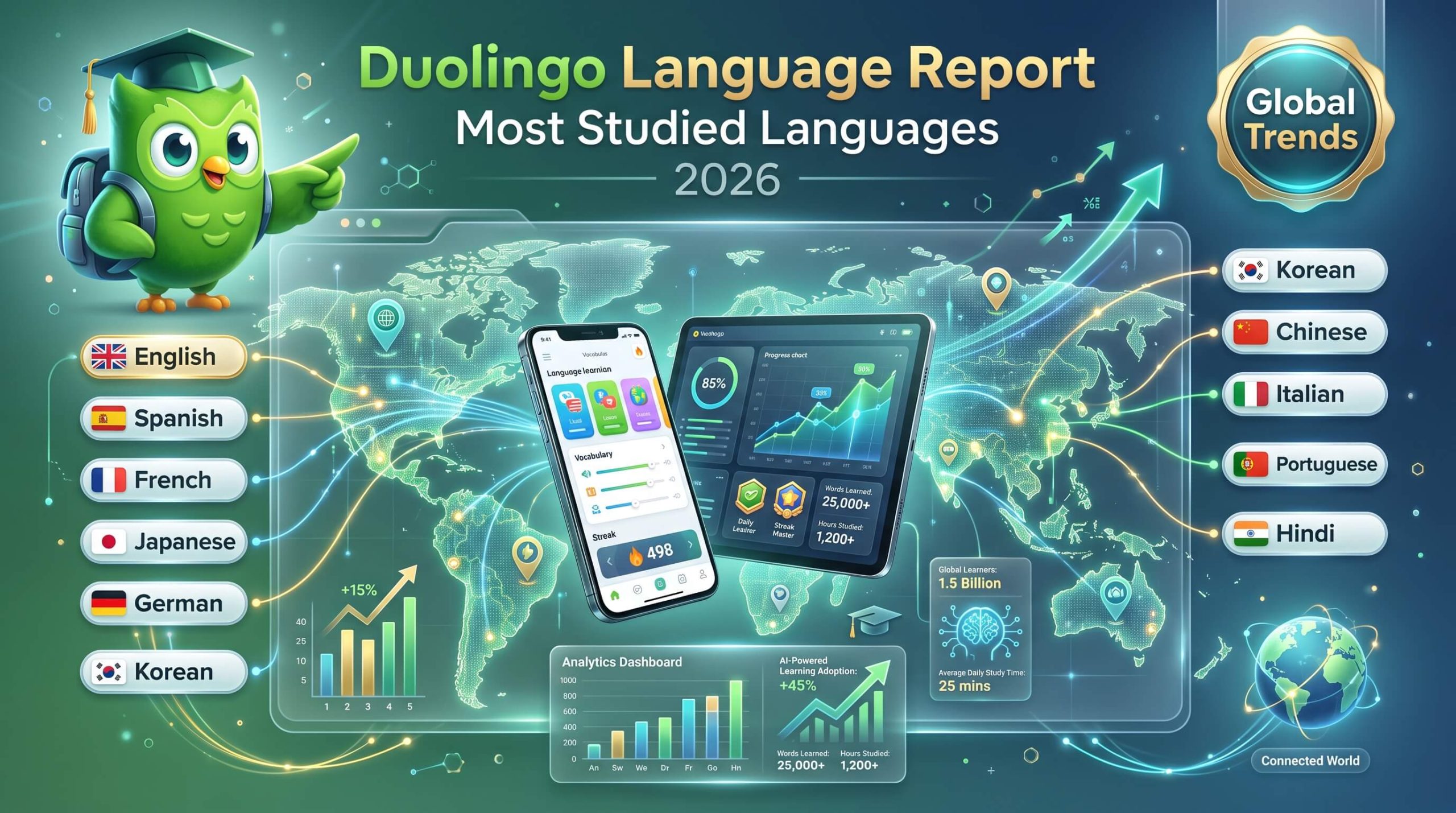
According to the 2025 report, the ten most-studied languages on Duolingo, based on learner activity between October 1, 2024 and September 30, 2025, are:
- English
- Spanish
- French
- Japanese
- German
- Korean
- Italian
- Chinese
- Portuguese
- Hindi
The two biggest movers this year were Japanese, which became the fourth most popular language to study globally, surpassing German, and Korean, which became the sixth most popular, moving past Italian.
The “Second Choice” Language Map Is Just as Revealing
The global top 10 tells you what people study most overall, but Duolingo’s report also breaks down which language ranks second most popular in each country — and this map looks strikingly different from the first-place map.
Globally, French is the most common second-place language, ranking as the second most-studied language in 60 countries. Spanish follows in 48 countries, German in 22, English in 15, and Japanese and Portuguese tied at 13 each. Chinese appears as the second-place language in 9 countries, Russian in 4, and Italian and Korean in 3 each, with Arabic, Hindi, Irish, and Turkish each holding the second spot in a single country.
This matters because it captures something the top-10 list alone can’t: French and Spanish’s continued strength as complementary languages — the ones people study once English is already covered — rather than as each country’s primary academic focus. For context on first-place dominance: English holds the number-one spot in 154 countries, Spanish in 26, French in 12, and German in 2. Put the two data sets together, and French’s real global footprint (strong second-place presence across 60 countries, despite only 12 first-place wins) becomes far more visible than the top-10 ranking shows on its own.
Why the Rankings Shifted This Year
It’s tempting to read a ranking change as a pure shift in cultural interest, but Duolingo’s own explanation is more specific than that. For the first time, speakers of more than 20 additional languages could study Japanese and Korean directly from their own language, rather than needing to already know English, Japanese, or Chinese to access those courses.
In plain terms: Japanese and Korean didn’t necessarily become more desirable overnight. They became more accessible. Previously, someone who spoke, say, Portuguese or Thai as a first language had no direct path into Duolingo’s Japanese or Korean courses. Once that access barrier came down, enough new learners enrolled that it reshuffled the global top 10. This is a useful distinction: rising interest in K-dramas or anime may be part of the cultural backdrop, but the report itself attributes the ranking change specifically to expanded course availability, not to a documented shift in stated learner motivation.
English’s Continued Global Dominance
English remains, by a wide margin, the most-studied language in the world on Duolingo. This year, English became the number-one language in 154 countries, an increase of 14% over 2024, and English is now among the top two most popular languages in all but 25 countries worldwide.
What’s notable is where that demand is concentrated. English ranks highly even in countries with high existing English proficiency or official English status, including the United States, Sweden, and Tanzania — suggesting the appeal isn’t purely about learning a foreign language from scratch, but often about formalizing, certifying, or polishing skills people already partially have.
That certification angle shows up directly in the data. Demand for the Duolingo English Test — an online English proficiency exam accepted by thousands of universities and institutions — grew alongside general English study. In 2025, test-takers came from 219 countries and spoke 148 different first languages, a notable increase from 2024. Asia accounted for 55% of all test sessions, while Africa’s share grew from 7% to 8.3% year-over-year, driven largely by rising popularity in Nigeria, Ethiopia, and Ghana. Among non-native English speakers taking the test, Mandarin, Spanish, and Arabic speakers made up roughly 31% of all sessions combined.
Fastest-Growing Languages Tell a Different Story Than the Top 10
The global top 10 measures overall volume — which languages have the most learners in absolute terms. But Duolingo also tracks which languages are growing fastest in specific countries, and that list looks different, dominated by Chinese, Korean, and Portuguese.
- Chinese is the fastest-growing language in Argentina, Brazil, Colombia, France, Germany, Indonesia, Mexico, Poland, South Korea, Spain, Thailand, and Türkiye — and the second-fastest-growing language in the United States.
- Korean is the second-fastest-growing language in seven countries: Argentina, Colombia, France, Germany, Mexico, Poland, and Spain.
- Portuguese is the fastest-growing language in China and India, and the second-fastest in Indonesia, Japan, South Korea, and Türkiye. Duolingo’s report suggests this may connect to Brazil’s expanding economic and cultural influence, though it frames this as a plausible interpretation rather than a directly measured cause.
This distinction matters for anyone deciding what to study: a language can already be enormous (like English or Spanish) while growing slowly, or it can be a smaller course with fast, early-stage momentum (like Korean in several European markets). Which one is more relevant to you depends on whether you’re chasing scale or timing.
United States-Specific Rankings
Duolingo’s published Language Report presents rankings at a global and country-by-country level — for example, it reports which language ranks #1 and #2 in each of the countries it tracks — but the primary 2025 report does not publish a standalone, dedicated breakdown for the United States with current, dated percentage figures.
Older, unofficial aggregator sites cite figures like “Spanish accounts for 45.4% of U.S. Duolingo users” or “English is the second most-studied language in the U.S. at 21%,” but these figures could not be verified against a specific, current-dated Duolingo report and may reflect outdated years mixed together. [VERIFY: exact current U.S.-specific percentage breakdown — not confirmed in Duolingo’s official 2025 report or any primary source located during research]
What can be said with confidence, based on Duolingo’s own historical blog commentary, is that Spanish has consistently been described as the most-studied second language in the United States on the platform in past editions, which lines up with broader, independently documented patterns — Spanish is the most common non-English language spoken at home in the U.S. according to Census Bureau data — but readers should treat any specific current percentage for U.S. learners with caution until Duolingo publishes an explicit, current U.S.-level dataset.
The Countries Studying the Most Languages — and Studying Hardest
Beyond raw language rankings, the report tracks two other useful measures: which countries have the most “polyglot” learners (people studying three or more languages), and which countries have the most serious learners overall (based on average time spent studying).
Most polyglot countries in 2025:
- Japan
- Australia
- Finland
- Germany
- United Kingdom
This is a genuine shakeup. For several years prior, Finland, Germany, and the U.K. had been trading the top spots among themselves. Japan and Australia jumping to first and second, respectively, is new for this edition.
Most serious learners (by average study time) in 2025:
- Japan
- Hungary
- Belarus
- Russia
- Germany
Japan has now held the number-one spot for the second year in a row, and for the third time in the last four years.
Which languages attract the most serious learners (regardless of country) is a related but different metric — and here the list looks notably different from the overall top 10:
- Spanish
- English
- Italian
- Welsh
- Norwegian
The presence of Welsh and Norwegian in fourth and fifth place is a real outlier worth pausing on. Neither language comes close to cracking the global top 10 by learner volume, but both apparently attract a smaller, unusually dedicated learner base — suggesting these are often chosen deliberately (heritage learners, personal connection to the language) rather than picked up casually.
An Unexpected Finding: What Latin Learners Also Study
One of the more specific findings in the 2025 report involves Latin, which Duolingo doesn’t count among its “top 10” living languages but does track as a distinct course. Learners studying Latin are more likely than learners of any other language to also study Duolingo’s other subjects: over 19% of Latin learners also study chess, 14% also study math, and 13% also study music.
Duolingo doesn’t offer a specific explanation for this pattern in the report, and it would be speculative to assert a definitive cause — but it’s a notable enough correlation that it’s worth flagging for anyone interested in the psychology of language learning, or simply curious why a “dead” language shows this particular behavioral signature.
How the Top 10 Has Shifted Over the Past Few Years
Because Duolingo has published this report annually since 2020, it’s possible to trace how the ranking has actually moved — and the picture is one of a mostly stable core with meaningful churn near the bottom of the list.
In the 2023 report, Korean climbed to sixth place in the global rankings for the first time, and Portuguese entered the top 10 outright, displacing Russian from the list. In the 2024 report, English extended its number-one position to 135 countries — up more than 10% from the year before — and East Asian languages continued reshuffling beneath the top three, though the overall order of the top 10 held steady from 2023. The 2025 report is where the more significant movement happened: Japanese’s jump to fourth place (past German) and Korean’s move to sixth (past Italian) represent the biggest single-year shift in the top 10’s internal order across the three most recent editions.
The throughline across all three years is that English, Spanish, and French have not moved from the top three at any point in this window. The competition has consistently been for positions four through ten, and increasingly, that competition is being decided by which languages Duolingo makes accessible from the most starting languages — not simply by which languages are culturally trending in a given year.
How This Data Is Collected (and Its Limits)
It’s worth understanding what this report can and can’t tell you, since that shapes how much weight to put on any individual finding.
The 2025 report covers learners who studied languages on Duolingo specifically between October 1, 2024, and September 30, 2025. Data is aggregated by country or language to protect learner privacy, and countries with fewer than 5,000 Duolingo learners are excluded from rankings entirely. Age and motivation data are self-reported by users, and learners under 13 are excluded from all analyses.
The most important limitation, though, is simpler: this is Duolingo usage data, not a measure of global language demand as a whole. It tells you what’s popular on one specific app, among people who chose that app, in that specific 12-month window. Other platforms, university enrollment data, or in-person classes could show meaningfully different patterns. Duolingo is large enough — and has published this report consistently enough since 2020 — that its data is a genuinely useful proxy for broader interest trends, but it’s a proxy, not a census.
What This Means If You’re Choosing a Language to Study
If you’re using this report to help decide what to study yourself, a few practical takeaways emerge from the data above, distinct from just the raw ranking:
- If you want the language with the most learners and the most available resources, Spanish, French, or English (as a second language) remain the safest, most well-trodden paths — reflected in their consistent top-3 global position.
- If you’re interested in a language with early momentum rather than existing scale, Korean and Chinese show unusually strong recent growth in multiple major markets, including notable growth in the United States.
- If your goal is a smaller, more dedicated community rather than sheer popularity, languages like Welsh or Norwegian attract learners who tend to stick with the material longer, even though far fewer people study them overall.
- If you’re studying English for professional or academic reasons, certification demand is rising alongside general interest — worth knowing if you’re weighing whether to pursue a formal test like the Duolingo English Test.
Bottom Line
The headline finding from the 2025 Duolingo Language Report is straightforward: English, Spanish, and French remain the three most-studied languages in the world by a clear margin, while Japanese and Korean’s rise to fourth and sixth place reflects a genuine access change — new course availability — more than a sudden shift in cultural taste. Layered underneath that top-line ranking are more specific, sometimes surprising patterns: Japan’s dominance in both polyglot learning and daily study discipline, Chinese and Portuguese’s fast growth in markets far from their home regions, and the small but devoted communities around languages like Welsh and Latin.
As with any single-platform report, the smart way to use this data is as one strong, transparent signal among several — not the final word on what the world is learning.