
Open Duolingo, tap on a character like Oscar or Lin, and you’ll be dropped into a live text conversation: you’re ordering coffee in Paris, or turning down a friend’s request to watch their needy pet. It feels spontaneous. It isn’t, not exactly — and understanding why is the key to understanding whether Roleplay is worth your time, or your money.
Roleplay is Duolingo’s AI-powered conversation practice feature, part of the Duolingo Max subscription tier. It’s built on OpenAI’s GPT-4 technology, and it’s designed to solve a problem that’s dogged Duolingo since its earliest days: the app is excellent at teaching vocabulary and grammar, and historically much weaker at teaching people to actually talk.
This guide explains what Roleplay is, how the underlying AI system is actually built, what it costs, where it fits against Duolingo’s free and Super tiers, and where its real limitations are — based on Duolingo’s own technical documentation and independent testing from multiple reviewers.
What Is Duolingo Roleplay?
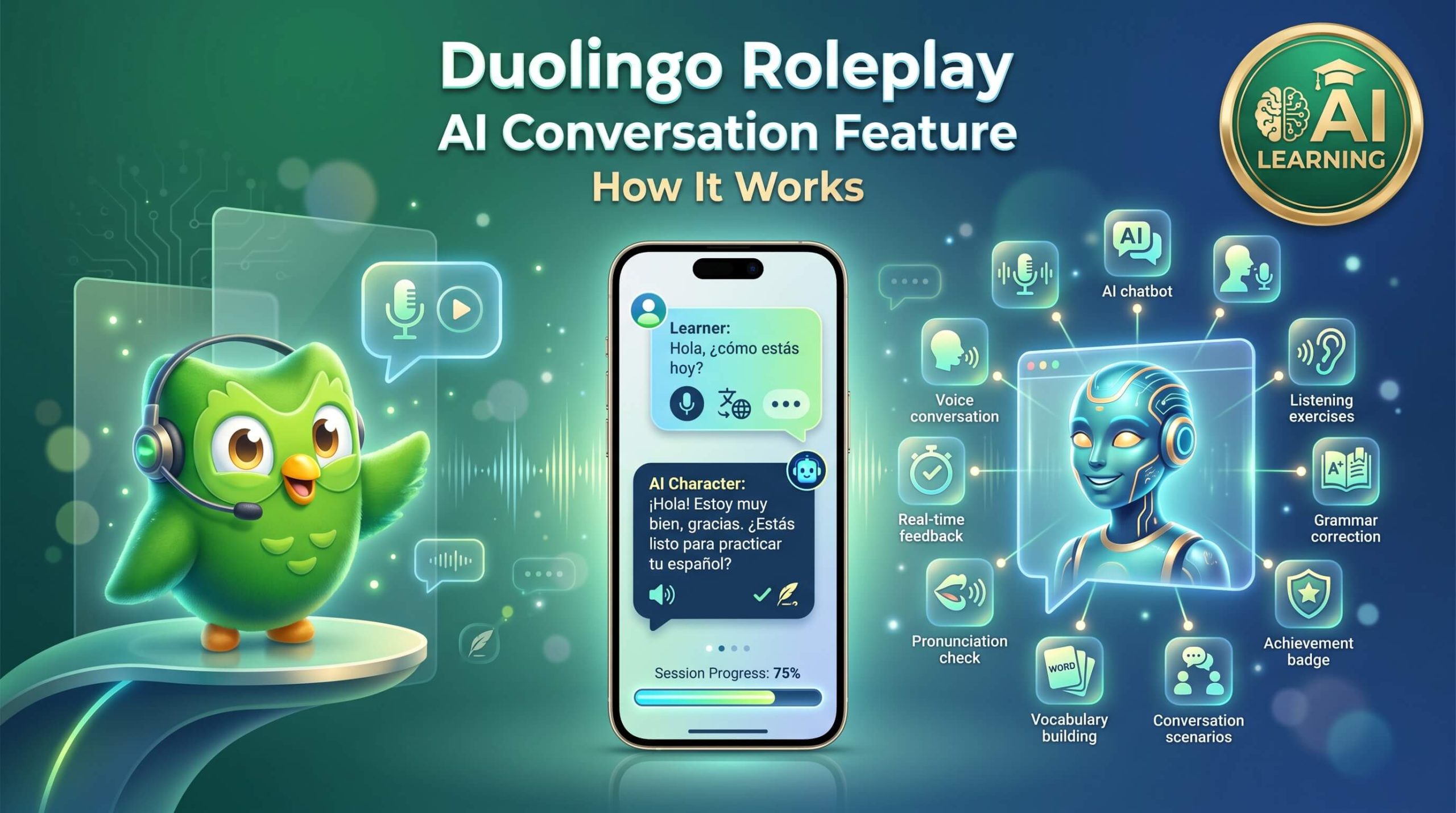
Roleplay is a conversational exercise available to Duolingo Max subscribers. Instead of translating isolated sentences or matching words to pictures, you have an open-ended, back-and-forth text conversation with one of Duolingo’s cartoon characters, guided toward a specific real-world goal.
According to Duolingo’s own announcement, learners might discuss future vacation plans with Lin, order coffee at a café in Paris, go furniture shopping with Eddy, or ask a friend to go for a hike. These challenges appear as “Side Quests” that live alongside your regular course path, and they earn XP like any other lesson.
The scenarios aren’t generated on the fly by the AI. Duolingo’s staff writes the prompts learners see — Duolingo’s team confirmed that humans write the scenarios learners see in Roleplay, making sure the initial prompt is aligned with where the learner is in their course, and that Duolingo’s experts also write the initial message in the chat and tell the model where to take the conversation. The company also says it constantly reviews AI-generated content to ensure the answers are factually correct and have the right tone — meant to be fun, encouraging, and, in Duo’s case, occasionally snarky.
After each session, you receive AI-generated feedback on the accuracy and complexity of your responses, along with suggestions for future conversations.
How Roleplay Actually Works Behind the Scenes
This is the part almost no consumer-facing coverage of Duolingo Max actually explains — and it’s the single most useful thing to understand if you’re deciding whether Roleplay will help you.
It is not one continuous AI conversation. It’s tempting to imagine Roleplay as a single prompt like “You’re Oscar, you’re talking to a Spanish learner, improvise a conversation about weekend plans,” after which the model just runs freely. That’s not how Duolingo built it. In Duolingo’s own words, every time a character responds in your conversation, a different prompt is controlling what they say — each separate prompt is hyper-focused on crafting a very specific type of response, such as one prompt optimized for forming questions, another for making statements that invite you to ask for more information, one for changing the subject, and another for pulling the conversation to a close.
Duolingo describes this with a call-center analogy: imagine each of the character’s turns is answered by a different specialist representative, and every time you respond, you’re transferred to a new one who’s been briefed on the full transcript so far. There’s an internal flowchart-like structure governing which “specialist” prompt takes over at any given moment — some can only fire after the narrator speaks, others only after you’ve responded, others only after a set number of exchanges. This is why Roleplay conversations feel purposeful and bounded rather than truly free-form — you’re not talking to one improvising AI, you’re moving through a sequence of narrowly-scoped generations stitched together to feel like a single conversation.
Four design elements make this work, according to Duolingo’s engineering explanation:
- Scripted scenarios with a learning objective. Every Roleplay session is seeded with a specific goal — for example, politely declining a friend’s request — plus setting and character context, so the conversation has a destination rather than aimless chat.
- CEFR-level calibration. Each prompt is instructed to stay within your CEFR proficiency band (for instance, restricting the model to A1-level vocabulary, simple present tense, and basic sentence structures for a true beginner), aiming to keep the language just challenging enough to be useful without being discouraging.
- Character personality injection. The model is fed background details about the character’s personality, speech style, and relationships to other Duolingo characters, so Oscar sounds like Oscar and not a generic chatbot.
- A narrator layer. A separate narrator voice opens the scene, can interject with new information mid-conversation, and closes things out — giving each session a clear beginning, middle, and end instead of an open-ended chat that could ramble indefinitely.
Roleplay vs. Video Call: What’s the Difference?
Duolingo Max actually bundles more than one AI conversation feature, and it’s easy to conflate them:
- Roleplay puts you into a scripted, goal-oriented scenario (ordering coffee, asking for directions, declining an invitation) with one of Duolingo’s existing characters, and gives you structured feedback afterward.
- Video Call is a more open-ended, real-time spoken conversation with an AI character named Lily. Lily typically starts by referencing something you recently studied, then lets the conversation go wherever you want, and — according to Duolingo — remembers what you discussed in earlier calls.
Roleplay is closer to a guided exercise with training wheels; Video Call is closer to unstructured conversation practice.
What Does Duolingo Max Cost?
This is where the article needs to be more careful than most competing coverage — because the honest answer is that Duolingo doesn’t publish a single, fixed public price, and the figures reported across otherwise-credible sources genuinely disagree.
Multiple sources, including TechCrunch’s original 2023 launch coverage, put the U.S. price at $29.99 per month or $167.99 per year at launch. That figure — roughly $29.99/month or a discounted ~$168/year when billed annually — is the one that recurs most often across independent trackers and wikis in 2026 as well. But it isn’t universal: at least one independent reviewer cites a materially lower $19.99/month figure, and other trackers list annual pricing anywhere from about $168 to $199 depending on region, platform (App Store vs. Google Play vs. web), and active promotions.
[VERIFY: exact current U.S. price — sources disagree between roughly $19.99–$29.99/month and $168–$199/year; Duolingo does not publish pricing publicly, and it varies by platform, region, and promotional timing. Check the Shop tab in your own Duolingo account for your actual quoted price before subscribing.]
What’s more consistent across sources is the structure: Max sits one tier above Super Duolingo, a Family Plan option covering multiple users typically runs meaningfully higher than the individual plan, and pricing outside the U.S. is generally lower (for example, UK monthly pricing has been reported around £19.99, notably less than the typical U.S. monthly figure).
An Important Recent Change: Explain My Answer Is Now Free
For most of Duolingo Max’s life, it bundled three features: Video Call, Roleplay, and a third feature called Explain My Answer, which gives you an AI-generated breakdown of why a response was right or wrong, with follow-up Q&A.
As of January 2026, Explain My Answer became a free feature available to all Duolingo users, not just Max subscribers. This is corroborated by Wikipedia’s summary, which notes that the feature used to be Max exclusive but is now free for all users as of 2026, and by independent reviewers who track Duolingo’s pricing changes closely.
This matters if you’re deciding whether Max is worth paying for: it means the unique, paid value of Duolingo Max in 2026 has narrowed to essentially two features — Roleplay and Video Call. If your main interest was getting AI explanations for your mistakes, you no longer need to pay for Max to get that.
Which Languages Support Roleplay?
At launch, Duolingo Max’s AI features were limited to Spanish and French for English speakers on iOS only, per TechCrunch’s original coverage. The rollout has since expanded. Duolingo’s own feature page states that English speakers learning Spanish, French, German, Italian, and Portuguese have access to both Video Call and Roleplay, while those learning Japanese, Korean, and Chinese can currently use Video Call only (not Roleplay).
(language availability may have changed further since Duolingo’s page was last updated — check Duolingo’s current in-app language list, since AI feature rollout has expanded multiple times since 2023.) If you’re learning a language outside this list — Russian, Mandarin beyond the Chinese/English pairing already noted, Arabic, Hindi, or any of Duolingo’s dozens of other courses — Roleplay and Video Call are very likely not available to you yet, regardless of what tier you pay for.
Is Roleplay Actually Good for Learning?
The honest answer, based on both Duolingo’s own framing and independent testing, is: it’s a genuine improvement over passive drilling, with real limits.
What it does well:
- It’s structurally different from Duolingo’s core lessons, which are mostly translation and matching exercises. Roleplay forces you to generate language rather than just recognize it, which is a different — and for many learners, harder and more useful — cognitive skill.
- The goal-oriented scenario design means you’re practicing toward a specific communicative outcome (declining an invitation, ordering something specific) rather than free-associating, which gives the practice session focus.
- The CEFR-calibration approach is a reasonable answer to a real design problem: language practice that’s too easy teaches nothing, and language practice that’s too hard is just frustrating.
What it doesn’t do:
- It cannot replace conversation with an actual human. Independent reviewers who’ve tested Roleplay directly describe it as “genuinely impressive from a technology standpoint” while also noting that at current pricing, Max is expensive relative to competitors offering unlimited AI conversation practice, and that sessions can feel short and scripted compared to true free-form dialogue.
- Because each turn is generated by a narrowly-scoped prompt rather than one continuously “thinking” model, Roleplay conversations are, by design, more constrained than talking to a general-purpose AI chatbot directly. That’s a deliberate trade-off Duolingo made for pedagogical focus — but it means you shouldn’t expect Roleplay to handle genuinely open-ended tangents the way a raw ChatGPT conversation might.
- It doesn’t replace the nuance of real pragmatic language use — tone, subtext, and the unpredictability of talking with an actual native speaker are things AI practice still can’t fully substitute for.
Duolingo Max vs. Super Duolingo: Do You Need Roleplay?
If you’re trying to decide whether to pay for Max at all, it helps to separate what you’re actually paying for:
- Free Duolingo gives you the core lesson content, with ads and Duolingo’s “energy” system limiting how much you can practice before you’re locked out temporarily.
- Super Duolingo removes ads and the energy/hearts limitation, and adds a personalized review hub — but it does not add new curriculum or conversation features. You’re paying to remove friction, not to unlock new content.
- Duolingo Max adds everything in Super, plus Roleplay and Video Call specifically. Since Explain My Answer is now free for everyone, Roleplay and Video Call are effectively the only things that differentiate Max from Super going forward.
The practical question, then, isn’t “is Duolingo Max good” — it’s narrower than that: do you specifically want structured AI conversation practice badly enough to pay the gap between Super and Max? If your frustration with free Duolingo is ads and lesson limits, Super solves that on its own. If your frustration is that Duolingo never makes you actually produce spoken or written language in real time, Roleplay and Video Call are the features actually built to address that — and Max is the only way to access them.
How to Try Roleplay
Duolingo Max has historically been offered with a free trial period before billing begins (commonly reported as 7 or 14 days, though (current trial length and availability, since promotional terms change by region and are not consistently documented). If you want to test whether Roleplay fits how you actually learn before committing to an annual plan, check the Shop tab in your Duolingo account for your current trial offer rather than relying on a fixed number reported elsewhere — including this article.
The Bottom Line
Roleplay is a genuinely well-engineered feature: rather than pointing a general AI chatbot at you and hoping for the best, Duolingo built a layered system of narrow, purpose-built prompts — calibrated to your proficiency level, shaped around a specific communicative goal, and wrapped in a narrator structure — to make short AI conversations feel focused and complete. That’s a real design achievement, and it explains why Roleplay conversations feel more like guided practice than random chat.
Whether it’s worth paying for depends entirely on what you’re missing from free or Super Duolingo. If you want more reps at recognizing vocabulary and grammar, you don’t need Max. If you want structured practice actually producing language in a live back-and-forth — and you’re learning one of the languages where Roleplay is currently available — it’s the one feature on Duolingo built specifically to close that gap.