
Last updated: November 2026
If your university accepts all three, take the Duolingo English Test. It costs $70, takes about an hour at home, and gives results in 2 days. But many universities and almost all visa offices do not accept it, and that is the real decision. IELTS and TOEFL cost far more and take longer, but they are accepted almost everywhere, including for visas.
This guide compares the three tests on cost, format, scoring, acceptance, and visas, with 2026 prices and the big TOEFL scoring change from January 2026, so you can pick the right one before you pay.
Duolingo vs IELTS vs TOEFL at a Glance
| Feature | Duolingo English Test | IELTS Academic | TOEFL iBT |
|---|---|---|---|
| Run by | Duolingo | British Council, IDP, Cambridge | ETS |
| Fee in the US | $70 | About $325 | About $280 |
| Test time | About 1 hour | 2 hours 45 minutes | Under 2 hours |
| Where you take it | At home, online | Test centre, or IELTS Online at home in some countries | Test centre or Home Edition |
| Score scale | 10 to 160, in steps of 5 | Bands 0 to 9, in half bands | 1 to 6, in half points, since 21 Jan 2026 |
| Results in | Within 2 days | 1 to 5 days on computer, about 13 days on paper | About 3 days |
| Accepted by | 6,500+ institutions | 11,000+ institutions | 11,500+ institutions |
| Accepted for visas | Generally no | Yes, widely | Yes, widely, with exceptions |
| Score valid for | 2 years | 2 years | 2 years |
Cost: Duolingo Is Far Cheaper
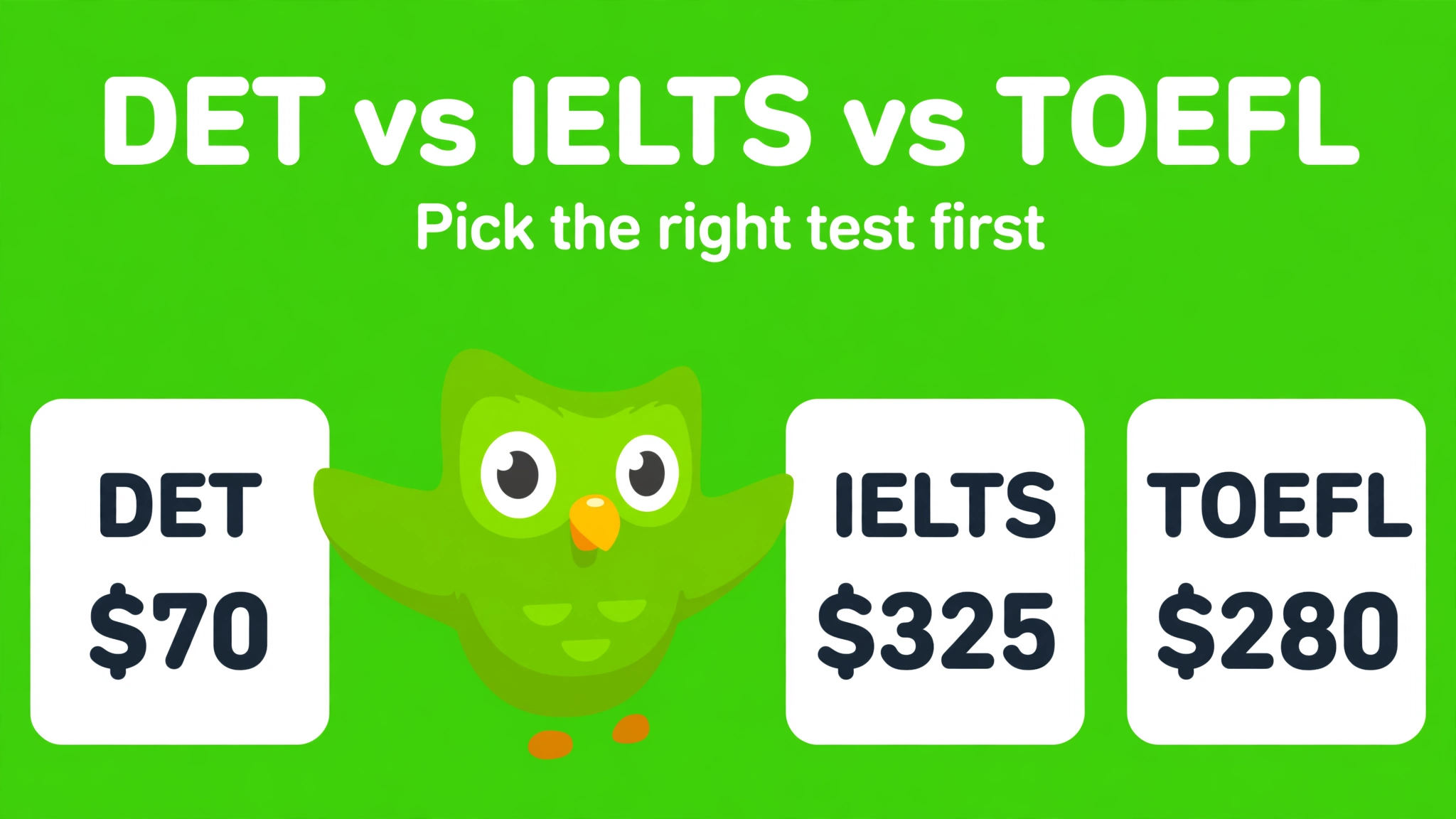
Cost is the biggest difference. The Duolingo English Test costs $70 for one test. A two-test bundle costs $118, and Faster Results costs $40 extra. IELTS costs about $325 at US test centres, and TOEFL iBT costs about $280 in the US. Fees change by country and by centre, so confirm the price for your own city before you book, but the gap is the same everywhere: Duolingo costs roughly a quarter of the other two.
That gap matters if you may need to retake the test. A second DET costs another $70. A second IELTS costs another $325. If your budget is tight, start with the free DET practice test, which takes about 45 minutes and gives you an estimated score range, before you spend anything.
Extra costs also differ. TOEFL charges for rescheduling, late registration, and extra score reports beyond the free ones. IELTS charges separately for a One Skill Retake if you want to redo one section. Duolingo lets you send your certified score to unlimited institutions for free.
Format: How Each Test Works
Duolingo English Test
The DET is fully online and adaptive. You take it at home on a Windows or Mac computer, in about an hour, with no appointment. Questions get harder or easier based on your answers. It has 13 question types, including Read and Select, Fill in the Blanks, Interactive Reading, Interactive Listening, Write About the Photo, Interactive Writing, Speak About the Photo, and Interactive Speaking. It ends with a Writing Sample of 5 minutes and a Speaking Sample of 3 minutes, which institutions can view alongside your score.
IELTS Academic
IELTS takes 2 hours 45 minutes at a test centre, on paper or on computer. The paper test is being phased out from mid-2026 in favour of computer delivery. It has four fixed sections: Listening, Reading, Writing, and Speaking. Speaking is a face-to-face interview with a live examiner, which has not changed since IELTS began. That suits people who speak better to a person than to a microphone, but it means you must travel to a centre and book a date.
TOEFL iBT
TOEFL takes under 2 hours and is fully computer-based, at a test centre or as a Home Edition. Since the January 2026 redesign, the Reading and Listening sections are adaptive: the difficulty of your second set of questions depends on how well you did on the first. Speaking answers are recorded and scored by automated systems, checked by human raters. There is no live examiner.
| Section | Duolingo English Test | IELTS Academic | TOEFL iBT (2026) |
|---|---|---|---|
| Reading | Adaptive questions, mixed into the test | 3 passages, 60 minutes | Adaptive sets |
| Listening | Adaptive questions, mixed into the test | 4 recordings, 30 minutes | Adaptive sets |
| Writing | Short adaptive tasks plus 5-minute sample | 2 tasks, 60 minutes | Academic writing tasks |
| Speaking | Recorded answers plus 3-minute sample | Face-to-face interview, 11 to 14 minutes | Recorded answers, scored by machine and human raters |
Scoring: The Big TOEFL Change in 2026
Scoring changed more in 2026 than in any year before, because of TOEFL.
- Duolingo: 10 to 160, in steps of 5. The overall score is the average of the four individual subscores, rounded to the nearest 5. You also get four integrated subscores: Literacy, Comprehension, Conversation, and Production.
- IELTS: bands 0 to 9, in half bands. Your overall band is the average of your four section scores, rounded to the nearest half band.
- TOEFL: since 21 January 2026, scores are reported on a 1 to 6 scale in half points, aligned to the CEFR levels. Until January 2028, score reports also show a comparable 0 to 120 total, so universities that still publish old thresholds can read both. ETS suggests converting old requirements as follows: 100 becomes 5, 90 becomes 4.5, and 80 becomes 4.
That TOEFL change matters if you are comparing old guides or old university pages. A guide that says TOEFL is scored 0 to 120 is out of date, even though the 0 to 120 figure still appears on score reports during the changeover. Likewise, Duolingo’s own comparison chart puts C1 at DET 130 to 150, not 125, so be careful with third-party converters that inflate DET scores by half an IELTS band or more.
Typical university minimums give a rough sense of the levels. Many universities ask for DET 120, IELTS 6.5, or TOEFL 5 on the new scale (about 100 on the old scale). Top universities often ask for DET 125 to 130, IELTS 7 to 7.5, or TOEFL 5.5. Always check the exact requirement on your target university’s own page, because minimums change by program and by year.
Acceptance: Where Each Test Works
IELTS and TOEFL are accepted by more than 11,000 institutions each, in almost every country. The Duolingo English Test is accepted by more than 6,500 institutions, and the list grows every year, but it is still much shorter. The test that is cheapest means nothing if your university is not on its list.
Check acceptance in this order. First, open your target university’s admissions page and search for the test by name. Second, check the test’s own institution directory. Third, check whether the program sets a subscore minimum as well as an overall minimum, because a DET score of 120 with a weak speaking subscore can still fail a program that needs 110 in Conversation.
Geography matters too. IELTS is strongest in the UK, Australia, and New Zealand, and it is the usual choice for UK visas. TOEFL is strongest in the US and Canada. Duolingo is strongest for US university admission and is growing in Canada, where more than 100 institutions accept it for admission.
Visas: The Deciding Factor
This is where the choice is usually made for you. The Duolingo English Test is generally not accepted for visas. The UK’s approved Secure English Language Test list does not include it. Australia does not accept it for visas, and does not accept tests delivered fully online or remotely proctored. Canada’s Express Entry language-test list does not include it, and it does not count as language proof for a Post-Graduation Work Permit.
There is one important exception to understand. For a Canadian study permit, IRCC does not itself demand a specific English test: your university decides which test it accepts for admission, and the study permit follows the admission. So DET can work for the admission step of a Canadian study permit, even though it is not an IRCC-approved test. Read our full guide to DET and the Canadian study permit for the full picture.
IELTS and TOEFL are accepted for visas in most countries, but check the exact visa route. For a UK visa you need IELTS for UKVI, not ordinary IELTS. For Australia, only TOEFL tests taken before 21 January 2026, and TOEFL iBT Australia, were approved for visas at the time of writing, so check the current Australian list before booking a new TOEFL. Rules change, and a test booked for admission is not automatically valid for a visa.
Which Test Should You Take?
- Take the Duolingo English Test if your universities accept it, you need results fast, you are on a tight budget, and you do not need the score for a visa. It is the cheapest and quickest option by a wide margin.
- Take IELTS Academic if you are applying to the UK, Australia, or New Zealand, if you need a visa, or if you speak better to a real person than to a microphone. It is the most widely accepted test for migration and professional registration.
- Take TOEFL iBT if you are applying mainly to US universities, you are comfortable with academic English on a screen, and your universities publish TOEFL requirements. It is the most established test for US admission.
- Take two tests only if you must: for example, DET for a fast university application and IELTS for the visa. That costs more, but it is cheaper than missing a deadline or a visa requirement.
How Long to Prepare
Preparation time depends on your current level, not on the test. As a rough guide, allow 1 to 2 months for the DET, and 2 to 3 months for IELTS or TOEFL, studying a few hours a day. The DET is shorter and has a free official practice test, so you can measure your level before you pay. IELTS and TOEFL have official practice tests and courses, but the tests themselves are longer and the speaking section needs real practice with a person or a recording.
Whatever test you choose, start with the official practice material for that test. Third-party books and videos often teach the old format: for the DET, that means Read Aloud, which was removed in July 2025, and for TOEFL, that means the old 0 to 120 scoring and the old three-hour format.
Frequently Asked Questions
Which is easier, Duolingo, IELTS, or TOEFL?
There is no easy test, only a test that fits you. The DET is the shortest and cheapest, and its adaptive format means you face fewer very hard questions. IELTS has a human speaking interview, which helps confident speakers. TOEFL has the most academic reading and listening. Pick by acceptance and visa needs first, then by format.
Is the Duolingo English Test accepted by universities?
Yes, by more than 6,500 institutions, including many top US universities. But acceptance is not universal. Check each university’s admissions page before you book.
Can I use the Duolingo English Test for a visa?
Generally no. The UK, Australia, and Canada’s Express Entry do not list it for visas. The one partial exception is Canadian study permits, where the university’s admission decision matters more than the test itself. Check the visa rules for your country before you rely on DET.
What changed in TOEFL scoring in 2026?
From 21 January 2026, TOEFL iBT reports scores on a 1 to 6 scale in half points, aligned to the CEFR. Until January 2028, reports also show a comparable 0 to 120 total. Old guides that only mention 0 to 120 are out of date.
How much does each test cost in the US in 2026?
DET $70, TOEFL iBT about $280, IELTS Academic about $325. Prices vary by country and centre, so confirm on the official booking page before you pay.
How fast do results come?
DET results come within 2 days, or within 12 hours with Faster Results. TOEFL results come in about 3 days. IELTS computer results come in 1 to 5 days, and paper results in about 13 days. All three scores are valid for 2 years.



One Comment