
Last updated: November 2026
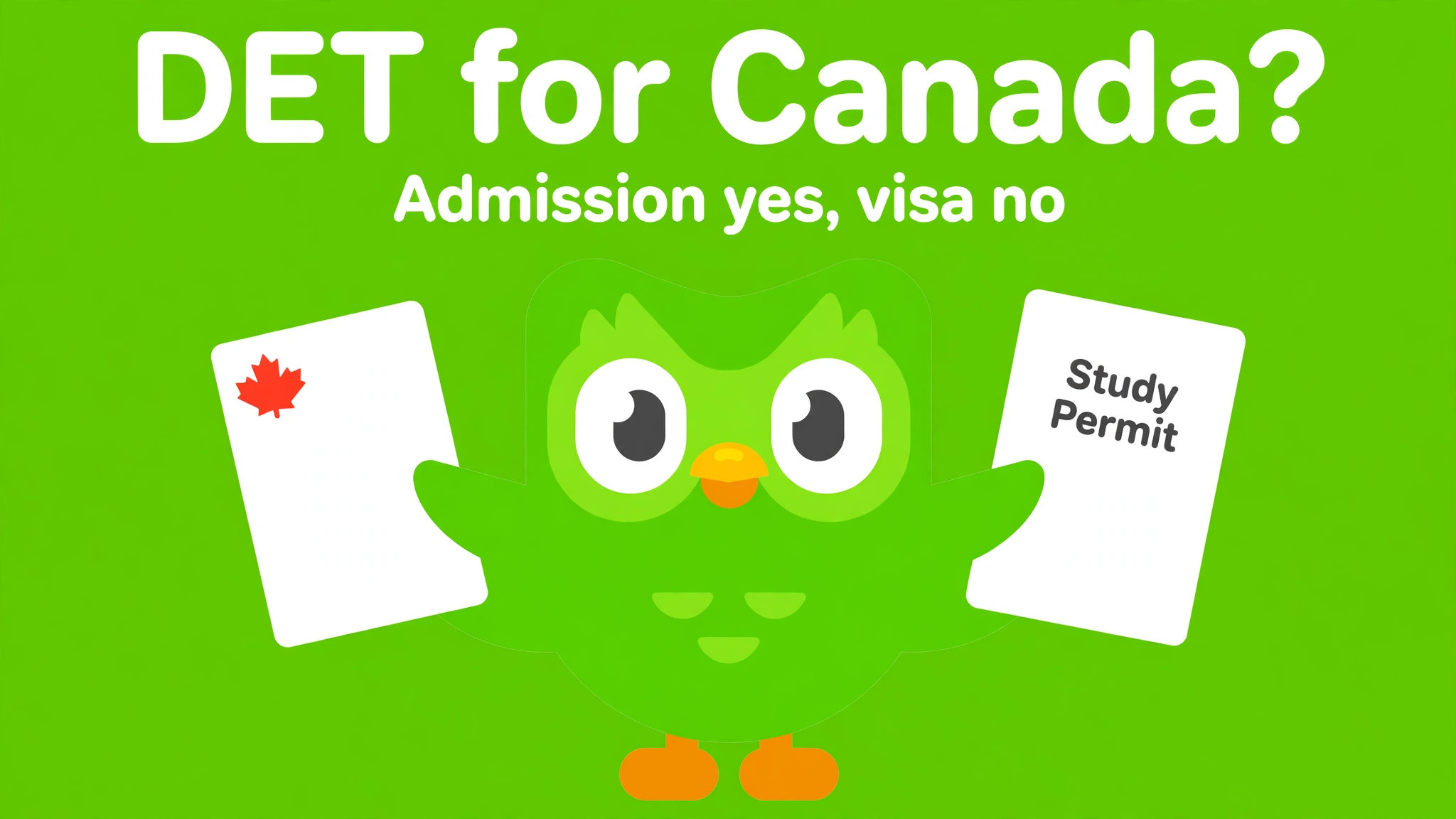
Yes, but only in one sense, and the difference matters. The Duolingo English Test is accepted by more than 100 Canadian universities and colleges for admission. But it is not an official language test for Canadian immigration. The Canadian government does not list it for Express Entry or for a Post-Graduation Work Permit, and it never did.
Here is the short version. For a standard Canadian study permit, the government does not demand one specific English test. Your university decides which test it accepts for admission, and the study permit follows that admission. So if your university accepts the DET, you can use it for the admission step of your study permit application. You cannot use it as proof of English for immigration later, and you should not write on any form that the government itself accepts it.
The Two Steps People Confuse
Almost every wrong article about this topic mixes up two different things: getting into a Canadian university, and getting a Canadian study permit. They are separate steps, with separate rules.
| Step | Who decides | Does the DET work? |
|---|---|---|
| 1. Admission to a Canadian university or college | The university itself (a Designated Learning Institution, or DLI) | Yes, if that university accepts it. More than 100 Canadian institutions do. |
| 2. Study permit from the Canadian government | IRCC (Immigration, Refugees and Citizenship Canada) | IRCC does not demand a specific test for a standard study permit. Your admission letter is what matters most. |
| 3. Post-Graduation Work Permit (PGWP) after you graduate | IRCC, from a fixed list of approved tests | No. DET is not on the approved list. |
| 4. Permanent residence through Express Entry | IRCC, from a fixed list of approved tests | No. DET is not on the approved list. |
An older version of this article said that more than 150 Canadian universities accept the DET “for study visa applications”. That wording is wrong, and this update corrects it. Universities accept the DET for admission. The visa itself is a separate government decision, and the government does not accept the DET as its own language proof.
What Happened to the Student Direct Stream
The Student Direct Stream, or SDS, was a fast-track study permit route for students from 14 countries. It only accepted IELTS or CELPIP for English, so the DET was blocked from it entirely. IRCC permanently closed the SDS on 8 November 2024. There is no replacement.
Since then, every study permit application goes through the same standard stream. IRCC has never published a universal list of accepted English tests for a standard study permit application, because the test decision sits with your university, not with the government. That is why the DET can work for the admission step now, even though it could never work under the old SDS rules.
Some websites still describe the SDS as open, or claim it was expanded in 2026 to accept more tests. That is wrong. The SDS is closed. If a guide tells you to apply through the SDS, or tells you which test the SDS accepts, do not follow it.
Which Canadian Universities Accept the DET?
More than 100 Canadian universities and colleges accept the Duolingo English Test for admission, and Duolingo lists more than 6,500 accepting institutions worldwide. The number grows every year, but it is not every university, so check your own program before you book the test.
Typical minimum scores at well-known Canadian universities include:
| University | Typical minimum DET score | Notes |
|---|---|---|
| University of Ottawa | 120 overall, 120 in Literacy | Check the program page, some programs ask for more |
| University of Waterloo | 120 overall, 110 in Literacy, 110 in Production | Subscore minimums apply, not just the overall score |
| University of Alberta | 120 overall, no subscore below 100 | Subscore floor matters |
| Lakehead University | 110 for most programs, 120 for Nursing, Law, and some Education programs | Higher minimums for professional programs |
These figures come from the universities’ own published requirements as reported in recent guides. Minimums change by program and by year, so always confirm the current requirement on the university’s own admissions page, and confirm with its international student office if the page is unclear. A DET score of 120 with a weak subscore can still fail a program that sets a subscore minimum, so read the full requirement, not just the headline number.
What IRCC Actually Accepts for Immigration
For immigration steps, IRCC uses a fixed list of approved tests, and the DET is not on it. This is the part that catches people out, because a test that worked for admission does not work later.
| Purpose | IRCC-approved English tests | DET accepted? |
|---|---|---|
| Standard study permit | No fixed test list. Your DLI decides. | Yes, for admission, if your DLI accepts it |
| Post-Graduation Work Permit (PGWP) | IELTS General Training, CELPIP General, PTE Core | No |
| Express Entry (permanent residence) | CELPIP General, IELTS General Training, PTE Core | No |
Since 1 November 2024, PGWP applicants must show a language result at CLB 7 in all four skills for university degree programs, or CLB 5 for college programs, from an IRCC-approved test. If you plan to work in Canada after you graduate, you will need IELTS General, CELPIP General, or PTE Core at that point, even if you entered Canada on a DET score. Plan for that second test early, so it does not surprise you in your final year.
How to Use the DET for Your Canadian Study Permit
- Confirm your university accepts the DET. Open the admissions page for your exact program. Search for “Duolingo” on the page. If it is not listed, email the international admissions office and ask in writing. Do not rely on a general list of universities.
- Check the minimum score, including subscores. Note the overall minimum and any Literacy, Production, or Conversation minimum. The DET reports scores on a 10 to 160 scale, in steps of 5.
- Take the free practice test first. It takes about 45 minutes and gives you an estimated score range. Book the real test only when the bottom of your range is at or above your target. The real test costs $70 and gives results within 2 days.
- Send your certified score to the university. Sending is free to unlimited institutions. Your score is valid for 2 years.
- Get your admission letter. The university’s letter of acceptance is the key document for your study permit application. You also need a Provincial Attestation Letter (PAL) in most cases, proof of funds, a valid passport, and biometrics. Master’s and PhD students at public institutions are exempt from the PAL requirement from 1 January 2026.
- Apply for the study permit. The permit fee is CAD 150. Processing through the standard stream usually takes 8 to 16 weeks depending on your country, so apply early. Canada capped study permits at 408,000 in total for 2026, including 155,000 new arrivals, and approval rates fell to about 30 to 35% in 2025, so a complete application matters more than ever.
Why the DET Is Still a Good Choice for Canada
Even with the immigration limits, the DET has real advantages for Canadian admission. It costs $70, while IELTS costs about $325 in the US and TOEFL about $280. You take it at home in about an hour, with no appointment and no travel to a test centre. Results come in 2 days, which helps if a university deadline is close. And you can take the free practice test as many times as you like before you pay.
The DET is the right choice when your university accepts it and you only need it for admission. It is the wrong choice when you need a test for a work permit or permanent residence later, or when your university does not list it. In those cases, take IELTS General, CELPIP, or PTE Core instead, or take the DET for admission and plan the second test before you graduate.
Common Mistakes to Avoid
- Booking the DET before checking acceptance. A good score at a university that does not accept the DET is wasted money.
- Assuming a visa accepts what a university accepts. Admission and immigration are different decisions. The DET works for the first and not for the second.
- Following old SDS advice. The SDS closed on 8 November 2024. Any guide that tells you to use it is out of date.
- Ignoring subscore minimums. A 120 overall with a 95 in Production can fail a program that needs 110 in Production.
- Leaving the PGWP test too late. If you want to work in Canada after graduating, you will need an IRCC-approved test. Book it before your final term gets busy.
Frequently Asked Questions
Is the Duolingo English Test accepted for a Canadian study permit?
Yes, in the sense that matters for most applicants: more than 100 Canadian universities accept the DET for admission, and IRCC does not demand a specific test for a standard study permit. But the DET is not an IRCC-approved test, and it does not count for a Post-Graduation Work Permit or Express Entry.
Can I get a Canadian student visa with only a Duolingo score?
If your university accepted you on the basis of your DET score, your admission letter supports your study permit application, and no separate IRCC language test is required for the standard stream. But IRCC can still refuse a permit for other reasons, such as funds or study plans, so the DET alone does not guarantee a visa.
What is the minimum Duolingo score for Canada?
There is no single national minimum. Each university sets its own. Most ask for 110 to 120 overall, often with subscore minimums. Check your program’s own page.
Is Duolingo accepted for a Canadian work permit?
No. For a Post-Graduation Work Permit, IRCC accepts IELTS General Training, CELPIP General, and PTE Core. The DET is not on that list.
Was the Duolingo test ever accepted for the Student Direct Stream?
No. The SDS only accepted IELTS and CELPIP. It closed permanently on 8 November 2024, and there is no replacement fast-track stream.
How much does the Duolingo English Test cost, and how long are results valid?
The test costs $70, results come within 2 days, and certified scores are valid for 2 years. A two-test bundle costs $118, and Faster Results costs $40.





One Comment